


China has released one of its most important climate policy documents in years. The new climate action plan sets the country’s direction for cutting emissions during the 15th Five-Year Plan period (2026–2030). It is designed to help China achieve its long-standing goals of peaking carbon dioxide (CO₂) emissions before 2030 and reaching carbon neutrality before 2060.
The plan goes beyond climate policy. It covers energy, industry, transport, buildings, technology, and carbon markets. Together, these sectors account for most of China’s greenhouse gas emissions. The government says the plan will help build a cleaner economy while supporting energy security and economic growth.
The world is paying close attention.
China is the largest emitter of carbon dioxide, producing about 30% of global CO₂ emissions. It is also the world’s biggest producer of solar panels, batteries, and electric vehicles. That means changes in China’s climate policy can influence clean energy investment, supply chains, and carbon markets around the world.
China Charts Its Course Toward 2030 and Net Zero
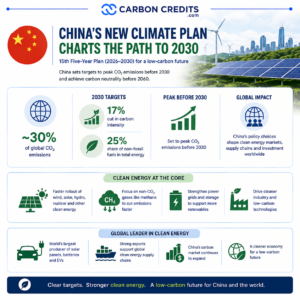
The plan introduces two headline targets for 2030.
- China will reduce its carbon intensity—the amount of CO₂ emitted for every unit of economic output—by 17% from 2025 levels. It also aims to increase the share of non-fossil fuels in total energy consumption to 25% by 2030.
These targets aim to help China peak its carbon emissions before 2030. They also set the stage for more significant cuts in the future. The plan will also support China’s next nationally determined contribution (NDC) under the Paris Agreement, which will cover climate action beyond 2030.
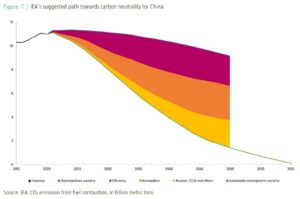
Unlike some earlier plans, however, this roadmap does not set an absolute cap on national CO₂ emissions. Instead, it continues to rely mainly on carbon intensity targets. Carbon Brief notes that, given economic growth, this approach might allow China’s total emissions to increase over the next five years. This would happen even as emissions become more efficient per unit of GDP.
Clean Energy Remains at the Center
Renewable energy remains the backbone of China’s climate strategy.
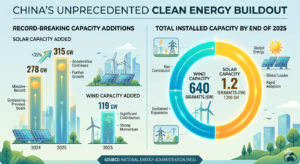
The plan calls for faster development of wind, solar, hydropower, nuclear power, and other non-fossil energy sources. It also helps create a clean, low-carbon, safe, and efficient energy system. Plus, it improves electricity transmission and storage to manage more renewable power.
China already leads the world in clean energy deployment. According to the International Energy Agency (IEA), the country has installed more renewable electricity capacity in recent years than any other country. It is also the world’s largest manufacturer of solar panels, batteries, and electric vehicles, giving it a central role in the global energy transition.
Those investments are beginning to affect emissions.
Carbon Brief’s latest analysis found that China’s CO₂ emissions have been flat or falling for 21 consecutive months. The country’s emissions declined by 1% in the final quarter of 2025, leading to an estimated 0.3% decline for the full year. Rapid growth in clean electricity has helped offset rising demand from other sectors.

SEE MORE: China’s 15th Five-Year Plan Commits $2.94 Trillion to Reach 50% Clean Electricity by 2030
China Expands Its Focus Beyond Carbon Dioxide
The new plan also gives more attention to non-CO₂ greenhouse gases, such as methane, nitrous oxide, and fluorinated gases. These gases make up a much smaller share of China’s emissions than carbon dioxide, but many trap far more heat in the atmosphere.
According to Carbon Brief’s analysis, non-CO₂ gases accounted for about 19% of China’s total greenhouse gas emissions in 2021. Methane was the largest source. It came mainly from coal mining, agriculture, oil and gas production, waste, and wastewater.
The plan aims to better control emissions. It includes:
- Improving methane monitoring,
- Reducing leaks from the energy sector,
- Promoting cleaner farming practices, and
- Strengthening management of industrial gases.
Carbon dioxide is the main focus, but tackling non-CO₂ gases could provide quicker climate benefits. Many of these gases warm the planet much more than CO₂ in the short term.
China Strengthens the World’s Largest Carbon Market
The new climate plan also strengthens China’s carbon market. It calls for further improvements to the national emissions trading system (ETS), which is already the world’s largest carbon market by covered emissions. The ETS currently covers the power sector and is expected to expand gradually to other heavy industries.
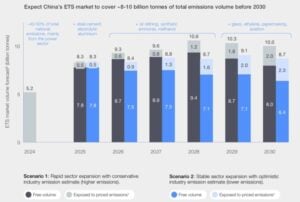
China plans to improve carbon accounting, emissions monitoring, verification, and trading rules. The goal is to make carbon pricing a stronger tool for reducing emissions while supporting cleaner industrial growth. The plan also encourages better links between carbon markets, green finance, and climate investment.
These changes could also support international carbon trading under Article 6 of the Paris Agreement. As more countries build carbon markets, stronger accounting rules will become increasingly important to avoid double counting and improve market confidence.
Clean Technology and Heavy Industry Enter a New Phase
Heavy industry remains one of China’s biggest climate challenges. Steel, cement, chemicals, and other energy-intensive industries still produce a large share of the country’s emissions. The new plan calls for cleaner production, higher energy efficiency, and faster adoption of low-carbon technologies across these sectors.
Technology will play a major role. The government will support innovation in:
- Advanced manufacturing,
- Clean energy equipment,
- Energy storage,
- Hydrogen,
- Carbon capture, utilization, and storage (CCUS), and
- Other low-carbon technologies.
These industries are expected to help reduce emissions while supporting economic growth and global competitiveness.
China already has a strong foundation. According to the IEA, the country produces most of the world’s solar panels and lithium-ion batteries and leads global electric vehicle manufacturing. Continued investment in these sectors could help lower clean energy costs worldwide while supporting China’s own climate goals.
How China’s Climate Decisions Will Shape Global Markets
China’s climate decisions reach far beyond its borders. The country is a major supplier of clean energy technologies used around the world. It also has the world’s largest national carbon market by covered emissions and plays an increasingly important role in global climate negotiations.
For investors, businesses, and governments, the new five-year plan offers a clearer picture of where China intends to invest over the rest of this decade. It signals continued support for clean energy and low-carbon industries while keeping the country’s long-term climate goals firmly in place.
It also provides a roadmap for how the world’s largest emitter plans to balance economic growth with climate action during a critical decade for global decarbonization. China intends to keep expanding its clean economy. Because of the country’s size and influence, the success—or failure—of this five-year plan will shape not only China’s climate future, but also the pace of the global transition to a low-carbon economy.