

Apple’s newest iPhone arrives with more than a new camera and faster performance. Behind the glossy launch of the iPhone 18 Pro and iPhone 18 Pro Max is another story: how much carbon it takes to make, ship, and use a smartphone.
At the same time, Apple is pushing recycled materials deeper into the device, using renewable electricity across manufacturing and eliminating landfill waste at established final assembly supplier sites.
iPhone 18 Pro’s Carbon Footprint Starts at 63 kg
Apple calculates the iPhone 18 Pro’s footprint using a life-cycle assessment covering the device, components, packaging, and in-box accessories.
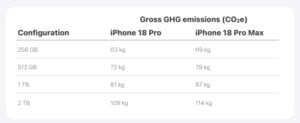
Its latest product environmental report puts a number on that footprint. Depending on the storage configuration, an iPhone 18 Pro generates between 63 kg and 109 kg of gross greenhouse gas emissions over its modeled life. For the Pro Max, the range is 69 kg to 114 kg.
The footprint rises with storage capacity.
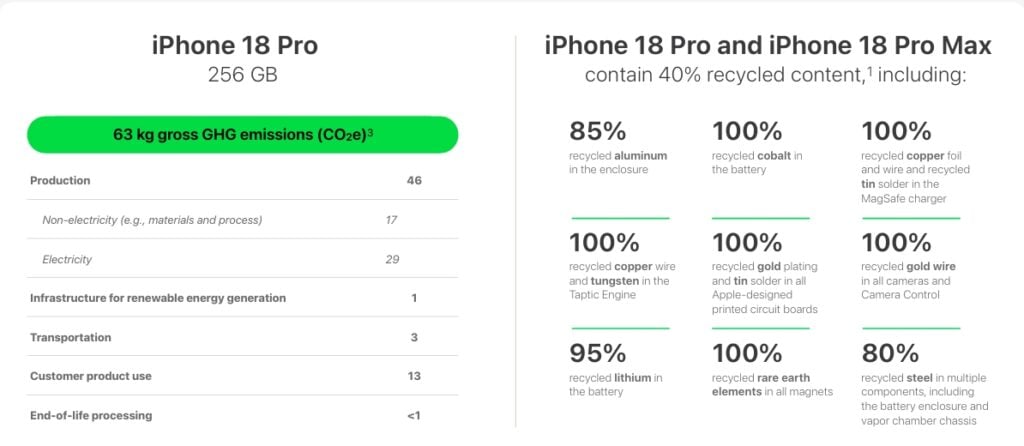
They say production is the biggest source of emissions, accounting for 46% of the 256GB iPhone 18 Pro footprint. Non-electricity-related production, including materials and processes, accounts for 17%, while electricity contributes 29%.
Transportation represents 3%, customer use 13%, infrastructure for renewable energy generation 1%, and end-of-life processing less than 1%.
That breakdown shows why Apple is focusing so heavily on materials and supplier electricity rather than just making the phone itself more energy efficient.
40% Recycled Content Goes Inside the New iPhone
The iPhone 18 Pro and Pro Max contain 40% recycled content by mass, excluding packaging and accessories. This time, the company has also increased the use of recycled materials across individual components:
Apple says recycled materials generally have a lower carbon footprint than newly mined materials, making material recovery an important part of its product decarbonization strategy. Here’s the snapshot of the sustainable materials packed inside its latest gadget:
50% of Manufacturing Electricity Comes From Renewables
Apple says 50% of the manufacturing electricity allocated to the iPhone 18 Pro and Pro Max comes from renewable energy.
That includes electricity procured by Apple or its suppliers through Apple’s Supplier Clean Energy Program. The company is ultimately working toward moving suppliers to 100% renewable electricity.
- The phones also use 60% less energy than the applicable U.S. Department of Energy efficiency standard, according to Apple.
The 20W USB-C power adapter used for the models has measured efficiency of 87.4% at 100V, 88.0% at 115V and 87.8% at 230V. Its no-load power consumption is 0.04W across all three voltage levels.
Less Waste, More Fiber
Apple says all established final assembly supplier sites for the iPhone 18 Pro and Pro Max have been independently validated as Zero Waste to Landfill.
Under UL’s standard, suppliers need to divert at least 90% of waste away from landfill, with higher diversion rates qualifying for Gold and Platinum designations.
Packaging is also 100% fiber-based and uses recycled or responsibly sourced fibers.
The company is pairing that with stricter chemical controls. Final assembly suppliers must use safer cleaners and degreasers based on methodologies such as ChemFORWARD, GreenScreen and the U.S. EPA Safer Choice program.
Apple also says its materials, accessories and packaging are covered by its Regulated Substances Specification and that it conducts toxicological assessments of materials that have prolonged skin contact.
Apple’s Bigger Emissions Problem
The iPhone footprint is only one piece of Apple’s climate story.
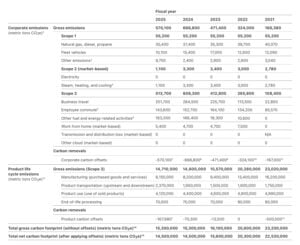
According to Apple’s 2026 Environmental Progress Report, the company’s 2025 gross greenhouse gas emissions were about 15.3 million metric tons of CO2e, while net emissions after offsets were 14.5 million tons. It estimated that its environmental programs avoided 43 million metric tons of emissions in 2025.
Notably, product manufacturing accounted for 53% of Apple’s gross footprint
Apple says its gross emissions are down more than 60% from 2015, even though revenue has increased 78% over the same period. Its 2030 goal is to reduce value-chain emissions by 75% from the 2015 baseline before addressing the remaining emissions.
The company’s environmental programs avoided an estimated 43 million tons of emissions in 2025, including:
- 26 million tons from supplier clean energy
- 7 million tons from direct emissions abatement
- 6 million tons from low-carbon materials
- 2 million tons from supplier energy efficiency.
Apple’s Emissions Data
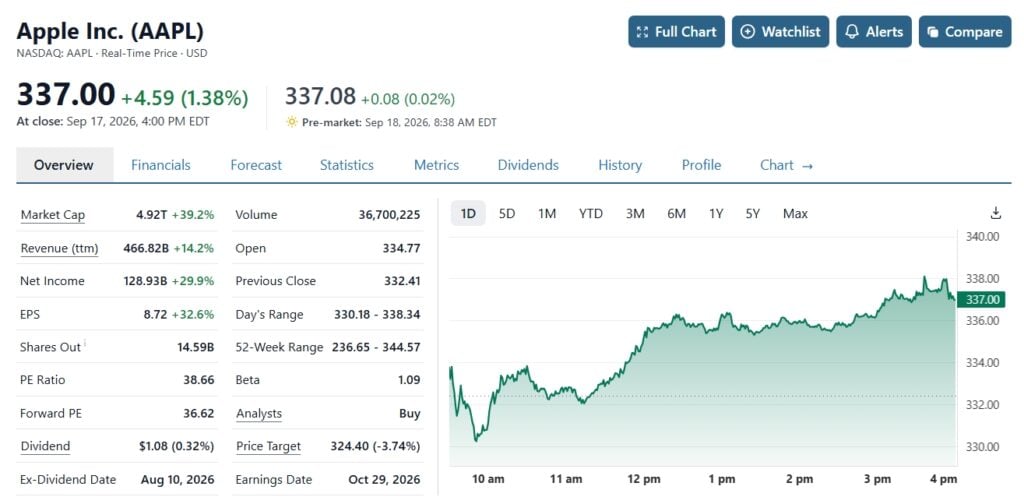
Apple Stock (AAPL) Rises as the iPhone 18 Pro Hits Stores
Apple shares closed at about $315.34 on September 9, according to market data reported after the launch. By September 11, shares had reached $332.27, representing a roughly 5.4% increase from the September 9 close.
On September 17, Apple shares closed at $337, according to market reporting, after gaining 1.4% that day as the phones approached their retail launch.
As trading began on September 18, AAPL was around $337, putting the stock roughly 7% above its September 9 closing level.
The market reaction, however, is being driven primarily by expectations around demand, pricing, and the premium iPhone mix rather than Apple’s environmental credentials. Early reports said carrier trade-in offers of as much as $1,200 were helping support demand for the new Pro models.
The Bigger Sustainability Test Is the Supply Chain
Apple’s iPhone 18 Pro shows how sustainability is becoming embedded in product design rather than treated as a separate corporate initiative.
More recycled metals, renewable electricity, fiber packaging, lower energy use, and supplier waste controls can all reduce the footprint of each device.
But Apple’s own numbers also show the scale of the challenge. Manufacturing remains the largest part of the iPhone’s carbon footprint, while product manufacturing and product use together account for 80% of Apple’s broader gross footprint.
The iPhone 18 Pro may therefore be greener by design, but Apple’s bigger climate challenge is making those improvements meaningful across hundreds of millions of devices and a global supply chain.
That is where the company’s 2030 target will ultimately be tested.