


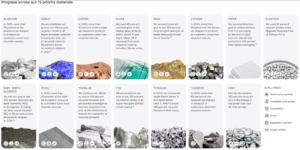
Apple’s latest Environmental Progress Report shows a clear shift in how the company is approaching sustainability. It shows that 30 percent of materials across all products shipped in 2025 came from recycled content, up from the previous year. This represents a steady year-on-year increase of around 6% points, showing consistent progress rather than one-time gains.
The company now uses 100% recycled cobalt in all its batteries. It also uses 100% recycled rare earth elements in all magnets. All of these show how circular manufacturing is becoming a core part of the way Apple designs, builds, and scales its products.
The shift reflects a broader strategy. The tech giant is working to reduce reliance on virgin mining and move toward a more circular supply chain. This is central to its long-term goal of reaching carbon neutrality across its entire value chain by 2030.
Recycled Materials Move Into Core Product Architecture
The most important change is not just how much recycled material Apple uses, but where it is being used. In its newest product line, including the MacBook Neo, Apple has significantly increased recycled content in critical components. According to the company’s 2026 Environmental Progress Report:
- Around 90% of the aluminum in the MacBook Neo enclosure is recycled
- 100% of cobalt in Apple-designed batteries is recycled
- The device overall reaches around 60% recycled content across key materials
These figures matter because aluminum and cobalt are among the most carbon-intensive materials in electronics manufacturing. Primary aluminum production uses a lot of energy. Cobalt extraction causes high emissions and comes with supply chain risks.
By shifting toward recycled inputs, Apple reduces emissions at the earliest stage of production. And that’s before devices are even assembled. This approach is part of a broader design philosophy.
The iPhone maker is increasingly engineering products around material recovery, not just performance or cost. That shift is central to its decarbonization strategy.
Emissions Avoidance Becomes a Key Climate Lever
Apple’s report highlights a clear link between recycled materials and emissions reduction.
In 2024, the company says that its use of recycled and lower-carbon materials helped avoid 6.2 million metric tons of greenhouse gas emissions. Over the same period, Apple’s total carbon footprint was 15.1 million metric tons. This means that material strategy alone accounted for a meaningful portion of the emissions reduction impact.
The logic is straightforward. When recycled materials replace virgin mining and refining, emissions fall sharply. This is especially important for metals like aluminum, copper, and cobalt, which carry high embedded carbon.
Apple is effectively shifting emissions reductions upstream — reducing impact before manufacturing even begins.
Meet Daisy, Dave & Cora: The Robots Powering Apple’s Recycling Revolution
A key part of Apple’s system is automation in recycling. The company has developed a set of specialized robotics platforms designed to recover materials from used devices at scale.
The first system, Daisy, can disassemble up to 36 different iPhone models and process as many as 1.2 million devices per year. Engineers designed it to efficiently recover high-value components that traditional recycling systems often miss.
Another system, Dave, focuses on dismantling the taptic engine, a component rich in rare earth magnets, tungsten, and steel. These materials are critical for electronics production but difficult to recover without precision engineering.
The newest system, Cora, expands Apple’s recycling capability further. It uses smart shredding and sensor sorting to boost recovery rates for more types of materials.
Together, these systems form a structured recovery pipeline. Devices returned through Apple’s trade-in and recycling programs are not simply dismantled. They are processed with the goal of reintroducing materials back into future product cycles.
This is a key shift. Instead of linear production — mine, build, dispose — Apple is moving toward closed-loop manufacturing.
Why Materials Are Now the Heart of Apple’s Net-Zero Plan
Apple’s recycled materials strategy is directly tied to its climate target.
The company aims to be carbon neutral by 2030. This commitment includes its business, supply chain, and product lifecycle. It also includes not just its own operations but also supplier emissions and product use emissions.
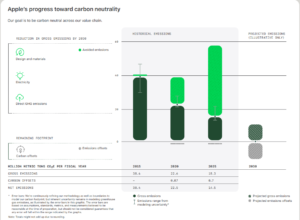
Within this framework, materials and manufacturing are the largest drivers of Apple’s emissions. The company’s lifecycle analysis reveals that most of its carbon footprint comes from product manufacturing. This mainly happens in Scope 3 supply chain activities like raw material extraction, component production, and assembly.
Apple also sees materials, electricity, and transportation as the top three sources of product emissions. Materials are key because metals like aluminum, cobalt, and rare earth elements have high carbon intensity.
This is why recycled content is central to Apple’s decarbonization roadmap. It reduces emissions in Scope 3 categories, which are typically the hardest to control.
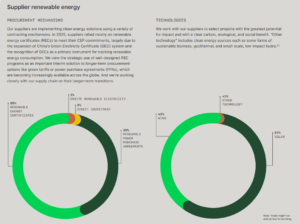
Apple has also pushed suppliers to adopt renewable energy and lower-carbon production methods, particularly in high-impact manufacturing regions. This creates two ways to reduce emissions: cleaner energy and cleaner inputs.
Emissions Profile Shows Progress, But Not a Straight Line
Apple’s emissions profile reflects both progress and complexity. The company’s total footprint is in the tens of millions of metric tons each year, reflecting the scale of its global operations.
In 2025, the company reported a total net carbon footprint of 14.5 million metric tons of CO₂e, down from 15.3 million metric tons of gross emissions before offsets.
Product manufacturing is still the main source of emissions, accounting for the largest share of emissions within Scope 3. In fact, manufacturing alone contributed about 8.15 million metric tons of CO₂e, or more than half of total product lifecycle emissions.
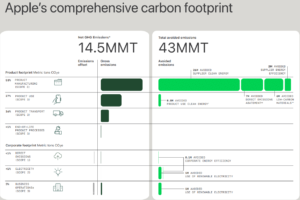
However, Apple reports gradual reductions in emissions intensity per product over time. Emissions have dropped by over 60% since 2015, while revenue has risen sharply during this time.
This means each device is now easier to make with less carbon. Total emissions can still change based on product cycles and demand.
The increasing use of recycled materials is a key driver of this improvement. It reduces the need for mining, refining, and high-energy processing — all of which sit upstream in the supply chain.
However, Apple’s emissions trajectory is not linear. Like many hardware companies, its reach depends on global demand, new product launches, and supply chain limits. This makes structural changes like material redesign more important than incremental operational gains.
Apple’s Carbon Credit Portfolio
Moreover, Apple uses carbon credits in a targeted way to address a small portion of its remaining emissions as it works toward its 2030 net-zero goal. The 2026 Environmental Progress Report states that the company retired verified credits from nature-based projects in 2025.
The portfolio includes the Lumin/Eucapine reforestation project in Uruguay, which accounted for 422,395 metric tons CO₂e (vintage 2020). It also includes the Windrock Improved Forest Management project in the United States, covering 319,785 metric tons CO₂e (vintage 2022).
These projects focus on restoring degraded land, improving forest management, and increasing long-term carbon sequestration. Apple sees carbon credits as a complement, not as substitutes, to its main decarbonization strategy.
This strategy focuses on reducing emissions first. It emphasizes using recycled materials, renewable energy, and improving the supply chain. Only after these efforts does Apple use high-quality credits to tackle leftover emissions.
The Real Shift: Apple Is Redesigning How Electronics Are Made
Apple’s recent report shows a clear direction for tackling its environmental footprint. The company is no longer treating sustainability as an external offset mechanism. Instead, it is embedding it directly into product architecture.
The increase to 30% recycled materials in products shows a big change in how the tech giant makes things. Key parts, like cobalt and aluminum, are almost entirely made from recycled content. Robotics-driven recycling systems reinforce this direction, creating a closed-loop system where old devices feed directly into new production.
At the same time, Apple’s emissions profile shows both progress and constraint. Reductions are real, but scaling global hardware production means absolute emissions remain significant.
Still, the direction is clear. Apple is moving away from linear electronics manufacturing and toward a circular model where materials are continuously recovered, reused, and reintroduced into production.
In doing so, it is reshaping what sustainability looks like in the global tech industry — not as an add-on, but as a design principle built into the product itself.