

The aluminum industry faces pressure to cut emissions while meeting the growing demand from electric vehicles, renewable energy, and consumer electronics. In this setting, Rio Tinto has achieved an important milestone in its low-carbon aluminum efforts.
The mining giant has started commissioning its $1.5 billion AP60 smelter expansion at the Arvida complex in Quebec, Canada. This project is one of Rio Tinto’s biggest investments in advanced aluminum production technology. It shows the company’s commitment to cutting emissions while boosting output.
The startup process began in March and will continue until late 2026. When complete, all 96 new AP60 pots will be operational, greatly expanding production capacity and solidifying Rio Tinto’s position in North America.
AP60 Expansion: A Major Step Forward for Low-Carbon Aluminum
Developed by Rio Tinto’s research teams, AP60 is one of the most efficient aluminum smelting technologies today. It boosts productivity while reducing energy use and emissions.
The press release says:
- The AP60 expansion will add about 160,000 metric tonnes of primary aluminum production each year.
- This raises the total output from AP60 technology to around 220,000 metric tonnes annually.
Aluminum is key in many industries. It is lightweight, durable, and can be recycled without losing quality. As industries move toward cleaner technologies, the demand for aluminum grows. It is essential for electric vehicles, solar panels, aircraft, and packaging.
Rio Tinto believes the AP60 expansion will meet this rising demand while lowering the environmental impact of aluminum production.
Furthermore, the project will offset production losses from older potrooms at Arvida. These potrooms will close by June for more efficient operations.
Cleaner Technology with Lower Emissions
AP60 technology offers notable environmental benefits.
Using Quebec’s hydropower, AP60 produces much lower emissions than usual for aluminum production.
- Aluminum made with AP60 emits about one-sixth of the greenhouse gases compared to the global average.
- It also produces about half the emissions of older technologies at the Arvida smelter.
Rio Tinto also expects AP60 to lower fine particulate emissions by up to 90%. This will help improve local air quality.
Claude Vanvoren, Rio Tinto’s Vice President of Technology and Research, noted the strong performance of AP60 cells last year. He highlighted design improvements that led to record-low emissions and enhanced productivity.

Economic Benefits for Quebec
Rio Tinto estimates the project will directly support about 100 permanent jobs in the region and maintain employment across its broader supply chain.
During construction, the project generated significant economic activity. At peak times, over 1,500 workers were on-site. Rio Tinto estimates it delivered over $1 billion in benefits to Quebec through spending on contractors, suppliers, and local services.
This investment strengthens Rio Tinto’s long-standing presence in the province and reinforces Quebec’s role in low-carbon aluminum production.
Supporting the Future of Carbon-Free Aluminum
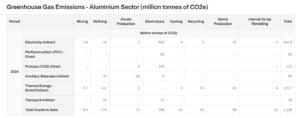
As per the Aluminum Climate Impact 2025 report:
“The global aluminum industry is responsible for about 2% of total carbon dioxide (CO₂) emissions worldwide. Between 2000 and 2024, global aluminum production more than doubled, driven largely by China, which produced 59% of the world’s aluminum in 2024.”
The AP60 project also sets the stage for more advanced aluminum technologies. Rio Tinto is a partner in ELYSIS, an initiative focused on eliminating greenhouse gas emissions from aluminum smelting.
Traditional aluminum production uses carbon anodes that release carbon dioxide. ELYSIS aims to replace these with technology that produces oxygen instead of emissions.
A demonstration plant is being developed in Quebec with support from the Canadian and Quebec provincial governments. This technology could transform aluminum manufacturing and significantly cut the industry’s carbon footprint.
The AP60 expansion lays the groundwork for this future transition, promoting cleaner production methods while new technologies are developed.
Climate Challenges and Growing Opportunities
Like many companies, Rio Tinto faces pressure from rising carbon costs and climate regulations.
The company expects higher carbon-related expenses in areas where aluminum production still relies on fossil fuels, especially in parts of Eastern Australia. These costs will likely rise as governments tighten climate policies.
At the same time, demand for low-carbon aluminum is set to grow.
Rio Tinto believes markets, particularly in Europe, will increasingly favor products with lower carbon footprints. The company’s hydropower-powered aluminum operations in Canada and planned decarbonization projects in Australia are well-positioned for this trend.
By 2050, demand for low-carbon aluminum could be nearly 1.8 times higher under certain climate scenarios. More ambitious global climate policies could push demand even higher.
Aluminum has already made a significant contribution to Rio Tinto’s earnings. From 2019 to 2023, it accounted for about 11% of group EBITDA. The company expects aluminum’s contribution to rise to around 15% by 2033 as it diversifies and expands production.
A Clear Roadmap Toward Net-Zero Operations by 2050
Rio Tinto has made climate action central to its long-term strategy.
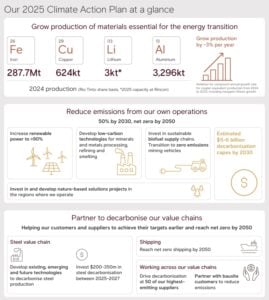
The company’s updated Climate Action Plan supports the global energy transition and aims to cut emissions in its operations.
- In 2025, Rio Tinto reported gross Scope 1 and Scope 2 emissions of 31.5 million tonnes of CO2 equivalent, a reduction of 0.2 million tonnes from the year before.
Since 2018, the company has cut operational emissions by 14%. After accounting for high-quality carbon offsets, net emissions are now 17% below the baseline.
Several initiatives have helped achieve these reductions, including renewable energy contracts and investments in cleaner technologies.
Managing Environmental Risks
The company closely monitors several hazardous emissions, including sulfur oxides (SOx), nitrogen oxides (NOx), and particulate matter like PM10 and PM2.5.
It reports that emissions of sulfur oxides, nitrogen oxides, and fluoride have remained stable over the past five years. However, particulate matter emissions have slightly increased in the last three years.
To address these concerns, Rio Tinto invests in emission-control technologies and monitoring systems to meet regulations and stakeholder expectations.
The final aim is to go net-zero operational emissions by 2050. And the company consciously recognizes that this goal needs major tech breakthroughs. Almost half of its emissions come from sources that are hard to eliminate with current technology.
Thus, projects like AP60 and ELYSIS show Rio Tinto’s plans to tackle these challenges. They combine innovation, renewable energy, and operational improvements. This way, the company aims to provide materials for the energy transition while lowering its environmental impact.