

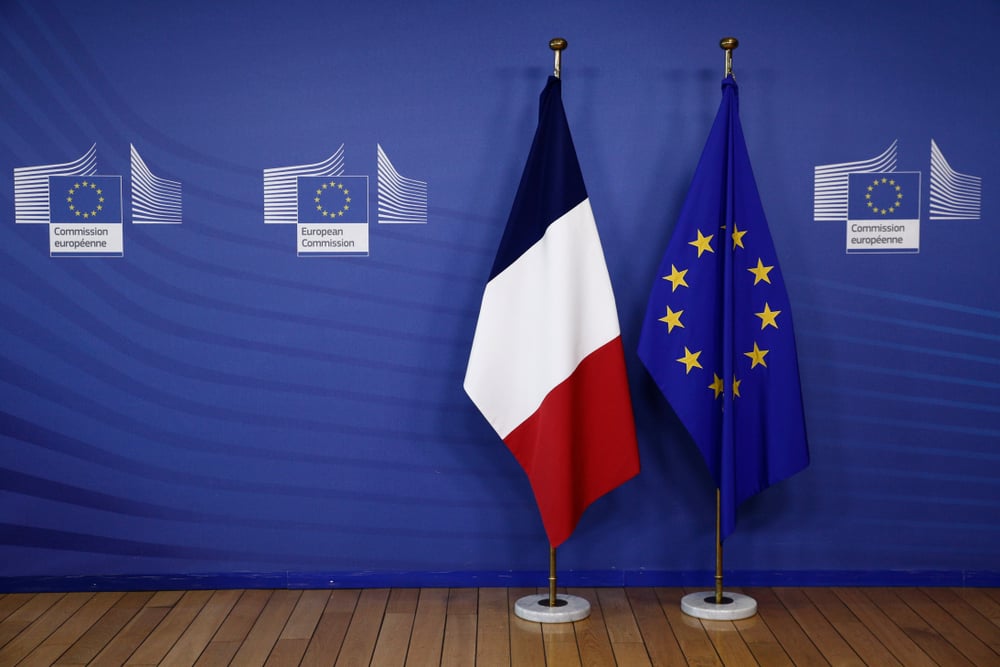
France is making one of its biggest clean energy investments yet. The European Commission has approved a €63 billion (US$72 billion) support program to help France build and operate 11 offshore wind farms over the next 25 years. The plan aims to speed up renewable energy development, reduce greenhouse gas emissions, and strengthen Europe’s energy security as electricity demand continues to rise.
The approval comes at a time when Europe is working to replace fossil fuels with cleaner electricity while meeting its climate goals. At the same time, power demand is growing because of electric vehicles, heat pumps, and AI data centers.
For France, offshore wind is becoming a key part of this transition. Teresa Ribera, Executive Vice-President for Clean, Just and Competitive Transition,
“Today’s decision clears the way for France’s offshore wind support scheme. France will continue working towards a fully decarbonised energy system, and the Commission will continue supporting Member States in achieving our common climate objectives.”
France Unleashes a Historic Offshore Wind Buildout
The projects will be located in the North Sea, the Atlantic Ocean, and the Mediterranean Sea. Together, they will provide up to 11.1 gigawatts (GW) of new offshore wind capacity and generate about 47.8 terawatt-hours (TWh) of clean electricity each year. That is enough to supply more than 10% of France’s annual electricity demand.
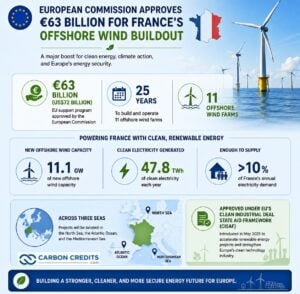
The program was approved under the European Union’s Clean Industrial Deal State Aid Framework (CISAF). It was introduced in May 2025 to speed up renewable energy projects and strengthen Europe’s clean technology industry.
France will award the projects through competitive auctions. Winning developers will receive long-term two-way Contracts for Difference (CfDs). These contracts provide stable revenues by linking payments to electricity market prices. They help lower investment risks while protecting consumers from excessive power prices.
The new program also moves France closer to its goal of installing 18 GW of offshore wind by 2035 and 45 GW by 2050, making offshore wind a key part of the country’s clean energy transition.
Offshore Wind Supports France’s Climate Goals
Offshore wind is a key part of France’s clean energy strategy. The country aims to reach carbon neutrality by 2050. To get there, it plans to expand renewable energy while keeping its low-carbon nuclear power system.
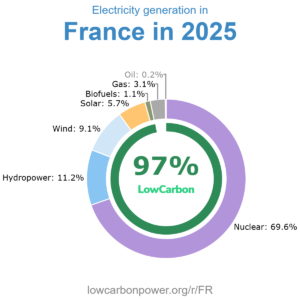
The government wants offshore wind capacity to grow to 18 GW by 2035 and 45 GW by 2050. With more than 5,500 kilometers of coastline, France has some of Europe’s best offshore wind resources.
More offshore wind will help cut fossil fuel use, improve energy security, and meet rising electricity demand from electric vehicles, industry, and AI data centers. The new €63 billion program could speed up that transition and support France’s long-term climate goals.
Expanding offshore wind will make the country’s power mix even cleaner. It will also reduce the need for fossil fuel generation during periods of high demand.
Why Offshore Wind Is Booming Worldwide
France’s investment reflects a much bigger global trend.
According to the Global Wind Energy Council (GWEC), global offshore wind capacity has now grown to over 83 GW. The industry is expected to add over 410 GW of new offshore wind capacity between now and 2035 as countries invest in cleaner electricity and stronger energy security.
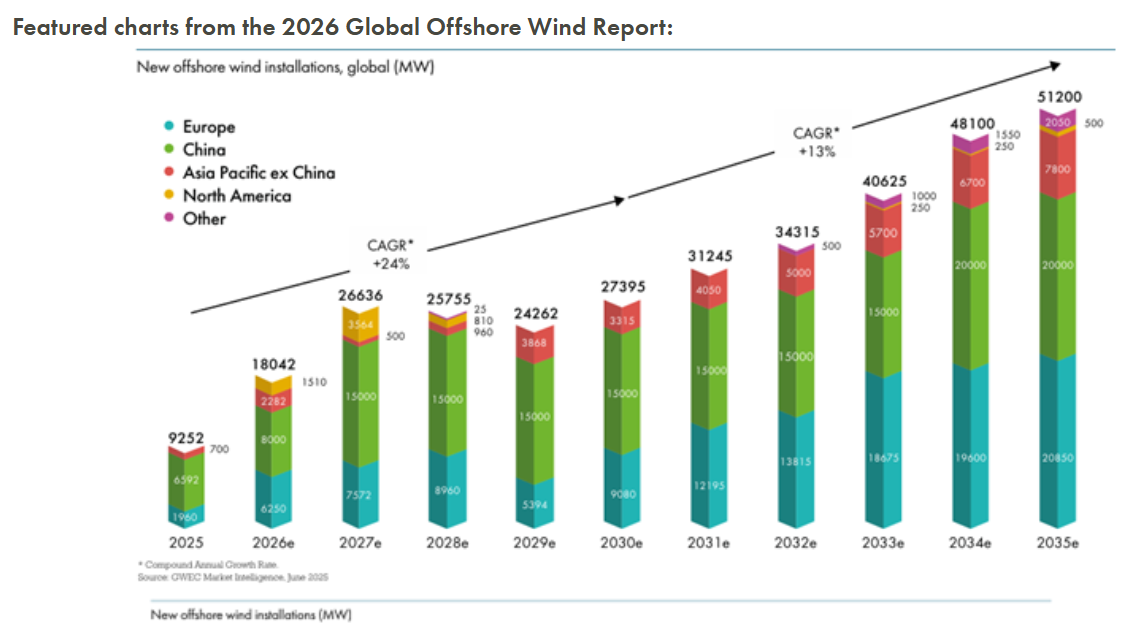
Europe continues to lead the market. WindEurope says the region installed 16.4 GW of new wind power capacity in 2025. Wind now supplies about 20% of Europe’s electricity, making it one of the continent’s largest sources of clean power.
France has some of Europe’s best offshore wind resources because of its long Atlantic and Mediterranean coastlines. However, it has expanded more slowly than countries such as the United Kingdom, Germany, and the Netherlands. The new support program will help close that gap over the coming years.
It will also support the European Union’s target of cutting net greenhouse gas emissions by at least 55% by 2030 compared with 1990 levels.
The power sector remains one of the world’s biggest sources of emissions. According to the International Energy Agency (IEA), electricity and heat generation account for about one-third of global energy-related CO₂ emissions. Replacing coal and natural gas with renewable electricity is one of the fastest ways to reduce those emissions.
Wind Energy Is Reshaping Europe’s Power Mix
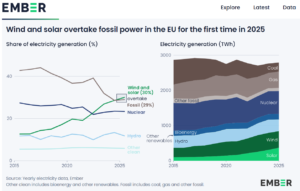
Ember reports that wind and solar produced almost 30% of the EU’s electricity in 2025. At the same time, fossil fuel generation kept falling with renewables overtaking it for the first time. The shift reflects years of investment in renewable energy and stronger climate policies across the region.
The next challenge is expanding the electricity grid.
The IEA says countries must build and upgrade millions of kilometers of transmission and distribution lines by 2040 to keep pace with rising electricity demand. Without stronger grids, many renewable energy projects could face delays because they cannot connect to the network.
Battery storage will also play a larger role. Batteries store extra electricity when wind output is high and release it when demand increases. Together, stronger grids and more storage will help make renewable electricity more reliable.
Billions Flow Into the Offshore Wind Revolution
The offshore wind industry is attracting record levels of investment.
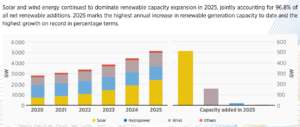
IRENA estimates that in 2025, renewable power added a record amount of new capacity worldwide. Solar and wind led most of these new installations. Governments and investors continue to favor these technologies because costs have fallen sharply over the past decade. Moreover, energy security has become a higher priority.
Europe remains one of the world’s largest offshore wind markets. The region has built a strong supply chain that supports thousands of jobs in manufacturing, engineering, construction, and port operations.
France’s €63 billion program aims to boost the industry. It offers developers the long-term certainty they need to invest in new projects.
France Is Investing in Europe’s Clean Energy Future
The European Commission’s approval marks one of the largest offshore wind support programs ever introduced in Europe.
For France, the investment could reduce emissions, improve energy security, and strengthen domestic clean energy industries. For Europe, it reinforces offshore wind’s growing role in building a low-carbon economy.
The program also sends a broader message to global markets. Governments are no longer investing in renewable energy only to meet climate targets. They are also doing it to improve energy independence, support economic growth, and prepare electricity systems for a future powered by AI, electric transport, and clean industries.
As offshore wind capacity expands across Europe, projects like France’s €63 billion program will play an increasingly important role in reducing emissions while supplying the reliable electricity needed for the next phase of the global energy transition.