


Gevo Inc. (NASDAQ: GEVO) reports strong results from its low-carbon fuels and carbon removal initiatives. The renewable fuels company is advancing in carbon markets, biofuels, renewable natural gas (RNG), and sustainable aviation fuel (SAF). As a result, management expects significantly higher earnings for 2026 than previously predicted.
The company believes its non-GAAP adjusted EBITDA for 2026 could more than double prior estimates. This positive outlook stems from carbon credit opportunities, increased production, improved operations, and new tax credit revenue.
Gevo’s Chief Executive Officer Paul Bloom said:
“We continue to deliver solid progress on recognizing greater value from our commodities, carbon business and incentives. Our actions taken in the second quarter demonstrated that our carbon strategy is working to deliver increased value for our shareholders from our operating assets, while also advancing our growth objectives.”
Carbon Business Drives Growth
A major milestone for Gevo this year is its entry into compliance and voluntary carbon markets.
The company has completed a new carbon intensity pathway under Canada’s Clean Fuel Regulations (CFR) for its low-carbon ethanol made with carbon capture and sequestration (CCS). This allows Gevo to generate and sell compliance carbon credits in Canada, with sales beginning this year and revenue expected in the third quarter of 2026.
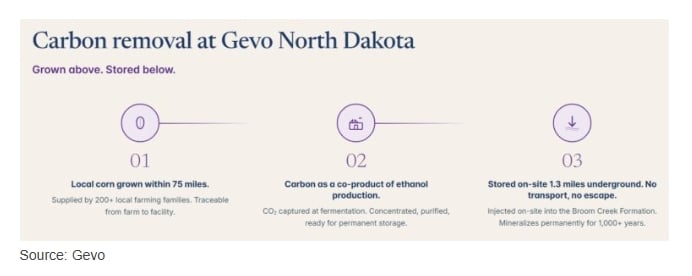
Gevo is also expanding in the voluntary carbon market via its bioenergy with carbon capture and storage (BECCS) project in North Dakota.
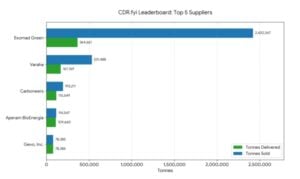
- According to carbon market platform CDR.fyi, Gevo ranks among the world’s top five suppliers of delivered carbon removal credits. Unlike many firms still in development, Gevo consistently delivers verified credits to clients.
Chief Carbon Officer Alex Clayton sees significant growth potential in this area. He stated that Gevo is creating new opportunities while helping to set standards for quality carbon removal. Clayton believes the company could generate over $30 million in carbon-related revenue as demand rises. He also noted the long-term goal is to build a trusted carbon credit market for global trading.
Carbon Credit Sales Surge
Demand for Gevo’s carbon removal credits has soared in 2026.
The company reports that sales in the first half of the year have already surpassed total sales for all of 2025. Notable organizations have retired carbon dioxide removal certificates (CORCs) from Gevo’s North Dakota BECCS project via the Puro.earth registry.
Clients include Nasdaq, Delta Air Lines, Bank of Montreal, Monzo Bank, and Amgen, all seeking reliable carbon removals. Recently, Nasdaq retired credits for about 8,500 tonnes of carbon dioxide equivalent and highlighted this partnership in its latest sustainability report.
Launching a Carbon Marketplace
To meet rising demand, Gevo has launched an online platform for its carbon removal business.
This new site allows buyers to access Gevo’s carbon credits directly and explains how its BECCS technology works. The platform aims to simplify the purchasing process and educate companies on meeting climate targets through verified removals.
Gevo states that all its carbon credits are certified under the Puro Standard via Puro.earth. Cula Technologies provides monitoring to ensure transparency in project performance and verification. The company is also in discussions to improve standards in the voluntary carbon market.
Expanding Carbon Arbitrage Strategy
Gevo describes its business model as a “carbon arbitrage” strategy.
Instead of relying solely on fuel sales, the company gains value from multiple sources linked to the same production process. Low-carbon ethanol production generates fuel revenue, carbon credits, tax incentives, and carbon removal credits through CCS. These diverse revenue streams improve project economics and lessen reliance on fuel prices.
Management notes that growth in compliance and voluntary carbon markets is boosting returns from this integrated model.
Section 45Z Tax Credits Expected
A key factor in Gevo’s improved outlook is the U.S. Section 45Z Clean Fuel Production Tax Credit.
The company anticipates monetizing over $70 million in Section 45Z tax credits during 2026. These credits relate to ongoing production of low-carbon ethanol and renewable natural gas, rewarding further reductions in carbon intensity. Gevo expects to see cash proceeds from these tax credits in the second half of this year.
Financing Push Supports Gevo’s 2028 Capacity Expansion
The company is also planning to double the facility’s capacity to about 150 million gallons annually. Engineering work, permitting, and initial equipment purchases have already started. This larger expansion aims for completion in 2028 after securing financing.
It expects to finalize financing arrangements, including a partnership with Ara Energy, in the second half of 2026. If successful, this expansion would roughly double ethanol production, carbon capture capacity, and revenue from the North Dakota site.
SAF Facility, Project Northstar Gets a Boost
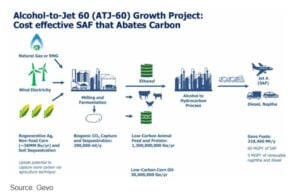
Gevo is advancing Project Northstar, its main sustainable aviation fuel facility planned for North Dakota.
The company has completed Front-End Loading Phase 3 (FEL-3) engineering for the project. Construction costs are now estimated at $600 million, with typical engineering uncertainty around 10%.
Most of the alcohol-to-jet technology modules have performed close to earlier estimates, within 2% of previous projections. However, total project costs have risen due to site-specific challenges.
Gevo noted that weaker soil conditions at the North Dakota site require more civil engineering work. Shipping and logistics costs for key equipment have also increased. These site-specific costs added about $100 million to the overall project estimate.
Management mentioned that future facilities in different locations could have lower or higher costs depending on local conditions. The company is now working to secure additional long-term SAF purchase agreements before making a final investment decision later this year.
Operational Improvements Boost Production
- The press release highlighted that a debottlenecking project is underway to increase low-carbon ethanol production capacity to around 75 million gallons by the end of 2026.
Additionally, the project is on track and within budget. Once complete, management predicts that production of ethanol, coproducts, captured carbon dioxide, and related incentives will rise by about 10% to 15% starting in 2027.
The company states that this expansion should not require significant unplanned production shutdowns.
Growing Support for SAF
Gevo revealed that market conditions for SAF are improving across North America.
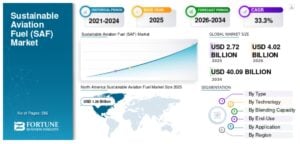
According to Fortune Business Insights, the global sustainable aviation fuel (SAF) market was valued at US$2.72 billion in 2025.
The market is expected to grow to US$4.02 billion in 2026 and reach US$40.09 billion by 2034, reflecting a 33.3% compound annual growth rate (CAGR) during the forecast period. North America led the global SAF market in 2025, capturing 46.43% of total market revenue.
Several U.S. states, like Colorado, Hawaii, Kentucky, Massachusetts, Minnesota, and New Mexico, have started or grown SAF tax credits and low-carbon fuel programs.
These efforts aim to prompt airlines to use cleaner aviation fuels. Together, these states use nearly 3 billion gallons of jet fuel each year, showing a big potential market for sustainable options. Gevo thinks these policies could boost long-term demand and improve funding for future SAF projects.
Renewable Natural Gas Performance
Gevo’s renewable natural gas business has also shown strong results in the second quarter.
The company reported RNG production above budget, averaging around 106% of planned output for the year. Meanwhile, its specialty fuels business in Silsbee, Texas, has transitioned from a cost center in 2025 to a profitable venture expected in 2026. Additional cost-cutting measures are projected to reduce annual corporate expenses by over $5 million.
- As Gevo prioritizes Project Northstar, it is considering winding down development of its SAF project in Lake Preston, South Dakota.
Management noted that ending work at Lake Preston might lead to big non-cash write-downs. However, they expect no extra cash spending on it. Instead, resources will shift to North Dakota, where Gevo sees better long-term opportunities for both sustainable aviation fuel and carbon removal.
Gevo is focusing on carbon management and renewable fuels for long-term growth. With rising carbon credit sales and more access to compliance markets, the company is well-positioned. They are also boosting biofuel production and benefiting from valuable tax incentives. Progress on their flagship SAF project further supports this strategy.