

France has published a structured policy document titled “Roadmap for Transitioning Away from Fossil Fuels” (2026) by the French Government. This roadmap sets out how the country plans to reduce its dependence on coal, oil, and natural gas over the coming decades. It does not introduce entirely new commitments. Instead, it consolidates existing climate and energy strategies into a single framework and gives them a clearer direction.
The plan aligns with the goals of the Paris Agreement, especially the global objective of achieving net-zero emissions by 2050. It also reflects decisions from the Global Stocktake under COP28 guidance, which emphasized a fair, orderly, and science-based transition away from fossil fuels.
The roadmap was also influenced by broader European Union commitments to decarbonize the energy system and reduce dependence on fossil fuels.
A Unified Climate Strategy Built on Existing Policies
The roadmap is built mainly on two long-standing national frameworks: France’s National Low Carbon Strategy (SNBC) and the Multiannual Energy Planning (PPE).
These policies already define France’s climate targets and energy direction. The new roadmap brings them together under a single umbrella to enhance clarity and coordination.
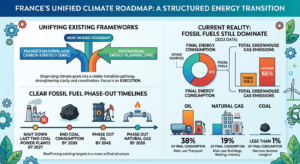
- It confirms clear phase-out timelines for fossil fuels. Coal consumption is expected to end by 2030, oil by 2045, and natural gas by 2050.
In addition, France plans to shut down its last two coal-fired power plants by 2027. These steps are already part of the national energy policy but are now reaffirmed in a more unified structure.
This approach shows that France is organizing its climate goals into a more visible transition pathway. The focus is on execution rather than new ambition.
Fossil Fuels Still Dominate Energy Use
Despite strong policy direction, fossil fuels continue to play a major role in France’s energy system. In 2023, fossil fuels accounted for slightly less than 60% of final energy consumption. They were also responsible for around 65% of total greenhouse gas emissions, according to French government climate data.
Oil remains the dominant fuel, mainly used in transport. It accounts for about 38% of final energy consumption. Natural gas accounts for around 19% of energy use, primarily in buildings, heating, and industry. Coal has now become marginal, representing less than 1% of total consumption.
A significant portion of these fossil fuels is imported, which creates energy security concerns. This dependence is one of the key reasons France is linking climate policy with energy sovereignty in this roadmap.
Transport Is the Core Focus of Oil Reduction
Transport is the largest source of emissions linked to oil consumption in France. The roadmap, therefore, places strong emphasis on electrification.
One of the key targets is for electric vehicles to represent 66% of new car sales by 2030. Alongside this, France is investing in charging infrastructure and expanding electrification to buses and heavy-duty vehicles. Public transport usage is also expected to increase by 25% by 2030.
These measures are designed to reduce oil demand in one of the most energy-intensive sectors. Transport decarbonization is seen as essential to meeting national emissions targets and reducing import dependency.
Buildings and Gas Phase-Out Strategy
Natural gas is widely used in buildings for heating and in some industrial applications. To reduce gas consumption, France is focusing on electrification and efficiency improvements.
A key measure is the ban on installing gas boilers in new residential and commercial buildings from the end of 2026. At the same time, the government plans to install around one million heat pumps per year by 2030.
Energy renovation of buildings is another major pillar. Better insulation and efficiency improvements are expected to significantly reduce heating demand. According to the roadmap, about 85 terawatt-hours of gas consumption could be replaced by domestically produced energy by 2030. This is equivalent to roughly 20% of current gas imports.
These actions show that France is targeting both demand reduction and fuel switching at the same time.
Clean Energy Expansion and Industrial Transition
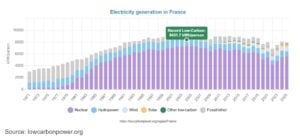
France’s roadmap places strong emphasis on expanding low-carbon energy production. The country already relies heavily on nuclear power for electricity generation, which keeps its power sector emissions relatively low.
According to data from RTE France, emissions from electricity generation have fallen to one of their lowest levels in recent years due to nuclear dominance and growing renewable capacity.
- Looking ahead, France plans to expand offshore wind capacity to 15 GW by 2035 and add 1.3 GW of onshore wind annually. Solar photovoltaic capacity is expected to triple by 2035.
The country is also investing in emerging technologies. These include up to 8 GW of electrolyzers for green hydrogen production, a sixfold increase in biomethane output, and a doubling of biofuel use by 2035. Renewable heat production is also expected to double.
This diversified energy strategy aims to reduce dependence on fossil fuels while maintaining energy stability.
Latest Emissions Data: Progress, But Slowing Momentum
France has made long-term progress in reducing greenhouse gas emissions, but recent data shows a slowdown in the pace of reduction.
According to the European Environment Agency and French national statistics, total emissions in 2023 were around 376 million tonnes of CO₂ equivalent. In 2024, emissions fell slightly further to about 369 MtCO₂e. Early estimates for 2025 suggest emissions may have dropped to around 363 MtCO₂e, according to energy research estimates from Enerdata.
Overall, France has reduced emissions by roughly 35% compared to 1990 levels. However, this is still not fast enough to meet its 2030 climate targets.
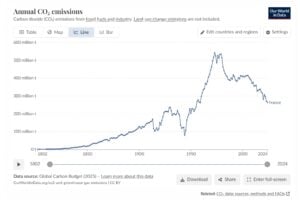
The IEA has noted that emission reductions in France are currently slower than required. The country would need a much faster decline rate to stay aligned with its national and EU climate commitments.
Transport remains the largest emitting sector, followed by buildings, industry, and agriculture. This sectoral imbalance explains why the roadmap focuses so heavily on electrification and efficiency improvements.
Improvements in Air, Water, and Land Protection
France has made progress in several environmental areas beyond emissions. Air quality has improved due to reduced pollution levels. Water quality is also relatively strong, with a majority of water bodies meeting good chemical standards.
Protected natural areas now cover more than 31% of the territory, exceeding earlier 2030 targets. Waste generation per person has also declined over the past decade.
However, challenges remain. Renewable energy still represents only about 22.3% of final energy consumption, below the 2030 target of 33%. Recycling systems, especially for plastics, are not yet fully efficient. Organic farming also remains below national targets.
This shows that environmental progress is real but uneven across sectors.
Clarity vs Action: France’s Climate Plan Faces the Real Test
Environmental experts and organizations have responded with mixed views. Speaking to AFP, Anne Bringault of the Climate Action Network said France has at least set clear timelines for phasing out fossil fuels after years of slow policy movement.
At the same time, Greenpeace France’s Lorelei Limousin described the roadmap as an early step but insufficient given the scale of the climate crisis. The concern is that existing policies may not be strong enough to accelerate emissions cuts quickly.
These reactions reflect a broader debate in climate policy: whether long-term planning is being matched by short-term action.
Thus, France’s fossil fuel roadmap provides clarity and structure by consolidating the existing policies. It provides direction, but success will depend on how quickly it can turn policy into measurable emissions reductions.