

A massive tungsten project in Kazakhstan is emerging as one of the most important critical minerals stories of 2026. This week, Skyline Builders Group Holding Ltd and Cove Kaz Capital Group LLC announced a merger agreement that will create a new Nasdaq-listed company called Kaz Resources Inc.
The new company will focus on developing strategic mineral assets in Kazakhstan, including tungsten, rare earths, lithium, tantalum, niobium, and beryllium.
At the center of the deal is the Severniy Katpar tungsten project. The mine is estimated to contain around 1.4 million tonnes of tungsten resources. That is an extraordinary figure considering China’s total tungsten reserves are estimated at roughly 2.4 million tonnes.
In simple terms, one mine in Kazakhstan could equal more than half of China’s entire known tungsten reserve base. That is why the transaction is attracting global attention. It is not just another mining deal. It’s a geopolitical move linked to supply chain security, defense manufacturing, and the fight over critical minerals.
Tungsten Is Becoming One of the World’s Most Strategic Metals
Tungsten is not as widely discussed as lithium or copper, but it is one of the most important industrial metals in the world.
The metal is extremely hard and highly resistant to heat. It is widely used in aerospace systems, military equipment, semiconductors, industrial machinery, drilling tools, electric vehicle (EV) manufacturing, and advanced electronics.
The U.S. classifies tungsten as a critical mineral. Modern industries and defense systems depend on it a lot.
Demand is now rising sharply. At the same time, supply is becoming tighter. That combination is pushing tungsten prices to record highs.
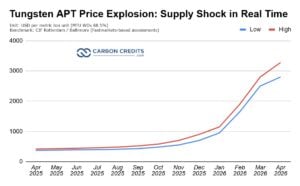
Tungsten prices jumped in early 2026. Benchmark ammonium paratungstate (APT) prices hit record levels in April 2026, up from relatively stable levels in 2025, rising from $400/MTU to over $3,000/MTU. Buyers rushed to secure the supply.
China’s Export Controls Spark Global Supply Panic
China currently dominates the global tungsten industry. China is estimated to control about 75% to 85% of the world’s tungsten production. It also holds a larger portion of the processing capacity.
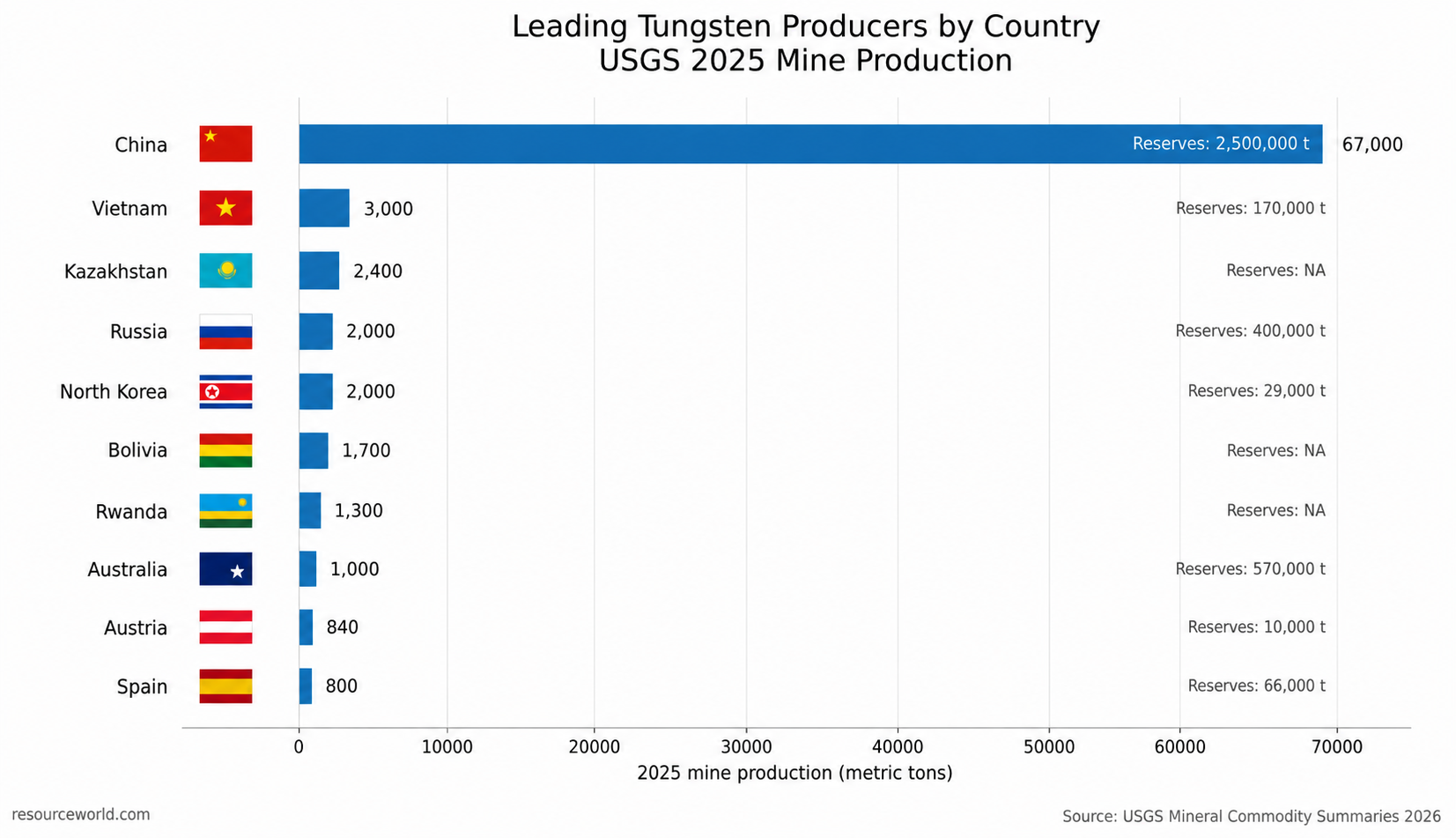
That concentration has become a growing concern for Western governments. The market is now realizing how vulnerable the global tungsten supply chain really is.
One of the biggest drivers behind the recent tungsten rally is China’s tightening control over exports. Industry reports say that Chinese export limits cut global tungsten availability in 2026. Some estimates suggest export volumes fell by around 40%, while international buyers struggled to source alternative supplies fast enough.
This has created what many analysts now describe as a structural supply shortage.
Fastmarkets reported that Chinese mining quotas and lower ore grades were tightening the market. Rising industrial demand made things worse, and then export restrictions added to the strain.
Reuters also reported that inventories remain extremely tight across global markets. The result has been explosive price growth, as shown above.
Several industry trackers reported tungsten prices more than doubled between 2025 and 2026. Some tungsten chemical products reportedly rose more than 200% in only a few months.
Analysts increasingly believe the market may remain undersupplied for years.
A market forecast predicts that the global tungsten supply-demand gap will surpass 17% from 2026 to 2028. Another report says global tungsten shortages might last until 2027. This is due to new mines outside China taking years to develop.
That backdrop makes Kazakhstan’s giant tungsten project strategically important.
The Kazakhstan Mine Could Become the West’s Next Critical Minerals Hub
According to company disclosures, the Severniy Katpar and Upper Kairakty projects could eventually produce around 12,000 metric tonnes of tungsten annually. That would represent roughly 15% of current global tungsten production.
Very few mining projects outside China are large enough to shift global supply balances. This one potentially can.
The United States appears highly interested in supporting the development financially.
The Export-Import Bank of the United States has reportedly issued a Letter of Interest for up to $900 million in financing support. Meanwhile, the U.S. International Development Finance Corporation is interested in possibly offering another $700 million. Combined support could total as much as $1.6 billion.
That level of potential backing highlights how seriously Washington views critical mineral security.
The project also reflects a wider global trend. Governments are shifting mineral supply chains from China to allied countries. They call this “friend-shoring.” Kazakhstan is becoming an important player in that shift.
Beyond Oil: Kazakhstan’s New Strategic Resource Boom
The country in Central Asia already holds large deposits of uranium, copper, rare earths, and battery minerals. Now it is positioning itself as a future hub for strategic metals needed by Western economies.
Kaz Resources controls several mineral concessions in Kazakhstan. These concessions include rare earth elements, lithium, tantalum, cesium, niobium, and tin. The company also owns a major stake in the Akbulak Rare Earth Project.
This diversification matters because many industries are no longer focused on securing only one critical mineral. Governments and manufacturers increasingly want stable access to entire supply chains.
That includes tungsten. The mineral is very important because it is hard to replace in many industrial and military uses.
Tungsten-based materials are crucial for many products. They are key in defense systems, armor-piercing ammo, jet engines, semiconductor tools, and heavy-duty cutting equipment.
As defense spending rises globally, demand is expected to increase even further.
Why Tungsten Is Becoming the Next Lithium
Multiple industry forecasts now predict strong long-term growth for tungsten demand. The global tungsten market was worth about $5.43 billion in 2025, and might reach around $9.19 billion by 2034, according to Fortune Business Insights.
Separately, Research Nester predicts the market may surpass $11 billion by 2035. This growth will be fueled by semiconductors, electrification, industrial manufacturing, and clean energy technologies.
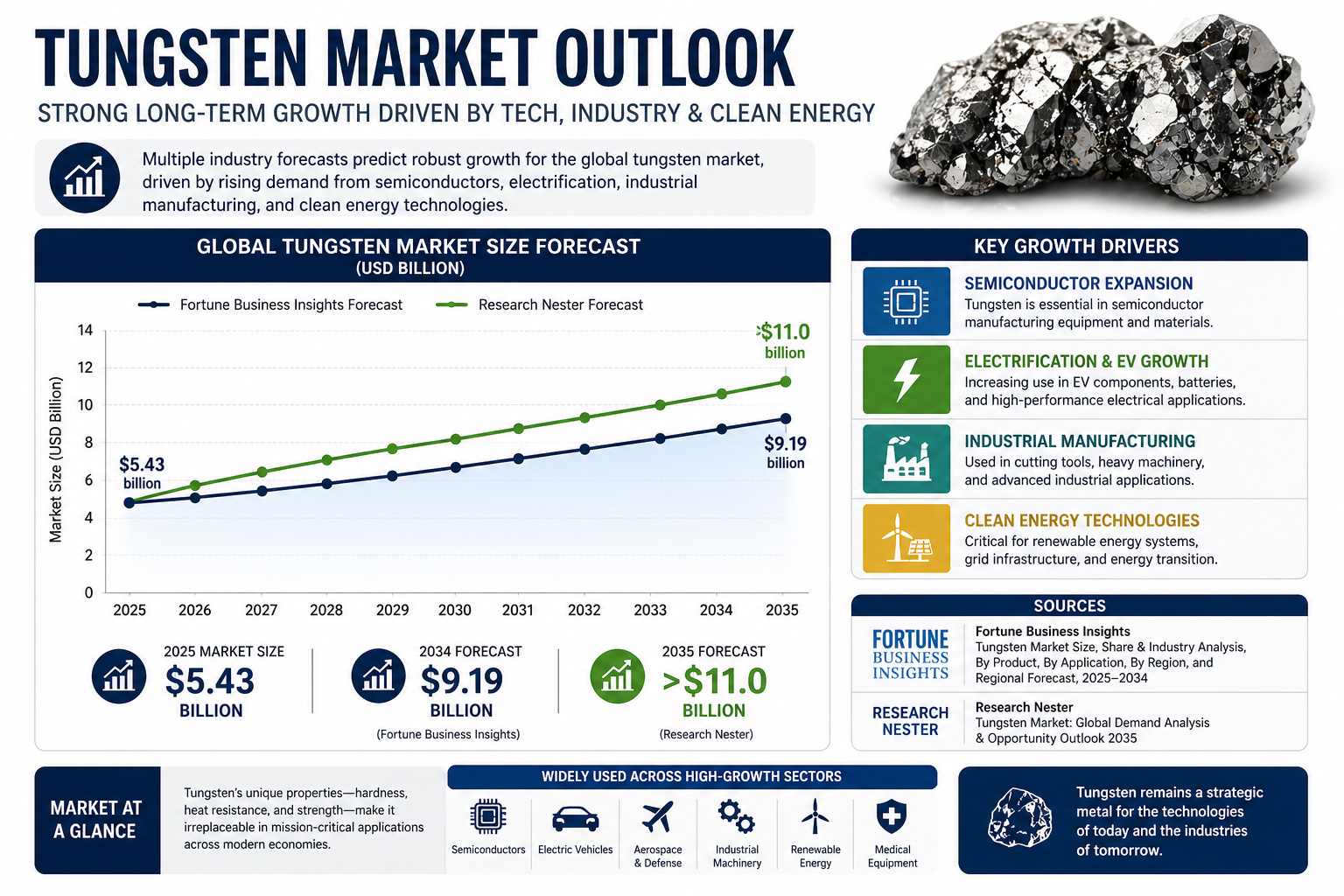
Analysts say several major trends are supporting long-term tungsten demand growth, including:
- Rising aerospace production,
- Increased global defense spending,
- Semiconductor expansion,
- EV manufacturing growth,
- Renewable energy infrastructure,
- Advanced industrial automation, and
- AI-related hardware manufacturing.
Tungsten is increasingly being viewed as a “strategic technology metal” rather than just a traditional industrial commodity. That shift is changing investor interest as well.
Mining and resource investors now see tungsten like they once saw lithium and rare earths. It’s a key material for future industrial growth.
Trump Family Ties Add Political Heat to Strategic Metals Deal
The story got more attention when reports said Donald Trump Jr. and Eric Trump invested in Skyline Builders through related investment groups. The involvement of the Trump family adds another political layer to an already strategic transaction.
Critical minerals have become one of the biggest economic and national security priorities in U.S. policy discussions.
Both Democratic and Republican administrations pushed for more mineral independence from China. This includes both domestic resources and allies. Beijing’s export restrictions on key materials have sped up that effort.
The New Global Resource War Has Already Begun
The Kazakhstan tungsten project represents more than a mining investment. It shows how critical minerals are becoming central to global economic strategy, industrial security, and geopolitics.
The world is entering a period where access to metals may become just as important as access to oil and gas once was. And tungsten is rapidly moving to the center of that conversation.
If the Severniy Katpar project reaches full production, it could become one of the most important non-Chinese tungsten supply sources in the world.
For the United States and its allies, that could mark a major step toward reducing dependence on China for one of the world’s most strategically important metals.