

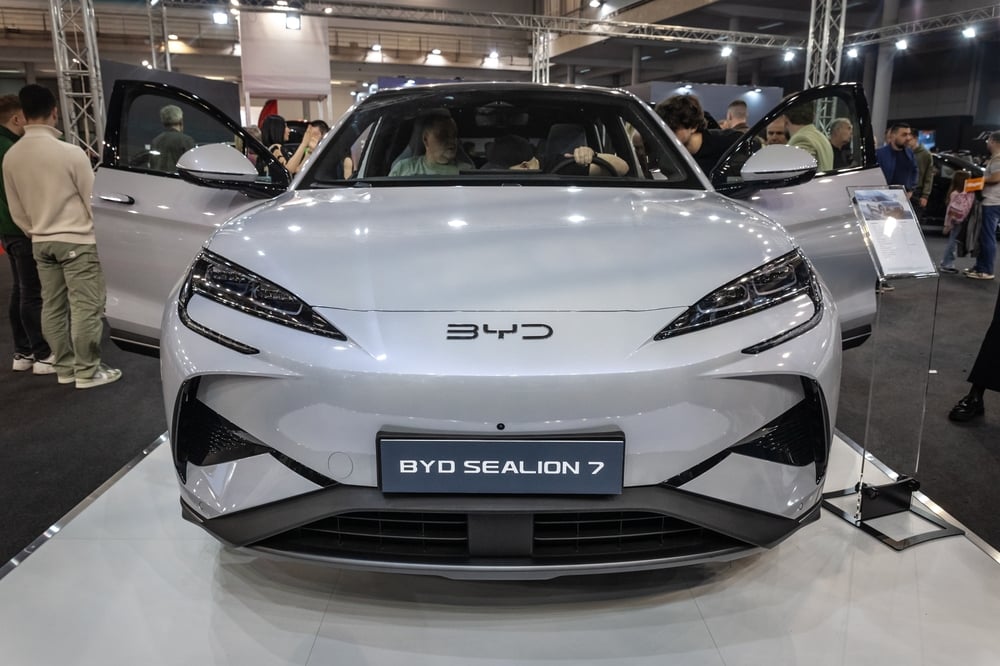
BYD, the biggest electric vehicle (EV) maker in the world, is experiencing high global demand for its new models. This comes even as it deals with rising costs and shrinking margins at home. The Chinese automaker is growing fast in Europe and other markets. It is also launching new high-performance cars for the mass premium segment.
The latest example is its new three-row electric SUV. It got over 30,000 orders in just 24 hours after pre-sales began, according to Electrek. The strong response shows that consumers still want electric SUVs. This is true even in a more competitive and price-sensitive EV market.
BYD is speeding up its global expansion, especially in Europe. EV adoption in the region is growing fast because of high fuel prices and tougher emissions rules.
Inside the 30,000-Order SUV Launch That Shocked the Market
BYD’s new three-row SUV, positioned as a flagship family model, has become one of its fastest-selling launches to date. Pre-orders passed 30,000 units within a single day of unveiling at the Beijing Auto Show.
The vehicle is priced from around 250,000 yuan ($36,500), placing it in the mid-range SUV category. It competes with models such as the Hyundai IONIQ 9 and Kia EV9, but at a significantly lower price point.
Key specifications include:
- Range of up to 590 miles (CLTC cycle),
- Up to 785 horsepower in dual-motor versions,
- Fast-charging capability based on BYD’s latest battery system, and
- Three-row seating for seven passengers.
The strong demand suggests that affordability and range remain key drivers of EV adoption, especially in large SUV segments where electrification is still developing.
Why China’s EV Price War Is Squeezing Profits
Despite strong product demand, BYD is facing financial pressure in its home market. The company reported a 55% drop in net profit in Q1 2026, falling to 4.08 billion yuan ($597 million). Revenue also declined by 12% to 150.2 billion yuan, according to Yahoo Finance.
The decline reflects intensifying competition in China’s EV sector, where multiple automakers are competing aggressively on price and incentives. Industry-wide discounting has reduced margins across the sector.
At the same time, BYD continues to invest heavily in research and development. The company invested around 11.3 billion yuan in R&D during the first quarter of 2026. This funding boosted developments in battery systems, electric drivetrains, and charging technology.
Overseas Expansion Becomes a Key Growth Engine
While domestic conditions remain challenging, BYD’s international business is expanding rapidly. In Q1 2026, overseas sales reached about 321,165 vehicles, representing nearly 46% of total NEV sales, according to industry reports. This marks a significant increase compared to previous years.
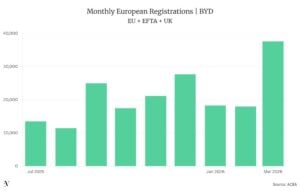
Europe has become a key growth region. BYD’s registrations in the EU jumped about 148% year-on-year in March. They reached 37,580 vehicles, as reported by the European Automobile Manufacturers’ Association.
The broader European EV market is also expanding. Battery electric vehicles accounted for a growing share of total car sales as fuel prices remain elevated and emissions rules tighten.
SEE MORE: How BYD’s European Surge and Canada Deal Are Challenging Tesla’s EV Dominance
The key drivers behind BYD’s European growth are:
- Rising oil prices are linked to geopolitical tensions,
- Faster EV adoption policies in EU markets,
- Expanding charging infrastructure, and
- Competitive pricing versus European automakers.
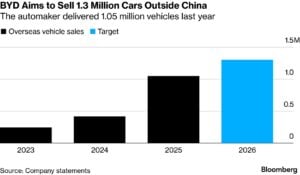
BYD is set to grow its manufacturing in Europe, including its plant in Hungary. The expansion aims to meet local demand and cut logistics costs. The Chinese EV giant also aims to sell 1.3 million units outside China.
Range, Price, and Scale: The New EV Winning Formula
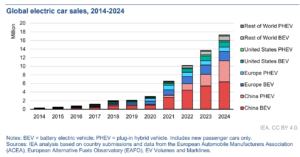
The global EV market continues to expand at a rapid pace. In 2025, worldwide EV sales hit around 20.7 million units. For the first time, EVs made up over 25% of global car sales, according to the International Energy Agency estimates.
China remains the largest EV market, accounting for more than two-thirds of global EV sales and over 70% of global EV production capacity.
This scale gives BYD a strong manufacturing advantage, particularly in cost efficiency and supply chain integration. At the same time, global demand is being supported by:
- Government subsidies and emissions regulations,
- Corporate fleet electrification,
- Rising fuel costs in key markets, and
- Expansion of charging networks.
These factors are expected to support continued EV growth through the end of the decade. Some forecasts suggest annual EV sales could exceed 40 million units by 2030.
High Fuel Prices Are Rewriting the EV Adoption Curve
Recent spikes in global oil prices have also influenced consumer behavior. Crude oil prices surged following geopolitical tensions in the Middle East, pushing Brent crude above $100 per barrel earlier in the year.
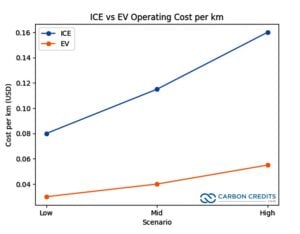
Higher fuel costs have historically increased demand for electric vehicles, particularly in Europe and Asia. As a result, the cost of running an EV becomes much lower than driving a gas-powered vehicle. This trend has contributed to BYD’s strong export growth in markets such as Australia, New Zealand, and Southeast Asia.
BYD’s leadership has stated that overseas sales could eventually account for half of total company revenue if current trends continue.
The company is boosting its presence in Europe by applying to join the European Automobile Manufacturers’ Association (ACEA). This move shows a stronger link to regional rules and industry systems.
BYD’s Strategy: Global Growth vs Domestic Margin Pressure
BYD is entering a phase of strong global expansion, but also rising domestic pressure. The company’s new SUV launch shows that consumer demand for affordable, high-range electric vehicles remains strong. At the same time, falling profits highlight the impact of price competition in China’s crowded EV market.
Internationally, BYD is gaining momentum, particularly in Europe, where high fuel prices and policy support are accelerating EV adoption.
As global EV sales grow and electrification spreads in key markets, BYD stays a key player in low-carbon transport. However, its future performance will depend on how well it balances aggressive global expansion with profitability in an increasingly competitive industry.