


Nickel’s latest price cycle is more than just a story of volatility. It shows how fast sentiment can flip in a market now shaped by policy, supply control, and long-term energy transition demand. The sharp move from a deep slump in late 2025 to a strong rebound in early 2026 has forced investors to rethink how they value nickel assets.
Let’s take a ride through nickel’s roller coaster journey.
Nickel Price Crash to Recovery: What Triggered the 2025–2026 Market Swing?
The downturn began with oversupply. By late 2025, nickel prices had dropped to around $14,000–$15,000 per tonne. A surge in production from Indonesia flooded the market and pushed prices lower. According to Reuters, prices touched near $14,235 per tonne during this phase. Producers struggled, margins shrank, and sentiment turned weak.
Then came the reversal.
Indonesia’s Supply Moves Drive Nickel Price Rebound
In early 2026, Indonesia changed the game. The country tightened mining quotas, slowed permits, and signaled more control over supply. Since Indonesia accounts for more than half of global nickel output, even small policy shifts had a big impact.
Here’s a complete one-year presentation of the nickel price cycle:
Nickel Spot Price
This sharp move from bust to bounce highlights a key shift. Nickel is no longer just driven by demand. It is now heavily influenced by policy—especially from Indonesia.
- CLICK HERE TO CHECK: LIVE NICKEL PRICES
Nickel’s Two Stories: Industrial Metal vs EV Battery Metal
This boom-bust-bounce cycle also reveals something deeper. Nickel now lives a “dual life.”
In the short term, it behaves like a traditional industrial metal. Most nickel still goes into stainless steel, so prices depend on construction activity, manufacturing, and China’s economy. When industrial demand slows, nickel prices fall quickly.
But in the long term, nickel is becoming a critical battery metal. It is a key input for EV batteries, especially high-purity Class 1 nickel used in NCM (nickel-cobalt-manganese) cathodes. This is where the real growth story lies.
According to forecasts from the International Energy Agency, global EV sales could cross 20 million units annually in the coming years. As a result, nickel demand could double by 2030. It creates a strong long-term tailwind.
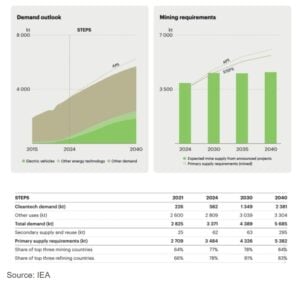
But there is a problem—supply is struggling to keep up.
Nickel Supply Challenges: Indonesia Dominance and ESG Pressures
Even though Indonesia dominates more than 50% of global nickel production, not all of it is suitable for batteries. Producing battery-grade nickel requires complex processing, especially through HPAL (High Pressure Acid Leach) technology.
And this is where bottlenecks appear.
HPAL projects are expensive, difficult to scale, and often face environmental concerns. At the same time, Western mining companies are dealing with strict ESG regulations, rising costs, and long permitting timelines. These challenges are slowing new supply growth outside Indonesia.
So, while the market may look oversupplied today, the long-term picture is less certain. If demand keeps rising and supply struggles to scale, the market could tighten quickly.
Why Nickel Projects Are Slowing Despite Strong Demand Outlook
This uncertainty explains why many nickel projects are not moving forward. Companies are cautious. Prices are still volatile, and committing billions of dollars in such an environment is risky. As per analysts, this is why several producers have delayed or scaled back projects due to cost pressures and unclear price signals.
Instead of rushing into production, many companies are focusing on de-risking their assets. They are improving project economics, advancing studies, and waiting for better market conditions.
At the same time, investors are changing their approach.
Exploration Assets Become “Long Option” Plays in Nickel Market
Rather than focusing on near-term production, investors are now looking at exploration-stage assets as long-term opportunities. These assets are being treated as “optionality” plays.
The idea is simple. Investors enter early, when valuations are low and sentiment is weak, and wait for a stronger price cycle. This is exactly where Alaska Energy Metals fits in.
Alaska Energy Metals’ Nikolai Project Stands Out
AEMC’s Nikolai project is not designed for today’s market. It is built for the future.
The project offers two key advantages: location and scale. Located in Alaska, it benefits from strong infrastructure potential, including access to roads, ports, and possible hydro power. This is a major advantage compared to remote or politically risky regions.
At the same time, Nikolai hosts a multi-billion-pound nickel resource. This scale matters. In a future supply-constrained market, large deposits become highly valuable.
The company is also advancing toward a Preliminary Economic Assessment (PEA), which will help define the project’s economics and development pathway.
Nikolai’s Economics: Built for Higher Nickel Prices
What makes Nikolai particularly interesting is how it performs under different price scenarios. Notably, at a more conservative long-term price of $18,000-$20,000 per tonne, the economics start to look strong. The project benefits from:
- Low strip ratios
- Large-scale resource base
- Additional value from byproducts like copper, cobalt, and platinum group elements (PGEs)
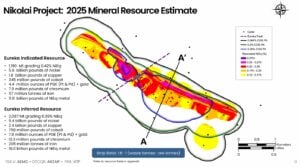
These factors improve overall project returns and reduce risk over time. And if prices move higher, the upside becomes even more significant.
Nickel Price Outlook: Can Prices Reach $25,000?
Some market forecasts suggest that nickel could enter a deficit later this decade. If that happens, prices could rise well above current levels.
This is where the “long options” strategy becomes clear.
AEMC is not betting everything on today’s market. Instead, it is positioning itself for a future where:
- EV demand continues to grow
- Supply remains constrained
- Prices move into a stronger range
Investors entering at current valuations are essentially buying exposure to that future upside.
Final Take: Volatility Today, Opportunity Tomorrow
Nickel’s boom-bust-bounce cycle has exposed how fragile and fast-moving the market can be. Prices fell sharply due to oversupply, then rebounded just as quickly when Indonesia tightened control.
But beneath this volatility lies a bigger shift.
Nickel is transitioning from a traditional industrial metal to a strategic resource for the energy transition. In the short term, it will continue to react to economic cycles. In the long term, it is driven by EV demand and supply constraints.
For Alaska Energy Metals, this shift creates a clear opportunity. The company is not chasing short-term gains. It is building a large, scalable asset that can deliver value in a tighter future market.
If nickel does move into a deficit and prices rise toward $20,000–$25,000, projects like Nikolai could become highly valuable.
In that sense, today’s uncertainty may actually be the best entry point. Because in the nickel market, the biggest rewards often come to those who position early—and wait.
- ALSO READ: Nickel Demand for EVs Could Flip the 2030 Market Balance
- LATEST: EV Batteries Need Nickel: Why Class 1 Supply Is Becoming Critical Amid Global Conflict
DISCLAIMER
New Era Publishing Inc. and/or CarbonCredits.com (“We” or “Us”) are not securities dealers or brokers, investment advisers, or financial advisers, and you should not rely on the information herein as investment advice. Alaska Energy Metals. (“Company”) made a one-time payment of $90,000 to provide marketing services for a term of three months. None of the owners, members, directors, or employees of New Era Publishing Inc. and/or CarbonCredits.com currently hold, or have any beneficial ownership in, any shares, stocks, or options of the companies mentioned.
This article is informational only and is solely for use by prospective investors in determining whether to seek additional information. It does not constitute an offer to sell or a solicitation of an offer to buy any securities. Examples that we provide of share price increases pertaining to a particular issuer from one referenced date to another represent arbitrarily chosen time periods and are no indication whatsoever of future stock prices for that issuer and are of no predictive value.
Our stock profiles are intended to highlight certain companies for your further investigation; they are not stock recommendations or an offer or sale of the referenced securities. The securities issued by the companies we profile should be considered high-risk; if you do invest despite these warnings, you may lose your entire investment. Please do your own research before investing, including reviewing the companies’ SEDAR+ and SEC filings, press releases, and risk disclosures.
It is our policy that information contained in this profile was provided by the company, extracted from SEDAR+ and SEC filings, company websites, and other publicly available sources. We believe the sources and information are accurate and reliable but we cannot guarantee them.
CAUTIONARY STATEMENT AND FORWARD-LOOKING INFORMATION
Certain statements contained in this news release may constitute “forward-looking information” within the meaning of applicable securities laws. Forward-looking information generally can be identified by words such as “anticipate,” “expect,” “estimate,” “forecast,” “plan,” and similar expressions suggesting future outcomes or events. Forward-looking information is based on current expectations of management; however, it is subject to known and unknown risks, uncertainties, and other factors that may cause actual results to differ materially from those anticipated.
These factors include, without limitation, statements relating to the Company’s exploration and development plans, the potential of its mineral projects, financing activities, regulatory approvals, market conditions, and future objectives. Forward-looking information involves numerous risks and uncertainties and actual results might differ materially from results suggested in any forward-looking information. These risks and uncertainties include, among other things, market volatility, the state of financial markets for the Company’s securities, fluctuations in commodity prices, operational challenges, and changes in business plans.
Forward-looking information is based on several key expectations and assumptions, including, without limitation, that the Company will continue with its stated business objectives and will be able to raise additional capital as required. Although management of the Company has attempted to identify important factors that could cause actual results to differ materially, there may be other factors that cause results not to be as anticipated, estimated, or intended.
There can be no assurance that such forward-looking information will prove to be accurate, as actual results and future events could differ materially. Accordingly, readers should not place undue reliance on forward-looking information. Additional information about risks and uncertainties is contained in the Company’s management’s discussion and analysis and annual information form for the year ended December 31, 2025, copies of which are available on SEDAR+ at www.sedarplus.ca.
The forward-looking information contained herein is expressly qualified in its entirety by this cautionary statement. Forward-looking information reflects management’s current beliefs and is based on information currently available to the Company. The forward-looking information is made as of the date of this news release, and the Company assumes no obligation to update or revise such information to reflect new events or circumstances except as may be required by applicable law.
Disclosure: Owners, members, directors, and employees of carboncredits.com have/may have stock or option positions in any of the companies mentioned: None.
Carboncredits.com receives compensation for this publication and has a business relationship with any company whose stock(s) is/are mentioned in this article.
Additional disclosure: This communication serves the sole purpose of adding value to the research process and is for information only. Please do your own due diligence. Every investment in securities mentioned in publications of carboncredits.com involves risks that could lead to a total loss of the invested capital.