


Shell Overseas Investment B.V., a wholly owned subsidiary of Shell plc, has signed an agreement to sell 100% of Solenergi Power Private Limited, including the Sprng Energy group of companies, to India’s Aditya Birla Renewables Limited (ABRen). It marks another significant investment in India’s rapidly expanding renewable sector.
The transaction reflects Shell’s strategy to reshape its global power business while strengthening Aditya Birla Group’s position as a leading renewable energy developer in one of the world’s fastest-growing electricity markets.
Machteld de Haan, President, Downstream, Renewables and Energy Solutions at Shell, said:
“This agreement reflects Shell’s continued focus on adjusting the portfolio in our power business. “We are high-grading our power portfolio and recycling capital in service of our asset-backed trading strategy outlined in Capital Markets Day 2025. This is another step in building a more focused, competitive and resilient business while improving returns year on year towards 2030.”
Shell to Sell Entire Sprng Energy Business
As per the press release, the deal, valued at $1.8 billion, is expected to close by the end of 2026, subject to regulatory approvals and customary closing conditions. The final purchase price will be adjusted for factors such as net debt and capital expenditure at closing.
The sale includes all of Sprng Energy’s physical renewable energy assets and its commercial contracts.
Sprng Energy has built one of India’s largest independent renewable power portfolios. The company currently owns 5.0 gigawatts-peak (GWp) of renewable energy projects. It includes 3.3 GWp of operating solar and wind assets and another 1.7 GWp under contract or development. These projects primarily supply clean electricity to state electricity distribution companies across India.
Sprng Energy Portfolio

Why Shell Is Selling
The sale is part of Shell’s broader strategy to streamline its global power business.
During its Capital Markets Day in 2025, Shell announced that it would focus more on an asset-backed power trading strategy rather than owning large numbers of renewable generation assets. The company said it plans to improve returns by optimizing its portfolio, increasing investment in flexible power generation, and executing projects more selectively across different regions.
Shell aims to achieve approximately 10% return on average capital employed (ROACE) by 2030, making disciplined capital allocation a key priority.
Although it is selling Sprng Energy, Shell emphasized that India remains an important market. The company will continue operating its integrated liquefied natural gas (LNG) business, mobility network, and lubricants business in the country. Shell recently strengthened its Indian lubricants business through the acquisition of Raj Petro Specialities.
Aditya Birla Expands Renewable Energy Portfolio
For Aditya Birla Renewables, the acquisition significantly expands its clean energy platform.
ABRen serves as the Aditya Birla Group’s dedicated renewable energy business, with Global Infrastructure Partners (GIP), part of BlackRock, as a strategic investor. The company develops a diversified portfolio of renewable projects across India, including solar, wind, hybrid power plants, floating solar facilities, and battery energy storage systems.
The acquisition of Sprng Energy instantly adds a large portfolio of operational assets while increasing ABRen’s presence across multiple Indian states.
The company has been investing heavily in advanced renewable technologies.
- Its solar projects use high-efficiency bifacial solar modules mounted on artificial intelligence-guided tracking systems that follow the sun throughout the day.
- These tracking systems increase electricity generation by maximizing sunlight exposure under changing weather conditions.
Floating Solar Offers New Growth Opportunities
One area where Aditya Birla Renewables sees strong growth is floating solar.
The company has already developed its first floating solar project in Madhya Pradesh. Unlike conventional solar farms, floating solar panels are installed on lakes, reservoirs, and other water bodies.
This approach offers several advantages. First, it reduces the need for large areas of land, which can be difficult and expensive to acquire. Second, the water beneath the panels naturally cools the solar modules, helping improve their efficiency. Finally, floating solar systems reduce water evaporation, making them especially valuable in hot and water-stressed regions.
As India seeks to expand renewable energy while protecting agricultural land and conserving water resources, floating solar is expected to become an increasingly important part of the country’s clean energy mix.
Sustainability Beyond Electricity Generation
Aditya Birla Renewables is also focusing on making its operations more sustainable.
One important initiative involves reducing water consumption at solar plants. Solar panels require regular cleaning to maintain peak performance, but traditional cleaning methods can consume significant amounts of water.
The company says it has steadily reduced per-megawatt water consumption across its projects by adopting more efficient cleaning technologies. It plans to continue lowering its water footprint as more renewable projects come online.
These improvements support India’s broader efforts to make renewable energy development environmentally sustainable while minimizing pressure on natural resources.
India’s Renewable Energy Boom Continues
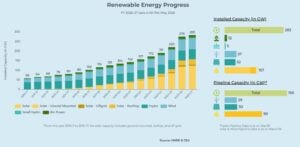
The acquisition comes as India continues to expand its renewable energy capacity at one of the fastest rates globally.
- According to the Ministry of New and Renewable Energy, India’s installed renewable energy capacity reached 288.59 GW as of June 30, 2026.
Solar power accounted for 162.15 GW, representing more than half of the country’s renewable capacity. Wind energy contributed 57.44 GW, while the remainder came from small hydropower, biomass, and waste-to-energy projects.
This rapid expansion is helping India diversify its electricity supply, reduce dependence on imported fossil fuels, and improve long-term energy security.
At the same time, India remains the world’s third-largest emitter of greenhouse gases due to its large population and growing economy.
Boosting Net-Zero Goals
- According to India’s latest National Inventory Report submitted to the UN Framework Convention on Climate Change (UNFCCC), the country’s total greenhouse gas emissions were approximately 4 billion tonnes of CO₂ equivalent in 2020, excluding emissions and removals from land use, land-use change, and forestry (LULUCF).
However, India’s per capita emissions remain well below the global average, reflecting lower emissions per person than many developed economies.
The country has committed to achieving net-zero emissions by 2070 while sourcing about 50% of its installed electric power capacity from non-fossil fuel sources by 2030. Continued investment in solar, wind, battery storage, and emerging technologies such as floating solar will be essential to meeting those goals.
Shell’s sale of Sprng Energy therefore represents more than a corporate portfolio adjustment. It also demonstrates continued investor confidence in India’s renewable energy sector.
As domestic companies like Aditya Birla Renewables expand their clean energy portfolios, India is likely to remain one of the world’s most important renewable energy investment destinations over the coming decade.