

Meta is strengthening its presence in India with a major investment in digital infrastructure and renewable energy. The company has signed an agreement with Reliance Industries to lease capacity at a new AI-focused data center in Jamnagar, Gujarat. At the same time, Meta has secured nearly 1 gigawatt (GW) of renewable energy through partnerships with Indian clean energy developers.
The move highlights India’s growing importance in Meta’s global strategy. With one of the world’s largest internet user bases, a rapidly expanding digital economy, and increasing demand for artificial intelligence (AI) services, India has become a key market for future growth.
Meta and Reliance Expand Their Long-Term Partnership
Meta and Reliance have worked together for several years. Their relationship began to deepen in 2020 when Meta invested $5.7 billion in Jio Platforms. That investment helped expand digital connectivity and supported millions of small businesses across India.
Since then, both companies have collaborated on technologies ranging from digital commerce to AI development. The new data center agreement marks another major step in that partnership.
Under the deal, Meta will lease capacity at Reliance’s upcoming data center campus in Jamnagar. The facility will run on renewable energy and use desalinated seawater for cooling, helping reduce pressure on local freshwater resources. Meta will pay the full cost of the energy and water needed to operate its portion of the facility.
- Reliance is developing what could become one of the world’s largest data center campuses. The first phase alone will provide 168 megawatts (MW) of capacity, with room for future expansion.
This scale is especially important as AI workloads require large amounts of computing power and electricity.
Jamnagar’s Strategic Advantages
Jamnagar offers strategic advantages for such a project. The location provides access to energy resources, land availability, and infrastructure needed to support large-scale AI operations. Combined with Meta’s global connectivity investments, including the Project Waterworth subsea cable system, the company aims to improve network performance and digital services for users across the region.
AI Is Driving a New Wave of Infrastructure Demand
The rapid growth of artificial intelligence is changing how technology companies build infrastructure.
Training and running advanced AI models requires massive computing capacity. As a result, global technology firms are investing billions of dollars in data centers, specialized chips, networking systems, and power supplies.
Meta’s Jamnagar investment reflects this broader trend. The company sees AI as a core part of its future products and services, from social media experiences to business tools and digital assistants.
By securing long-term infrastructure in India, Meta gains access to a growing market while positioning itself closer to users and developers. The project also supports India’s ambitions to become a global technology and AI hub.
Reliance Chairman Mukesh Ambani described the partnership as a significant milestone for India’s digital infrastructure sector. According to Ambani, the project demonstrates India’s ability to support world-class AI infrastructure and participate in the next phase of global technological innovation.
Renewable Energy Plays a Central Role
Alongside the data center investment, Meta announced major renewable energy agreements across India.
- The company signed new contracts totaling nearly 1 GW of clean energy capacity.
The largest agreement is with CleanMax, which will develop 837 MW of new solar and wind projects in Rajasthan and Karnataka. Including previous deals, Meta’s partnership with CleanMax now exceeds 900 MW.
Meta also signed an agreement with Fourth Partner Energy for 88 MW of additional solar and wind capacity across Tamil Nadu, Karnataka, Maharashtra, and Uttar Pradesh.
Together with Reliance’s renewable energy support for the Jamnagar facility, these projects will help power Meta’s growing operations in India with cleaner electricity.
The company says these investments are also expected to reduce emissions across its value chain while supporting the expansion of India’s renewable energy sector.
Meta’s Broader Sustainability Strategy
The India investments align with Meta’s global sustainability goals.
Since 2020, the company has matched 100% of its annual electricity consumption with renewable energy purchases. Over the past decade, Meta has contracted more than 15 GW of new clean energy projects worldwide, making it one of the largest corporate buyers of renewable energy.
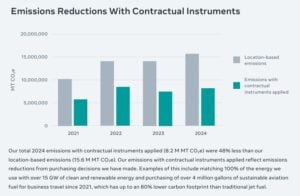
These efforts have produced measurable results. In 2024, renewable energy use helped Meta cut operational emissions by around 6 million metric tons of carbon dioxide equivalent (CO2e).
Massive Reduction in Value Chain Emissions
The company also uses Energy Attribute Certificates (EACs) to address certain Scope 3 emissions linked to activities such as remote work, product usage, and energy-related supply chain operations. These actions reduced value-chain emissions by another 1.4 million metric tons of CO2e during 2024.
- Overall, Meta reports that renewable energy procurement has helped lower total emissions by nearly 24 million metric tons of CO2e since 2021.
The company’s focus on additionality remains central to its strategy. Rather than simply purchasing existing renewable energy, Meta aims to support the development of new solar and wind projects that add fresh, clean power to electricity grids.
India’s Data Center Market Is Expanding Rapidly
Meta’s latest investment comes as India’s data center industry enters a period of rapid growth.
Industry estimates show that installed data center capacity reached about 4.48 GW in 2025. The market is expected to grow to 5.45 GW in 2026 and climb to more than 15 GW by 2031. That represents annual growth of nearly 23% over the forecast period.

Several factors are driving this expansion.
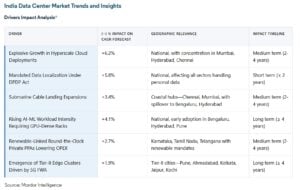
First, India’s Digital Personal Data Protection Act has increased the need for local data storage and processing. Companies are investing in domestic infrastructure to meet compliance requirements and improve service performance.
Second, global technology firms continue to commit large amounts of capital to India’s digital economy. Investments from major cloud providers and technology companies are accelerating demand for large-scale computing facilities.
Third, new subsea cable connections are improving international connectivity. Additional capacity landing in cities such as Mumbai and Chennai is strengthening India’s role as a regional digital hub.
At the same time, the rollout of 5G services is creating demand for more distributed computing infrastructure. Businesses increasingly need data processing closer to end users, encouraging the development of edge data centers in emerging urban markets.
The Shift Toward Hyperscale Facilities
India’s data center sector is also evolving from traditional colocation facilities toward larger hyperscale campuses.
Cloud providers are reserving massive blocks of capacity and securing long-term renewable energy agreements to control costs and support AI workloads. Many operators now view access to affordable clean power as a competitive advantage.
The growing use of AI further strengthens this trend. Large language models, advanced analytics platforms, and AI-driven applications require dedicated GPU clusters and specialized infrastructure.
Government initiatives such as the IndiaAI Mission are also increasing demand for high-performance computing resources across both public and private sectors.
As a result, developers are building larger facilities designed specifically for AI-era requirements.
Meta’s Jamnagar project fits squarely within this shift. By combining AI-ready infrastructure, renewable energy, and strategic connectivity investments, the company is positioning itself for the next stage of digital growth in India.
With strong local partnerships and rising demand for AI services, Meta’s latest investment signals confidence not only in India’s technology sector but also in its role as a future center for global digital infrastructure.