

Researchers at Chalmers University of Technology have developed a new artificial intelligence (AI)-based charging method that could help electric vehicle (EV) batteries last much longer without increasing charging time. The breakthrough may solve one of the biggest problems in the EV industry: how to charge batteries quickly without damaging them over time.
According to the researchers, the new charging system improved battery lifespan by 22.9% compared with traditional charging methods.
This improvement could have a major impact on the future of electric transportation. Longer battery life means lower replacement costs, less mining for raw materials, reduced waste, and better value for EV owners.
Why Battery Life Matters in Electric Vehicles
Battery health remains one of the biggest concerns for EV buyers. While electric cars are cleaner and cheaper to operate than gasoline vehicles, battery replacement can still be expensive. Fast charging also creates stress inside batteries, which slowly reduces their ability to hold energy.
Many EV owners use fast chargers regularly because they save time. However, charging too quickly can damage battery cells over the years. This is especially important for drivers who travel long distances or depend on public charging stations.
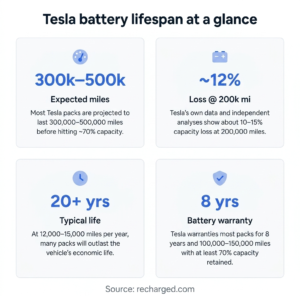
Today’s EV batteries already perform well. According to data collected by Recharged, most Tesla batteries still keep around 85% to 90% of their original capacity after driving nearly 200,000 miles. Some Tesla vehicles may even reach 300,000 to 400,000 miles before battery capacity drops to 70%.
The new AI-powered charging method could extend battery life even further.
How the AI Charging System Works
The researchers used a form of machine learning called reinforcement learning. In this system, AI learns by testing different actions and improving based on results over time.
Instead of using the same charging pattern every time, the AI system studies the battery’s condition before charging begins. It looks at factors such as:
- Current battery charge level
- Battery age
- Overall battery health
- Charging history
Based on this information, the AI adjusts the charging current in real time.
Traditional charging systems usually apply fixed current and voltage settings, no matter how old or healthy the battery is. The new AI method changes the charging process dynamically to reduce damage inside the battery.
The AI system also learns which charging patterns produce the best long-term battery performance. Over time, it becomes smarter and more efficient.
The 23% Battery Life Improvement
The study showed impressive results.
Using the AI-based charging strategy, researchers achieved a 22.9% increase in battery lifetime measured in equivalent full charging cycles. At the same time, charging speed remained almost the same.
The average charging time using the AI system was 24.12 minutes. Traditional charging methods averaged 24.15 minutes. That difference is almost impossible for drivers to notice.
And this means EV owners may get a much longer-lasting battery without sacrificing convenience.
The possible real-world benefits are significant. Some estimates suggest Tesla batteries can last between 300,000 and 500,000 miles. According to analysis from InsideEVs, a 23% improvement could add:
- Nearly 70,000 extra miles on the lower end
- More than 100,000 additional miles on the higher end
For automakers, this could reduce warranty costs and improve vehicle resale value. It could also help companies use fewer raw materials because batteries would not need replacement as quickly.
The Problem of Lithium Plating
One of the biggest causes of battery damage during fast charging is a process called lithium plating. The study, titled “Lifelong Reinforcement Learning for Health-Aware Fast Charging of Lithium-Ion Batteries”, was published in the journal IEEE Transactions on Transportation Electrification. The research was led by Changfu Zou and Meng Yuan.
Lithium-ion batteries store energy by moving lithium ions between electrodes. During fast charging, especially at high current levels, some lithium can build up as metallic deposits on the battery surface instead of being stored correctly.
This buildup significantly damages battery performance and shortens battery life.
Older batteries are even more vulnerable to lithium plating. However, most current charging systems still treat old and new batteries the same way.
The AI method changes that approach. It adjusts charging behavior based on battery condition, helping lower the risk of harmful chemical reactions. This is in contrast to the current charging systems, which often ignore battery aging during fast charging.
Changfu Zou, Professor at the Department of Electrical Engineering, Chalmers, explained,
“This work shows that the true bottleneck of fast charging is not simply current limits, but the evolving electrochemical state inside the battery. By integrating AI with physics-based understanding, we move closer to health-aware charging strategies that maximize both performance and lifetime.”
Real-World Testing Still Needed
Although the results are promising, the experiments were performed in laboratory conditions. The next step is real-world testing on physical battery packs and vehicles.
Commercial validation will be important before automakers fully adopt the technology.
Why This Matters for the EV Industry
The timing of this breakthrough is important because the global EV charging market is growing rapidly.
According to Grand View Research, the global EV charging infrastructure market was worth about $40.22 billion in 2025. It could grow to $50.2 billion in 2026 and eventually reach nearly $239 billion by 2033.
The market is expected to grow at a compound annual growth rate (CAGR) of 25%.
Fast chargers already dominate the market, accounting for more than 73% of charging infrastructure in 2025. This shows how important fast charging has become for EV adoption.
If AI charging systems can protect batteries while maintaining fast charging speeds, they may become a standard feature in future EVs.

Easy Software Updates Could Enable Adoption
One major advantage of the new charging method is that it may not require expensive hardware changes.
Researchers say the technology could be added through software updates in existing battery management systems. That means many automakers might adopt the system without redesigning the entire vehicle.
This could make the technology both affordable and scalable.
Still, researchers say the AI model must be adjusted for different battery chemistries and vehicle designs. Different EVs use different battery materials and architectures, so calibration will be necessary before large-scale deployment.
The researchers also noted that transfer learning could help speed up this process. In transfer learning, AI uses knowledge gained from one system and applies it to another similar system.
Environmental Benefits Could Be Huge
Longer-lasting batteries could also support global sustainability goals.
Battery production requires large amounts of lithium, nickel, cobalt, and other critical minerals. Mining and processing these materials create environmental impacts and carbon emissions.
If batteries last longer, automakers will need fewer replacement batteries. This could reduce mining demand and lower manufacturing emissions. Drivers would also benefit financially because they could keep their EVs longer without worrying about expensive battery replacements.
In conclusion, the AI-powered charging breakthrough from Chalmers University of Technology could become a major step forward for electric vehicles. If future real-world tests confirm the lab results, the technology could improve EV reliability, lower ownership costs, reduce battery waste, and support cleaner transportation systems.
As the EV charging market continues to expand globally, AI-driven charging may soon become an important tool for building longer-lasting and more sustainable electric vehicles.