

The global energy transition is accelerating, but fossil fuels won’t disappear anytime soon. Renewable energy is expanding, battery costs are falling, and electric vehicles are changing transportation. At the same time, artificial intelligence (AI), data centers, and industrial growth are creating a new wave of electricity demand.
This changing landscape raises an important question: How quickly can the world move toward cleaner energy without compromising affordability and energy security?
TotalEnergies explores this challenge in its Energy Outlook 2026, which examines the future of global energy through 2060. The report presents three possible pathways based on different levels of climate action, technological progress, and government policies.
Its findings point to a complicated energy transition. Renewables and electricity will gain a larger share of the market, but oil and natural gas will continue to support global energy demand. Meanwhile, carbon capture, sustainable fuels and battery storage could become increasingly important investment opportunities.
Global Energy Demand Is Rising. Can Emissions Keep Up?
The global economy needs more energy as populations grow, industries expand, and developing countries increase electricity access. However, energy consumption is not growing as quickly as economic output.
Between 2000 and 2025, global GDP increased by an average of 3.4% annually, while energy demand grew by 1.9% per year. Renewable energy supply also expanded, growing by an average of 3% per year.
This suggests that economies are gradually becoming more energy-efficient while adding cleaner sources to their energy mix.
- However, the emissions challenge remains significant. TotalEnergies estimates that energy-related carbon dioxide emissions increased from approximately 33 gigatons in 2015 to 36 gigatons in 2025. Although the pace of growth has slowed, emissions have yet to enter a sustained decline.
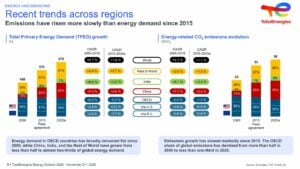
Emerging economies are playing a bigger role in this trend. China, India and other developing regions now account for almost two-thirds of global energy demand, compared with less than half in 2000.
Their energy choices will have a major influence on future emissions. Expanding renewable power, improving efficiency and developing cleaner industrial processes will be essential to meeting growing demand without locking in higher emissions.
Battery Costs Fall as the Clean Energy Race Accelerates
Investment in low-carbon energy is reshaping the global power sector. Governments and businesses are putting more money into renewable generation, electricity networks, energy storage and electric mobility.
Battery storage is emerging as one of the biggest developments.
According to TotalEnergies:
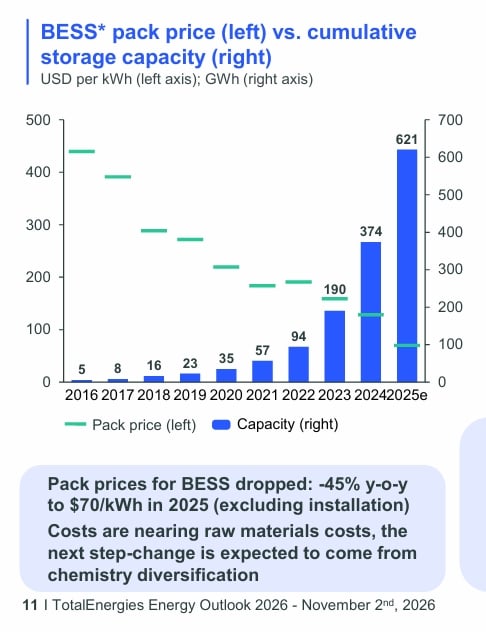
- Battery pack prices fell 45% year over year to approximately $70 per kilowatt-hour in 2025. Lower costs make battery energy storage systems (BESS) more attractive for utilities and renewable energy developers.
- Global cumulative installed Battery Energy Storage System (BESS) capacity reached approximately 621 GWh in 2025.
The technology also addresses a major weakness of solar and wind power: their output changes with weather conditions and time of day.
Batteries can store excess electricity when renewable generation is high and release it when demand increases. This makes renewable power more useful and helps electricity networks manage supply fluctuations.
Other developments accelerating the transition include:
- Lower battery prices improving the economics of energy storage.
- Growing electric vehicle adoption reducing dependence on conventional transport fuels.
- More investment in electricity grids to accommodate rising power demand.
- Greater interest in solar, nuclear, geothermal and biofuels to strengthen domestic energy supplies.
China remains a major driver of this transformation, supported by its large clean technology manufacturing base and growing domestic market.
TotalEnergies Maps Three Possible Energy Futures Through 2060
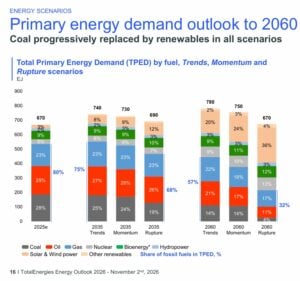
The most important part of the outlook is its three long-term scenarios: Trends, Momentum and Rupture. Each explores how the global energy mix could change under different climate policies and investment conditions.
Trends: A slower energy transition
This scenario assumes that existing policies and technology developments largely continue. Renewables expand, but fossil fuels remain important in the global energy mix. Coal gradually loses ground, while oil and natural gas continue supporting transport, industry and power generation.
Momentum: Climate action gathers pace
This pathway assumes stronger government action and faster deployment of low-carbon technologies. OECD countries reach carbon neutrality by 2050, while China accelerates progress toward its 2060 net-zero target. Emerging economies also increase their investment in cleaner energy.
Rupture: A faster shift toward a low-carbon economy
This is the most ambitious scenario. It assumes stronger international cooperation, faster electrification, and substantial investment in clean technologies. These changes help limit global warming to below 2°C.
The projected temperature outcomes highlight how different these pathways could be:
The gap between the scenarios shows how much faster the world needs to move to achieve its climate goals. Even the Momentum pathway falls short of limiting warming to 2°C.
The Rupture scenario would require major changes across electricity, transport, aviation, heavy industry and manufacturing.
AI and Data Centers will Push Electricity Demand to New Highs
Electricity is becoming the centre of the global energy transition. The rapid expansion of AI, data centers, electric vehicles and industrial electrification is creating additional demand for reliable power.
- TotalEnergies’ Trends scenario projects global electricity consumption to increase from approximately 31,900 terawatt-hours (TWh) in 2025 to 43,400 TWh by 2035. By 2060, demand could reach 73,300 TWh.
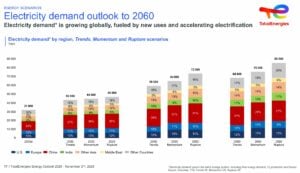
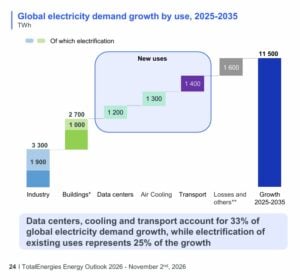
Data centers are an important part of this growth, but they are not the only driver. Cooling systems and transportation will also contribute significantly to rising electricity consumption.
- The report estimates that data centers, cooling and transport together will account for 33% of additional electricity demand between 2025 and 2035.
This creates a substantial opportunity for renewable power developers, battery manufacturers, grid operators and electricity infrastructure companies.
However, adding renewable capacity alone will not solve the problem. Countries will also need stronger transmission networks, energy storage and flexible power generation to keep electricity supplies stable.
The United States is one example. After more than 15 years of relatively stable electricity consumption, demand is expected to accelerate as data centers and industrial facilities expand.
Oil and Gas Aren’t Going Away Just Yet
Despite the rapid growth of renewable energy and electric vehicles, the report does not expect fossil fuels to disappear quickly.
Under the Trends scenario, oil demand changes gradually as electric vehicles and biofuels reduce consumption in road transportation. However, aviation, petrochemicals, and industrial applications will continue supporting demand.
Supply is another important consideration. Existing oil fields naturally lose production over time. As a result, companies will need continued investment to maintain output, even if global consumption eventually declines.
Natural gas has a different outlook. TotalEnergies expects global gas demand to continue growing until the 2040s before reaching a plateau.
Emerging markets, including India, China, Southeast Asia and the Middle East, will support this growth. Industrial development and electricity generation will remain important sources of demand.
This suggests that the energy transition will involve a gradual shift in the global fuel mix rather than an immediate replacement of conventional energy sources.
Carbon Capture and Sustainable Fuels Could Open New Markets
Renewables and electrification cannot address every emissions challenge. Industries such as aviation, shipping, chemicals and heavy manufacturing still face significant barriers to reducing their carbon footprints.
This is where carbon capture and storage (CCS), sustainable aviation fuels, biofuels and other low-carbon technologies could play a bigger role.
TotalEnergies’ scenarios highlight the potential for carbon capture to expand substantially over the coming decades.
Under the Rupture scenario, annual carbon capture capacity could reach approximately 4.3 gigatons by 2060, compared with around 2 gigatons under the Trends pathway.
Sustainable aviation fuels could also gain significant market share. Under the Rupture scenario, biofuels and synthetic e-fuels could collectively meet around 66% of aviation fuel demand by 2060.
These projections point to potential opportunities for carbon removal developers, CCS operators, low-carbon fuel producers and companies providing industrial decarbonization solutions.
However, the scale of deployment will depend on project economics, supportive policies, infrastructure development and access to capital.
The Investment Opportunity: Energy Transition Is Bigger Than Renewables
TotalEnergies’ Energy Outlook 2026 shows that the global energy transition will create opportunities across several industries, not just renewable power.
Battery storage, electricity grids, solar, wind and electric mobility could benefit from rising electrification. Natural gas and LNG may remain important as countries look for reliable and affordable energy supplies.
Carbon capture, sustainable fuels and industrial decarbonization could also attract investment as companies work toward lower-emission operations.

The biggest challenge will be financing this transformation while maintaining reliable energy supplies and controlling costs.
For investors, the report offers an important takeaway: the energy transition is not simply a contest between fossil fuels and renewables. It is a broader restructuring of the global energy system, creating opportunities for companies that can deliver affordable, reliable and increasingly low-carbon energy.