


44.01, a carbon removal company founded in Oman and headquartered in London, has signed an $11.7 million carbon removal purchase agreement with Frontier to permanently store carbon dioxide (CO₂) underground by converting it into rock. The deal will support the company’s efforts to move its technology from short-term field trials to continuous commercial operations.
Under the agreement, Frontier buyers will purchase the removal of 20,932 tonnes of CO₂ between 2028 and 2031. The project marks Frontier’s first offtake agreement for in-situ mineralization (ISM), a process that accelerates natural reactions between dissolved CO₂ and underground rocks to lock carbon away for geological timescales.
How 44.01 Converts CO₂ Into Rock
44.01 uses peridotite, a magnesium-rich rock that reacts with dissolved carbon dioxide to form stable carbonate minerals. The company has demonstrated its approach in Oman and the United Arab Emirates (UAE), where extensive peridotite formations provide potential sites for underground mineralization.
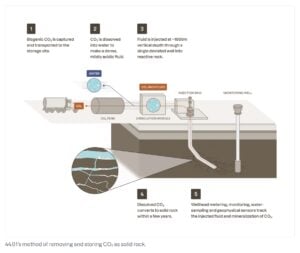
The process involves five main steps:
- Capture: The project separates biogenic CO₂ during biogas upgrading at a wastewater treatment plant and transports it to the storage site.
- Dissolution: The company mixes the captured CO₂ with water to create a mildly acidic solution.
- Injection: A deviated well, drilled to approximately 1,000 meters underground, distributes the carbonated water through naturally fractured peridotite.
- Mineralization: The dissolved CO₂ reacts with magnesium-rich minerals and forms solid carbonates. 44.01 says this process can take one to three years.
- Monitoring: Mass-flow meters, fluid samples, and geophysical sensors help track the injected CO₂, verify mineralization and monitor underground fluid movement and potential induced seismicity.
Once the CO₂ becomes solid carbonate, the risk of reversal becomes extremely low, allowing the carbon to remain stored over geological timescales.
Why In-Situ Mineralization Could Expand Carbon Storage
Permanent storage remains a major challenge for carbon removal projects. Technologies such as direct air capture and bioenergy with carbon capture and storage can generate concentrated CO₂ streams, but developers still need suitable locations and infrastructure to store the gas.
Conventional geological storage typically involves compressing CO₂ and injecting it into deep sedimentary formations. Although this approach works for large projects, it can be expensive for smaller facilities that produce limited volumes of CO₂. Pipelines, transportation infrastructure, and lengthy permitting processes can make these projects difficult to develop.
44.01’s technology could help address this problem by allowing developers to store CO₂ in reactive rock formations closer to where emissions originate.
For example, industrial sources near the company’s existing UAE site are within 50 kilometers of suitable peridotite formations but more than 300 kilometers from viable conventional storage in the Gulf. Similar opportunities may exist in Japan, Oman, Finland, inland Norway, and along the US Pacific coast.
The potential benefits include:
- Lower transportation needs: Projects could avoid expensive pipelines or shipping when suitable rock formations are located near CO₂ sources.
- Permanent storage: Mineralization converts dissolved CO₂ into stable solid minerals.
- Access for smaller facilities: Wastewater treatment plants, biogas facilities and smaller industrial sites could gain additional storage options.
- Broader industrial applications: The technology could store concentrated CO₂ captured from cement, steel and other hard-to-abate industries.
Frontier estimates that suitable reactive rock formations could support more than 5 billion tonnes of CO₂ storage annually worldwide. It also identifies more than 50 million tonnes of industrial emissions in the UAE that could potentially be captured and stored through in-situ mineralization. These figures represent estimated potential, not existing operational capacity.
Project Targets Commercial-Scale Operations
44.01 has conducted five field pilots and short-duration CO₂ injection programs since 2023. The Frontier agreement will help the company test whether it can maintain target injection rates over multiple years and determine how much water continuous operations require.
The company has designed its deviated wells to expose injected fluids to a larger volume of reactive rock. Drawing on drilling techniques used in enhanced geothermal energy and the oil and gas industries, this approach could improve injection rates and reduce costs.
44.01 also says that dissolving CO₂ in water before injection adds a containment layer. The company monitors underground fluid movement and relies on geological barriers to provide additional safeguards. TÜV SÜD and the XPRIZE Carbon Removal board have conducted third-party safety reviews of its approach.
Talal Hasan, founder and CEO of 44.01, said the agreement would help move in-situ mineralization toward commercialization. The company plans to improve operating performance, reduce costs, and make permanent storage accessible to more customers.
Hannah Bebbington Valori, Frontier’s head, said the technology could expand the range of locations where permanent CO₂ storage becomes economically practical.
CCS: Total Operational Capacity and Growth
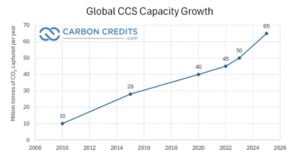
As of 2024, global CCS facilities in operation had a combined capture capacity of just over 50 million tonnes of CO₂ per year. This shows steady growth, up from about 40 Mt a few years ago. However, it still accounts for just a small part of the over 40 billion tonnes of CO₂ emitted worldwide each year.
Carbon Removal Market Sees Rising Demand
The deal comes as companies increase their purchases of carbon dioxide removal (CDR) to address residual emissions that remain after direct emission reductions.
Carbon capture and storage (CCS) and carbon removal serve related but different purposes. CCS generally prevents CO₂ from industrial sources from entering the atmosphere, while carbon removal takes CO₂ already in the atmosphere and stores it durably. In-situ mineralization can support both applications, depending on the source of the captured carbon.
Recent market activity points to stronger demand for durable carbon removal:
- Corporate demand is growing: Buyers committed to 2.1 million tonnes of carbon removal in Q2 2026, up 136% year over year, across 14 deals.
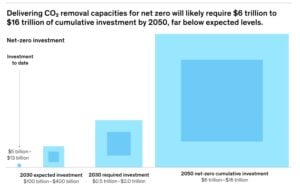
- Supply may fall short: McKinsey estimates durable carbon removal demand could reach 100 million tonnes annually by 2030, double the 50 million tonnes of announced supply.
- Financing supports growth: Advance purchase agreements help early-stage developers fund projects, test technologies and prepare for commercial expansion.
The World Economic Forum’s 2026 analysis, developed with Oliver Wyman and ClimeFi, also highlights limited access to capital, fragmented standards, and unclear accounting rules as barriers to scaling carbon removal technologies.
Frontier Deal Could Open a New Storage Pathway
The agreement allows 44.01 to demonstrate whether in-situ mineralization can operate continuously, store CO₂ permanently, and deliver reliable performance at a commercially viable cost.
If the project succeeds, the technology could expand permanent storage options for industrial facilities and carbon removal developers that cannot economically access conventional geological storage.
However, scaling the technology will depend on the results of multi-year trials, the availability of suitable rock formations, water requirements, and project economics.
For the wider carbon removal market, the deal highlights the importance of financing early-stage technologies that could increase long-term storage capacity. As demand grows, approaches such as in-situ mineralization could help developers build the infrastructure needed to deliver durable carbon removal at a larger scale.