


The voluntary carbon market (VCM) has long struggled with one major problem: pricing transparency. Most carbon credit trades still happen through private negotiations, broker quotes, or fragmented exchanges. Buyers often lack clear data on how prices may change over time. This makes it harder for companies to plan long-term carbon credit purchases or evaluate project quality.
Now, Abatable says it wants to bring more structure to the market. The London-based carbon market intelligence company launched what it calls the world’s first forward vintage curves library for VCMs. The platform gives buyers and investors forward-looking price data across different project types, delivery years, and credit vintages.
The launch comes as carbon markets move into a more mature phase. Companies want better pricing tools, stronger quality signals, and clearer forecasts. This is especially true as carbon credits link more to compliance systems, Article 6 trading, and long-term net-zero plans.
Old Market, New Problem: Why Carbon Pricing Still Lacks Clarity
Traditional commodity markets rely heavily on forward curves and benchmark pricing systems. Oil, electricity, metals, and natural gas markets use these tools to help companies manage future costs and investment risks.
The voluntary carbon market still operates very differently.
Carbon credit prices differ a lot. They depend on factors like project type, methodology, geography, integrity ratings, delivery year, and co-benefits. These co-benefits can include biodiversity or community impact. Even credits from the same category can trade at very different prices.
Abatable says its new system uses:
- Historical transaction data,
- Registry information,
- Real procurement offers, and
- Market intelligence from brokers and traders.
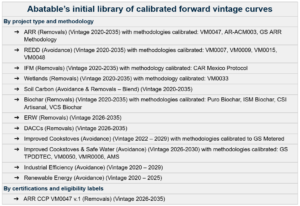
The company says the platform draws from more than 600 million offers and transactions annually through its procurement infrastructure. The library includes 13 forward curves, which include engineered and nature-based carbon projects. The vintages range from 2020 to 2035.
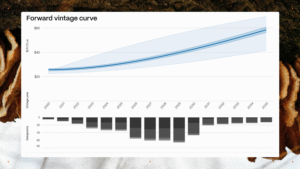
Abatable says prices for different vintages can vary by as much as three times depending on project type and methodology. The company also uses pricing data from:
- Carbon project developers,
- Trading desks,
- Brokers, and
- Third-party market observations.
To build the curves, Abatable applies the Nelson-Siegel model, a pricing method widely used in fixed-income financial markets. The company updates the library every quarter.
The platform takes a different approach than some market forecasts. It bases its curves on real transactions. This means it provides actual data, not just hypothetical supply-demand models.
Abatable’s Co-founder Maria Eugenia Filmanovic commented:
“We’re delighted to release the world’s first forward vintage curves library, delivering unprecedented pricing transparency for the market. Abatable has built the infrastructure to allow companies to engage effectively with environmental markets, through which we are able to provide transparency back to ecosystem players engaging with us to help refine their insights and transact with greater confidence.”
- RELATED: 2026 Could Redefine Voluntary and Compliance Carbon Market Convergence, with Japan Leading the Way
Why Carbon Credit “Vintage” Matters More in 2026
In carbon markets, “vintage” refers to the year when an emissions reduction or carbon removal occurred.
Vintage has become much more important in recent years because buyers increasingly prefer newer, higher-quality credits. Many companies now avoid older credits that may carry weaker methodologies or lower integrity standards. This shift has created a more segmented market.
- Abatable recently noted that the average carbon credit retired today is about six years old, with a median age of around five years.
The company noticed that buyers are increasingly favoring vintages from after 2020. This shift comes as concerns about carbon credit quality rise.
At the same time, the market still contains large volumes of older credits. This leads to a “two-speed market.” Higher-quality credits get higher prices, while lower-priced legacy credits still trade among buyers focused on costs.
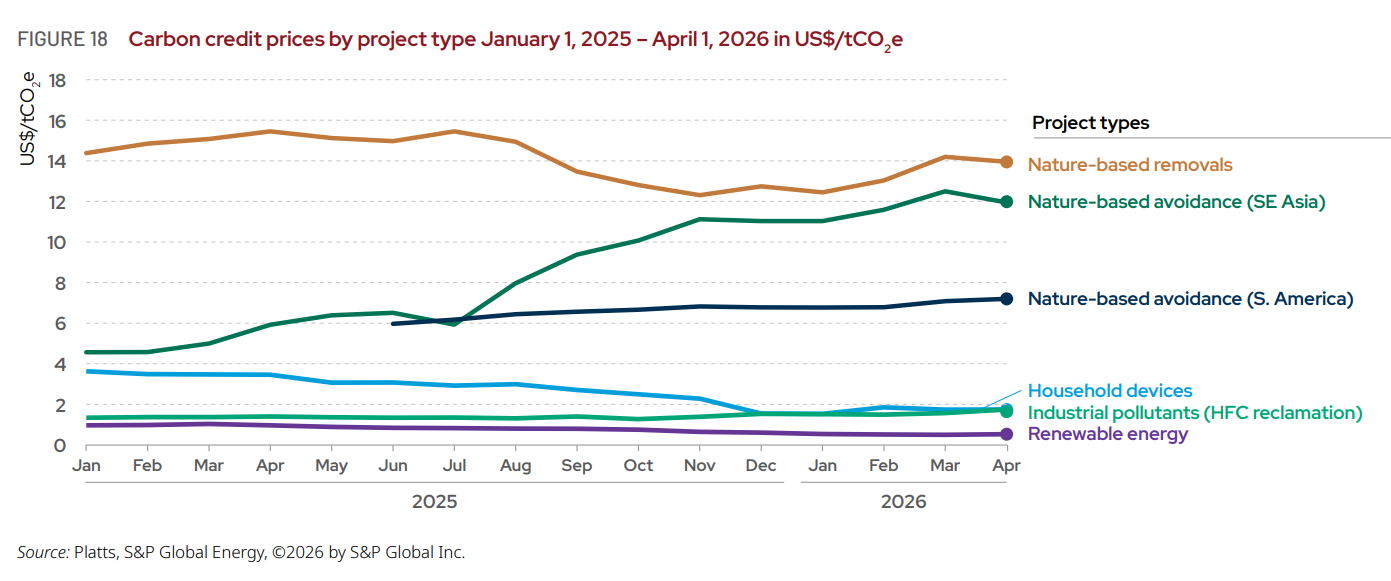
Price gaps inside the market continue to widen.
The World Bank’s 2026 carbon pricing report revealed that CORSIA-eligible aviation credits sold for about $15 to $22 per tonne in late 2025. In contrast, many other voluntary credits traded for $1 to $14 per tonne.
These widening spreads are increasing demand for better market intelligence tools.
Forward vintage curves help buyers compare future price expectations across different credit types and delivery periods. Companies can then build more structured procurement strategies instead of relying only on spot market pricing.
Here is the library of the vintage credits available on the Abatable platform:
A Market in Transition: From Criticism to Stabilization
The new platform was launched during a major transition period for voluntary carbon markets. Between 2022 and 2024, the sector faced intense criticism over:
- Additionality concerns,
- Over-crediting,
- Forestry methodologies,
- Weak verification standards, and
- Corporate offsetting claims.
These issues hurt buyer confidence and pushed prices lower across several project categories. However, the market is starting to stabilize.
The World Bank reported that global carbon credit issuances rose about 8% between 2024 and 2025. Government-backed crediting systems also increased from 24 to 34 mechanisms over the past decade.
Meanwhile, companies are signing more long-term carbon credit agreements. Abatable reported that the value of forward carbon credit agreements increased 58% in 2025, reaching about $5.8 billion.
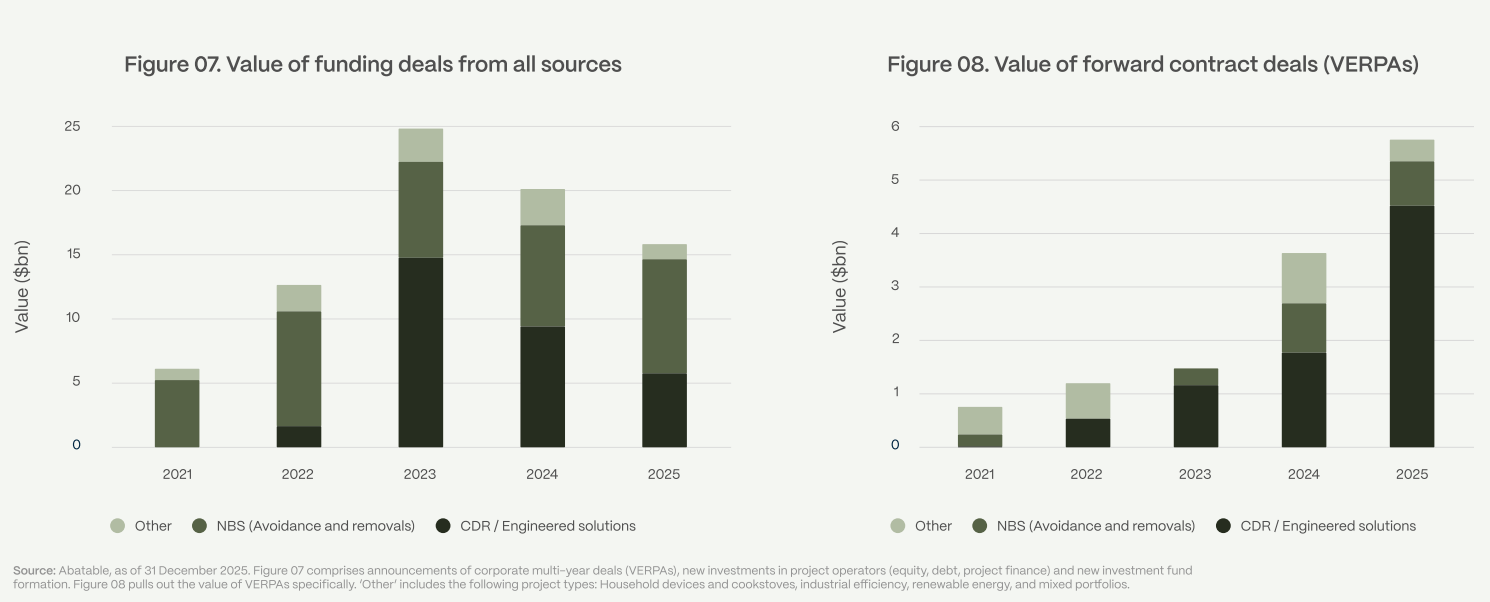
Investment also remains strong despite market volatility. Abatable estimates show that financing for carbon projects hit about $15.8 billion. This includes roughly $9 billion for nature-based projects.
At the same time, integrity standards are becoming more important.
The Integrity Council for the Voluntary Carbon Market (ICVCM) continues reviewing methodologies under its Core Carbon Principles framework. Abatable reports that over 50% of current market credits were issued using methods now under CCP review.
This quality shift is creating stronger pricing separation between premium credits and lower-rated supply.
Carbon Markets Are Starting to Resemble Financial Markets
The launch of forward vintage curves reflects a larger change happening across carbon markets. Buyers, investors, and developers increasingly want:
- Long-term price forecasts,
- Portfolio valuation tools,
- Better liquidity signals,
- Risk management systems, and
- Standardized market data.
This is pushing carbon markets closer to traditional financial market structures.
Analysts now describe carbon intelligence platforms as core infrastructure for the next phase of market growth. Companies increasingly rely on pricing analytics, ratings systems, and procurement tools to manage carbon portfolios.
Other market intelligence firms have also highlighted this shift. Sylvera recently advised companies to stop using flat “price-per-tonne” models. Instead, they should consider forward pricing based on quality, supply risks, and future demand.
The market still remains highly fragmented compared to oil or power markets. Carbon credits are not fully interchangeable because methodology and integrity differences strongly affect pricing.
Still, many analysts believe the market cannot scale efficiently without better pricing transparency and standardized data systems.
Transparency May Define the Next Phase of Carbon Markets
The voluntary carbon market is becoming more complex and more institutional. Governments continue building compliance systems. Article 6 markets under the Paris Agreement are expanding. Corporate buyers now demand stronger quality standards and long-term supply agreements.
Meanwhile, investors are funding carbon removal projects with delivery timelines stretching into the 2030s. All of these trends require more advanced pricing systems.
Abatable’s forward vintage curves library represents one of the clearest signs yet that carbon markets are evolving beyond fragmented bilateral trading into a more structured financial ecosystem.
The platform highlights a broader shift already underway: carbon markets increasingly depend on data transparency, pricing intelligence, and long-term risk management to support future growth.