


Buildings are one of the world’s biggest sources of greenhouse gas emissions. But many projects that could cut those emissions never get built because they lack funding. A new partnership hopes to change that. BEClimate has launched the BEVerify registry with Xpansiv and Quidos to connect building decarbonization projects with carbon markets.
The platform uses digital monitoring to turn verified emissions cuts into carbon assets. This can help schools, hospitals, offices, homes, and public buildings attract new investment. The launch also signals a bigger shift. Carbon markets are expanding beyond forests and renewable energy into the buildings where people live and work.
Buildings Produce More Than One-Third of Energy-Related Emissions
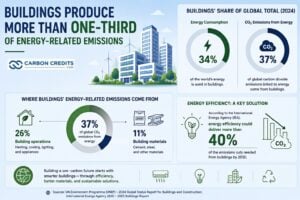
Buildings play a major role in global emissions. In 2024, buildings consumed about 34% of the world’s energy. They also produced 37% of global carbon dioxide emissions linked to energy, according to the UN Environment Programme (UNEP) and the Global Alliance for Buildings and Construction.
Building operations, such as heating, cooling, lighting, and appliances, accounted for about 26% of those emissions. Building materials like cement and steel added another 11%.
The sector is still moving too slowly. UNEP says emissions from buildings remain above pre-pandemic levels and the industry is not on track to meet global climate goals.
The challenge is clear. The World Green Building Council estimates that 80% of the buildings that will exist in 2050 have already been built. This means countries must upgrade existing buildings, not just build new green ones.
The Missing Piece Is Financing
The good news is that the technology already exists. Heat pumps, better insulation, rooftop solar, efficient lighting, and smart energy controls can greatly reduce energy use.
According to the International Energy Agency (IEA), energy efficiency could deliver more than 40% of the emissions cuts needed from buildings by 2030.
The biggest barrier is funding.
Many retrofit projects need large upfront investments. The savings from lower energy bills often take years to recover those costs. Because of this, many schools, hospitals, offices, and public buildings delay or cancel energy upgrades.
BEClimate believes carbon finance can help fill this gap. Its new BEVerify registry turns verified emissions reductions into carbon assets. This gives building owners another way to earn revenue, making more projects financially viable.
Digital Monitoring Could Transform Carbon Verification
BEVerify also aims to solve another long-standing problem: slow verification.
Many carbon projects take months before credits can be verified and issued. BEVerify uses digital Measurement, Reporting, and Verification (dMRV) to monitor building performance in real time.
The company says it has already reduced the process from months to just minutes. Every emissions reduction is supported by a full digital audit trail, making the system faster and easier to verify.

The registry runs on Xpansiv’s cloud-based market platform. It is designed to support future compliance programs, including Article 6, CORSIA, and carbon tax systems. This gives project developers a clearer path into both voluntary and compliance carbon markets.
If the model succeeds, it could unlock new investment for millions of buildings that have long been left out of carbon markets. That would help speed up emissions cuts while making building upgrades easier to finance.
Carbon Markets Move Into the Built Environment
For years, most carbon credits came from projects such as forest conservation, reforestation, renewable energy, and methane capture. Now the market is starting to expand into new sectors, including buildings.
This shift comes as buyers look for more ways to support verified emissions reductions. At the same time, governments are strengthening climate policies and raising expectations for corporate climate action.
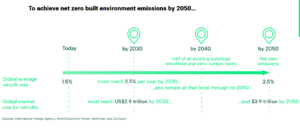
The opportunity is significant. The World Green Building Council says buildings must reduce operational emissions by 50% by 2030. They also need to achieve net zero by 2050 to meet global climate goals. Reaching those targets will require trillions of dollars in investment, $2.9 trillion in 2030 and $3.9 trillion in 2050, and much of it for upgrading existing buildings.
Carbon finance could help close part of that funding gap. A new revenue source can make retrofit projects more appealing for private and public building owners.
Digital Registries Are Reshaping Carbon Markets
The launch of BEVerify also reflects a broader shift toward digital carbon markets.
Project developers are shifting from manual reporting to digital systems. These systems offer near real-time data. This improves transparency and lowers the cost of verification.
Digital monitoring is becoming more important as carbon markets grow. New compliance systems under Article 6 of the Paris Agreement, the aviation sector’s CORSIA program, and national carbon pricing policies all require accurate and traceable emissions data.
This is where platforms like Xpansiv can play a bigger role. The company runs one of the largest environmental trading platforms worldwide. It supports transactions for carbon credits, renewable energy certificates, and other eco-friendly commodities.
- Connecting digital monitoring with digital registries can make carbon markets faster, more transparent, and easier to scale.
Buildings Could Become the Next Big Source of Carbon Credits
Buildings remain one of the world’s largest untapped sources of carbon reductions. Many schools, hospitals, offices, apartment buildings, and public facilities can cut emissions by:
- improving insulation,
- using cleaner heating systems,
- installing efficient lighting,
- adding rooftop solar, and
- implementing smart energy controls.
Many of these projects already make technical sense but struggle to secure funding.
BEVerify offers a different approach. Instead of relying only on lower energy bills, building owners may also be able to generate value from verified emissions reductions. That extra income could help more projects move from planning to construction.
For buyers, the platform provides access to carbon reductions backed by measured building performance rather than estimates. This can increase confidence as demand grows for high-integrity carbon assets.
A New Financing Model for Greener Buildings
The launch of BEVerify is about more than a new carbon registry. Carbon finance is starting to help sectors that receive less focus than forestry or renewable energy.
As countries work toward net-zero emissions, upgrading existing buildings will become one of the biggest climate challenges. Meeting that challenge will require new sources of capital alongside better technology.
By combining digital monitoring, faster verification, and carbon market infrastructure, BEClimate and Xpansiv are testing a model that could unlock investment on a much larger scale.
If it succeeds, carbon markets may no longer be limited to forests and industrial projects. They could also help finance cleaner schools, hospitals, offices, and homes—bringing building decarbonization into the next phase of climate action.