


Global companies are changing how they buy carbon credits. Instead of waiting for credits to become available, they are investing years in advance to help new projects get started. The latest example comes from Indonesia, where Google, McKinsey & Company, and Tencent have agreed to buy a combined 635,000 tonnes of nature-based carbon removal from Thryve.Earth over the next 10 years.
The deal will help restore forests in Sulawesi while giving the project the funding it needs to grow. It also shows how demand is shifting toward high-quality carbon removal projects that deliver real climate and community benefits.
Advance Carbon Deals Are Funding Tomorrow’s Climate Projects
The agreements are supported by the Symbiosis Coalition, a group formed by Google, Meta, Microsoft, and Salesforce in 2024. The coalition plans to buy up to 20 million tonnes of high-quality nature-based carbon removal by 2030. It is one of the largest buying efforts of its kind.
Under the new agreements, Google and McKinsey will buy more than 335,000 tonnes of carbon removal over 10 years, 260,000 of which is from Google. Tencent will buy another 300,000 tonnes during the same period. The deal is Tencent’s first carbon removal purchase outside of China.
The tech giant noted:
“Together with Symbiosis, we’re continuing to catalyze the highest-scale opportunities to restore natural ecosystems worldwide. It’s one element of our broader climate solutions portfolio, which also includes other breakthrough carbon removal projects and efforts to eliminate superpollutants.”
Randy Spock, Head of Carbon Removal at Google, stated in a post that it is the company’s largest carbon removal purchase so far. He further said that the project stands out for three main reasons:
- It restores degraded land,
- It supports local communities, and
- It is designed to last.
These are forward-offtake agreements. That means the companies are buying future carbon removals instead of credits that already exist. Their long-term commitments give Thryve.Earth the confidence to raise funding and begin restoring land today.

This model is becoming more common across the carbon market. Companies aim to ensure future supplies of high-quality carbon removals. They also want to help developers scale up projects.
Restoring Forests and Farms in Sulawesi
The project will restore about 6,000 hectares of degraded land in Sulawesi, one of Indonesia’s most important forest regions.
Instead of planting only one type of tree, Thryve.Earth will create an agroforestry system with several layers of crops and trees. Sugar palm and timber trees will form the upper canopy. Crops such as coffee, avocado, bananas, papaya, chili, and corn will grow underneath.
This approach removes carbon from the air while improving soil health, lowering wildfire risk, and increasing biodiversity. It also gives farmers several sources of income throughout the year instead of relying on a single crop.
Indonesia is well-suited for projects like this. The Food and Agriculture Organization (FAO) states that the country has around 92 million hectares of forest. This makes it one of the largest tropical forest nations in the world.
Ron Steinherz, Co-Founder and COO of Thryve.Earth, said:
“Turning degraded grassland back into productive forest is, above all, an operational challenge. By pairing high-quality saplings and rigorous field protocols with verifiable monitoring of every hectare, we give our partners confidence that the carbon removals and community benefits are real, measurable, and built to last.”
Thryve says the agroforestry model could grow to cover 250,000 hectares of degraded land in Indonesia and other Southeast Asian areas. That would greatly increase the region’s carbon removal potential.
Demand for Trusted Carbon Removals Is Outpacing Supply
The Sulawesi project also reflects a bigger trend in the carbon market. More companies are looking for carbon removal credits instead of traditional avoidance credits.
Carbon removal projects take carbon dioxide out of the atmosphere, making them an important tool for reaching net-zero goals.
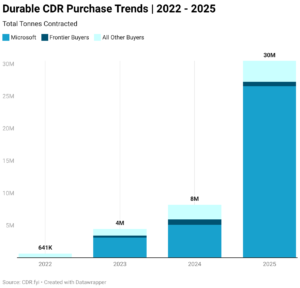
According to CDR.fyi, companies contracted more than 8 million tonnes of carbon dioxide removal in 2025, another record for the market. Nature-based projects still dominate purchases. They can be deployed on a larger scale and at a lower cost than engineered carbon removal.
Demand is also growing faster than supply. During its first global project search, the Symbiosis Coalition received 185 proposals from 40 countries. Those projects covered around 6.6 million hectares. They could remove over 180 million tonnes of carbon dioxide in the next ten years. However, only a small share met the coalition’s strict quality standards.
That gap shows why advance purchase agreements are becoming more important. They help finance the projects that buyers want, while increasing the future supply of trusted carbon removal credits.
Indonesia Is Emerging as a Carbon Removal Leader
Indonesia is becoming one of the world’s top markets for nature-based carbon removal.
The country has the third-largest area of tropical rainforest and about 14 million hectares of degraded land that could be restored, according to the World Bank. Restoring these landscapes can remove carbon, improve biodiversity, and strengthen rural livelihoods.
Nature-based solutions are also central to Indonesia’s climate strategy. Under its updated Nationally Determined Contribution (NDC), the country aims to cut greenhouse gas emissions by 31.89% on its own by 2030, or by 43.2% with international support. Forest protection and land restoration are expected to deliver much of these emissions cuts.
Projects like Thryve.Earth can help achieve these goals by bringing private investment into large-scale restoration while creating jobs and supporting local farmers.
Buyers Want Better Carbon Credits
The voluntary carbon market is also changing. Companies are getting more selective. They want carbon credits supported by solid science, dependable monitoring, and clear environmental and social benefits. This follows new guidance from various bodies:
- The Integrity Council for the Voluntary Carbon Market (ICVCM),
- The Voluntary Carbon Markets Integrity Initiative (VCMI), and
- The Science-Based Targets initiative (SBTi).
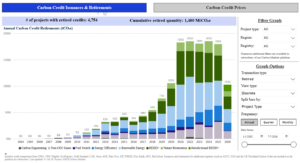
Demand for nature-based projects remains strong. According to MSCI, they accounted for about 37% of all voluntary carbon credit retirements in 2024, making them the market’s largest project type.
Long-Term Offtakes Could Shape the Next Carbon Market
Forward purchase agreements are becoming an important way to finance carbon removal.
Companies commit to buying future carbon removals instead of buying credits after projects are done. These long-term agreements give developers the confidence to restore land, attract investors, and expand projects.
Companies are signing record numbers of forward carbon removal agreements, CDR.fyi says. This is happening as competition increases for a limited supply of high-quality credits.
For communities, the benefits go beyond carbon. The Sulawesi project will create jobs and improve soil health. It will also reduce wildfire risk, boost biodiversity, and give farmers income from fruit, timber, and food crops. These added benefits help ensure the restored landscapes remain productive over the long term.
A New Model for Scaling Carbon Removal
The Thryve.Earth agreements represent more than 635,000 tonnes of future carbon removal. They show how the carbon market is evolving.
Large companies are moving beyond one-time carbon credit purchases and helping finance projects before they begin. This gives developers the certainty needed to scale restoration while securing future carbon removals for buyers.
Companies aiming for net-zero goals will likely see more investment in projects that merge carbon removal, protect biodiversity, and benefit communities. The latest commitments from Google, McKinsey, Tencent, and the Symbiosis Coalition suggest this shift is already underway.