

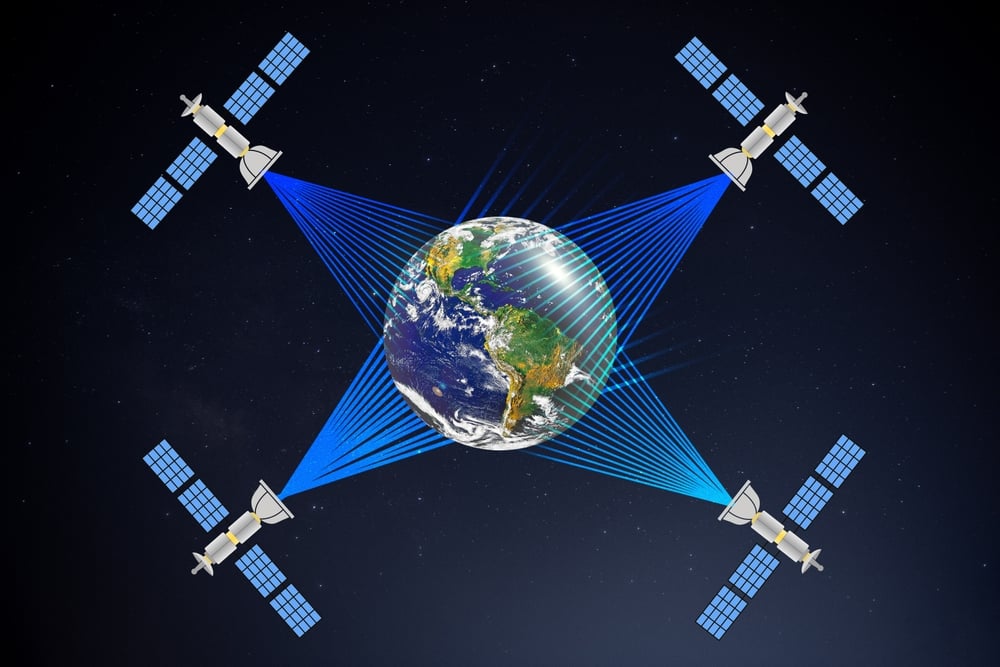
The U.S. Department of War is putting new money behind a technology that could change how solar power reaches the ground: beaming electricity from space. Virginia-based startup Overview Energy received a contract through the Department of War’s Operational Energy Capability Improvement Fund (OECIF). The company will design, build, and test a ground-based homing beacon for its planned space solar system.
The contract value was not disclosed.
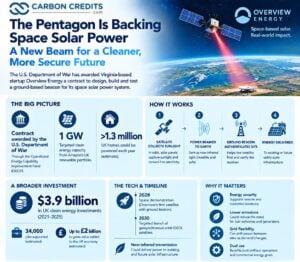
The beacon is a key part of Overview’s plan. It would allow satellites to identify and authenticate receiving sites on Earth before sending power to them. The company says its satellites will collect sunlight in orbit and convert it into a safe, invisible beam of near-infrared light. It plans to test the system in space in 2028, with its first geosynchronous-orbit satellites targeted for deployment from 2030.
The Pentagon Wants Solar Power Without Fuel Convoys
The project comes as solar power is already expanding at record speed on Earth. The International Energy Agency (IEA) says solar PV additions topped 600 GW in 2025, while total renewable capacity additions reached 800 GW.
Now, U.S. energy and defense agencies are exploring whether some of that growth can move beyond the planet.
Remote military bases can depend on fuel deliveries to keep generators running. Those supply lines can be expensive, difficult to protect, and vulnerable in conflict zones. Space-based solar power could offer another option.
Overview says its system could send power to remote or contested locations without regular fuel shipments. Satellites could also shift power between receiving sites as demand changes. That makes the technology especially interesting for military operations where reliable energy is difficult to provide.
The OECIF program is designed to support advanced technologies before they reach commercial use. The program works with military users to test new energy systems under real operational requirements.
Overview Energy is not starting from scratch. In May, the Air Force awarded the company a separate contract to study how space-based solar power could support military operations in constrained and contested logistics environments.
The latest contract focuses on a smaller but critical piece of the system: making sure the power beam reaches the right place.
A Beacon Will Tell Satellites Where to Send Power
The homing beacon would be installed at a receiving site on the ground. A satellite would use the beacon to locate the site and establish a secure connection before sending power. The system requires an active and authenticated beacon before transmission begins, according to Overview.
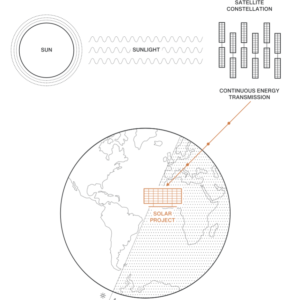
That security feature is important because a power beam cannot simply be pointed toward a general area. The satellite needs to know exactly where the receiver is and confirm that it is an authorized destination.
Overview plans to use near-infrared light to transmit the energy. The company says this approach would allow its satellites to deliver power to existing and future utility-scale solar infrastructure.
The system is designed around satellites in geosynchronous orbit (GEO). At that altitude, a satellite can remain aligned with the same area of Earth as the planet rotates.
Overview says this could allow its satellites to collect sunlight continuously rather than only when solar panels on the ground are exposed to sunlight. The company has already demonstrated power beaming from a moving airborne platform, testing the tracking and pointing technology that will be needed for its orbital system.
Overview Targets a 2028 Space Demonstration
The next major milestone is the company’s planned 2028 space demonstration. Overview plans to integrate the Pentagon-funded beacon into its first satellite. The company then expects to use the ground hardware as part of a larger GEO constellation targeted for deployment beginning in 2030.
These are company targets, not confirmed commercial launch dates. The 2028 test will matter because the full space-to-ground system has not yet been proven in orbit.
Several questions remain, however. The system must show that it can maintain a precise connection over the long distance between orbit and Earth. It must also demonstrate acceptable conversion and transmission efficiency while meeting safety requirements.
Launch costs are another major issue. Space-based solar systems require large structures and power-generation equipment to be placed in orbit. The economics will depend heavily on how cheaply those systems can be manufactured, launched, and maintained.
Overview has also attracted commercial interest. In April 2026, the company reached an agreement with Meta that gives the company early access to up to 1 GW of planned capacity. Overview expects commercial power delivery around 2030, although that timeline remains a company goal.
The US Is Funding Multiple Space Solar Approaches
Overview is part of a wider U.S. push into space-based energy. Another company, Katalyst Space, received an OECIF award in September to develop and launch robotic spacecraft that could assemble a large power-beaming system in orbit and transmit electricity back to Earth.
Its approach is different. Katalyst plans to use microwaves, while Overview is developing near-infrared transmission.
The Air Force Research Laboratory has also spent years studying space solar power. Its Space Solar Power Incremental Demonstrations and Research Project, or SSPIDR, is examining how satellites could collect sunlight, convert it to radio-frequency energy, and transmit it to ground-based receiving antennas.
The Arachne flight experiment is a major part of that work. It is designed to test solar power generation, beamforming, and wireless power transmission.
DARPA is separately developing technologies for airborne optical power transmission that could create more flexible wireless energy networks.
Together, these programs show that space-based power is moving beyond a purely theoretical idea. Yet, the technology remains at the demonstration stage.
Space Solar Is Arriving as Earth Solar Hits Records
The interest comes at a time when solar power is already dominating new renewable energy growth. The IEA says global renewable capacity additions reached 800 GW in 2025, up 16% from the previous year. It was the 23rd consecutive year of record renewable expansion.
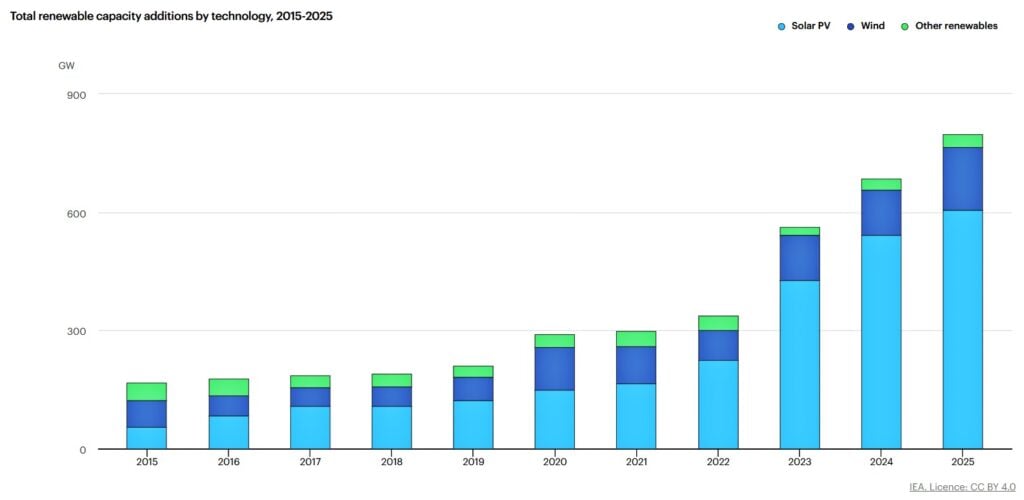
Solar PV made up more than three-quarters of those additions. More than 600 GW of solar capacity was added globally, taking total installed solar PV capacity to about 2,800 GW.
China remains the biggest driver. It added nearly 500 GW of renewable capacity in 2025, including about 370 GW of solar and 117 GW of wind.
The IEA expects renewable power capacity to grow by another 4,600 GW between 2025 and 2030, with solar PV accounting for nearly 80% of that increase. But conventional solar still faces limits.
Solar panels on Earth do not generate power at night, and their output can drop because of clouds, weather, and seasonal changes. Grid bottlenecks are also becoming a bigger problem as more renewable projects seek connections.
The IEA has identified more than 2,500 GW of renewable, storage, and large-load projects waiting in grid queues worldwide. Space solar is being developed partly as a way to overcome some of those limits.
From Climate Technology to Energy Security
Space solar power is not yet a proven low-cost alternative to conventional solar. For now, its strongest case may be energy security.
The Pentagon is interested in whether space-based power can provide electricity to locations where fuel deliveries are difficult or dangerous. At the same time, commercial companies see potential for supplying electricity to grids without building an entirely new ground-based power network.
That dual-use potential is helping attract government funding.
The climate benefits could become important if space solar eventually replaces fossil-fuel generation or reduces the need for diesel generators at remote facilities. But that outcome remains unproven.
For now, the key milestone is much simpler: can a satellite safely and efficiently send usable power to Earth? Overview’s 2028 demonstration should provide the first major answer.
If it works, space solar could move from a long-running science project toward a real energy technology. If it fails, the industry will gain valuable data on what still needs to change. Either way, the Pentagon’s latest investment shows that the race to expand solar power is no longer limited to the ground.