


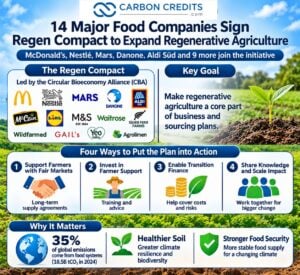
Fourteen major food companies and retailers, including McDonald’s, Nestlé, Mars, Danone, and Aldi Süd, have signed a new agreement to expand regenerative agriculture. The initiative aims to improve soil health, support farmers, and strengthen food supply chains against climate change.
The Regen Compact, announced on November 17, 2026, brings together businesses from across the food industry. Other signatories include McCain Foods, Lidl GB, Marks & Spencer, Waitrose, Silver Fern Farms, Wildfarmed, Gail’s, Yeo Valley and Agrolimen.
Led by the Circular Bioeconomy Alliance (CBA), the agreement asks companies to make regenerative agriculture part of their core business and sourcing plans. It supports farming methods that reduce soil disturbance and chemical use, protect biodiversity and improve natural carbon storage.
However, the compact does not set new targets or require all companies to use the same farming methods. Each signatory can choose actions that fit its business, suppliers and local farming conditions.
The agreement comes as food companies face rising costs, extreme weather and pressure to reduce their environmental impact. Its main test will be whether these voluntary commitments lead to real changes on farms.
Food Systems Face Growing Climate Risks
The compact describes regenerative agriculture as both an economic and food security priority. Farming depends on healthy soil, clean water, and stable weather. But climate change and nature loss are putting these resources under growing pressure.
The Food and Agriculture Organization (FAO) estimates that global agrifood systems produced 18.5 billion tonnes of CO2 equivalent in 2024. This equals about 35% of all global emissions. This includes emissions from farming, land use, food processing, transport, retail and waste.
The compact also highlights the financial cost of extreme weather. EU agriculture loses an average of €28 billion each year due to adverse weather. Heat and drought from climate change led to about $400 billion in losses for maize, wheat, and soybeans worldwide from 2000 to 2019.
Higher fertilizer prices add to the pressure on farmers. Rising costs can reduce farm profits, while extreme weather threatens harvests and food supplies.
Regenerative agriculture aims to reduce some of these risks. It focuses on improving soil health, using fewer synthetic inputs, protecting biodiversity, and making better use of water. Common practices include no-till or reduced-tillage farming, cover crops, and crop diversification.
The compact also stresses that there is no single method for every farm. The right approach depends on local soil, climate, crops, and economic conditions.
Four Ways Food Companies Can Help Farmers Go Regenerative
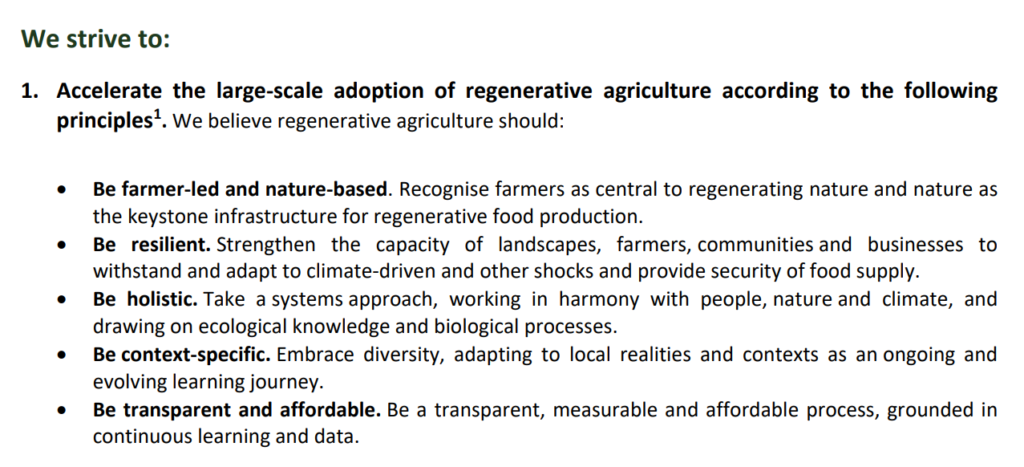
The agreement sets out five main principles. Regenerative agriculture should be farmer-led, nature-based, resilient, holistic and suited to local conditions. It should also be affordable and supported by clear data.
To put these principles into practice, the signatories identify four areas of action.
- First, companies should give farmers more reliable markets. This could include long-term supply agreements with farmers who use regenerative methods. Companies can also include regenerative farming practices in their own sourcing decisions.
- Second, businesses should invest directly in farmer support. This includes training, farm advice, peer-learning groups, and other services that help producers change their methods. The compact says this support should reflect farmers’ needs and should not be tied to selling more farm inputs.
- Third, companies should work with banks, lenders, investors and insurers to develop transition finance. This could help farmers cover the cost and manage the risks of changing their farming practices.
- Fourth, signatories should work with farmers, researchers, governments and other businesses to share knowledge and support larger projects. The goal is to improve farming across whole landscapes, rather than focus only on individual farms.
The compact also proposes using the CBA’s Living Labs model. These projects can provide shared tools, open-access farm data and public plans for landscape-level changes. They will focus on non-commercial work and will not share sensitive business information.
Nestlé, Mars and McDonald’s Have Existing Programs
Several signatories already support regenerative agriculture through their supply chains. These programs show how companies could put the compact’s ideas into practice. However, they were already underway and are not new targets created by the agreement.
Nestlé reported that 20.7% of its key ingredient volumes came from farmers using regenerative agriculture practices in 2025. The company aims to raise this share to 50% by 2030. Its work covers ingredients such as dairy, coffee, cocoa, cereals and grains.
Nestlé also updated how it calculates this figure in 2026, converting ingredient volumes back to their original fresh state. This means the number may differ from its original 2025 report.
Mars supported around 77 climate-smart agriculture projects in 26 countries and across 12 crops in 2025. Its programs include regenerative farming, farmer training, and efforts to make crops more resilient to climate risks.
McDonald’s also supports farming and grassland projects. Its Grassland Resilience and Conservation Initiative in the United States aims to affect 4 million acres of grazing land by 2032. The program links better land management with grassland protection and stronger livestock supply chains.
These examples show that some companies already have experience with regenerative farming. The compact aims to build on this work and encourage wider action across the food industry.
Annual Reports Will Track Progress Without New Mandatory Targets
The compact includes a process to track progress, but it does not create a new mandatory reporting system. Starting in 2027, signatories will share their existing reports and public disclosures with the compact’s Secretariat each year. The Secretariat will use these materials and other public information to prepare an annual summary.
It will also review the standards and systems companies use to measure regenerative agriculture. However, it will not rank or score individual companies. Signatories can keep using their current measurement systems, and they do not have to collect new data for the compact.
The CBA will be led by the Secretariat, with the European Alliance for Regenerative Agriculture as an adviser and lead on benchmarking. The Secretariat will also bring signatories together and support joint projects.
The compact aims to keep reporting simple for farmers and companies. It says data should be collected once and reused where possible, instead of creating extra paperwork.
Still, the lack of new company-specific targets makes it harder to measure how quickly each signatory will act. The annual summaries may show progress, but they will not provide a common scorecard for individual businesses.
FAIRR Finds Gaps in Corporate Commitments, But Outlook Is Strong
The Regen Compact comes as investors call for stronger proof that companies’ regenerative agriculture programs deliver results. A June 2026 report by investor network FAIRR assessed 78 listed food and agriculture companies. It found that only 28% had set measurable regenerative agriculture targets, down from 35% in 2023.
The report also found that 40% of companies provided financial support to farmers using regenerative methods. But this spending was only 0.01% to 0.05% of company revenue. No company in the assessment had set a specific pesticide-reduction target as part of its regenerative agriculture program.
There was some progress in measuring results. FAIRR found that 54% of companies measured regenerative agriculture outcomes or had systems in place to do so, up from 16% in 2023. Yet, only 4% had set targets based on these outcomes.
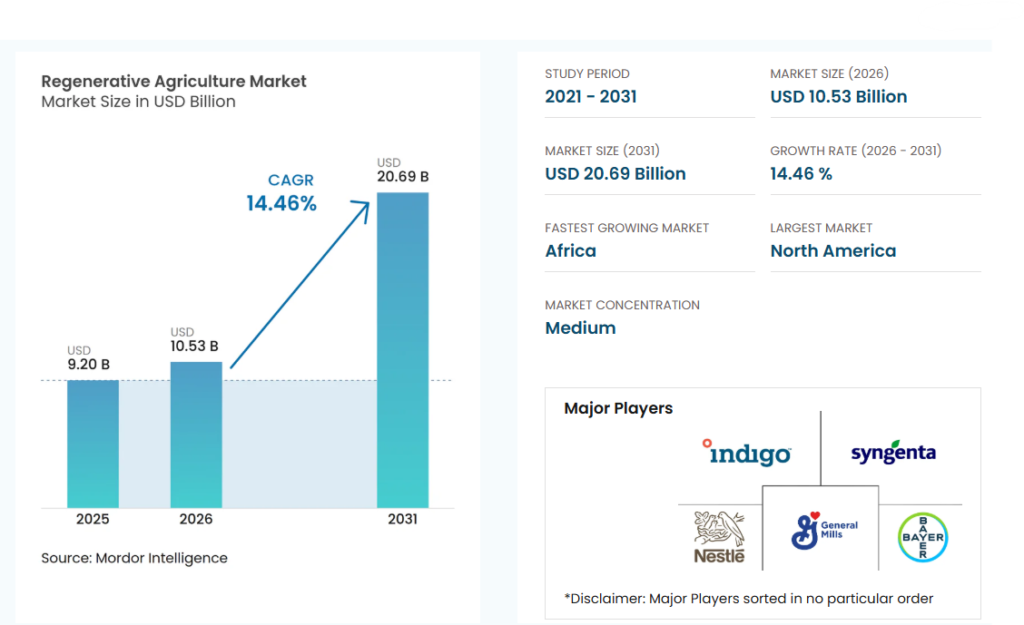
Despite lagging corporate accountability, the regenerative agriculture outlook remains expansive, and market momentum is accelerating. Mordor Intelligence projects the global regenerative agriculture market will grow from $10 billion in 2026 to $20 billion by 2031. Driven by Scope 3 emissions pledges and policies like the EU Nature Restoration Law, FAIRR estimates $1.4 trillion in business opportunities by 2030.
According to the November 2026 Action Agenda on Regenerative Landscapes survey, over 40 major companies have committed $6.4 billion to transition nearly 100 million hectares and 9.5 million farmers by 2030. Of this, 66 million hectares are already in active programs.
The Regen Compact offers a way for major food businesses to work toward industry goals. Long-term supply deals, farmer training and access to finance could help more farmers make the change. However, the real impact will depend on how much support reaches farms and whether companies expand their programs.
The agreement is a step toward wider use of regenerative agriculture across food supply chains. Its first annual progress summary, following the start of reporting in 2027, should offer an early look at whether the signatories are turning their shared goals into action.