

German energy company Uniper plans to invest around €6 billion in new projects through the early 2030s, with most of the money going toward gas-fired power plants and data center development. The plan comes as Europe faces rising electricity demand, growing investment in artificial intelligence (AI) infrastructure, and pressure to secure reliable power supplies.
Uniper announced the investment program at its Capital Markets Day in London on November 16. It expects the projects to strengthen earnings and support its role in Europe’s changing energy system.
However, the plan also raises questions about the company’s climate goals, especially its commitment to reach carbon neutrality across its value chain by 2040. Uniper’s latest Sustainability Report shows that its direct emissions fell last year.
Still, emissions from the company’s wider business remain substantial, particularly those linked to natural gas sales and trading. Its new investment priorities will test how quickly it can expand cleaner energy while continuing to rely on gas.
Uniper Sets Out €6 Billion Growth Investment Plan
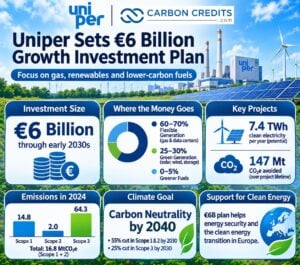
Uniper expects to invest around €6 billion in growth projects through the early 2030s. The program focuses on three business areas: flexible power generation, renewable energy and lower-carbon fuels.
The largest share, around 60% to 70%, will go to its Flexible Generation business. This includes building new gas-fired power plants and converting existing sites for data center development. Based on the planned budget, this could represent approximately €3.6 billion to €4.2 billion.
Uniper sees gas plants as important for balancing electricity supply when wind and solar output is low. The company expects demand for flexible power to rise as Europe adds more renewable energy and electrifies more industries.
Data centers are another major growth opportunity. Uniper said it has already secured around 700 megawatts (MW) of grid capacity for projects in advanced development. The potential sites are in Germany, the United Kingdom, the Netherlands and Sweden. Three projects have reached an advanced stage, although the company has not disclosed their locations or full details.
Uniper could sell or lease existing sites to data center developers or provide power agreements to operators. Its existing land and grid connections may help developers avoid some of the delays involved in securing new connections.
The company will allocate another 25% to 30% of its growth budget to Green Generation. This covers solar power, onshore wind, battery storage and pumped-storage hydropower. A smaller share of around 0% to 5% will support selected projects involving greener fuels and infrastructure.
Uniper said it has already committed around €1.3 billion to growth investments since 2023, with more than 20 projects in development or execution. Michael Lewis, Chief Executive Officer of Uniper, noted:
“Uniper enters its next phase from a position of strength. We have a high-quality asset base at the heart of Europe’s energy system, and our existing portfolio is already delivering earnings growth. Every beat of our strategy seeks to unlock value: by investing selectively and strengthening the quality of our earnings, we aim to create long-term value for shareholders while continuing to play a leading role in security of supply and the energy transition.”
New Gas Plants Will Support Europe’s Power Demand
Gas-fired generation will remain central to Uniper’s investment strategy. The company expects European electricity demand to increase as transport, heating and industry shift toward electricity. Data centers and AI services are also adding to power needs.
Gas plants can provide electricity when renewable generation falls, or demand rises. This flexibility can help support grid stability, but burning natural gas still releases carbon dioxide.
Uniper’s November investment presentation lists two major gas-fired combined-cycle power plant projects in Germany: Staudinger, with a planned capacity of around 860 MW, and Scholven, at around 870 MW. Together, they represent approximately 1.73 GW of potential generation capacity.
The company also plans to expand renewable power and storage. The project pipeline has about 570 MW of solar and onshore wind projects in Europe and the UK. It also includes the revitalization of the 160 MW Happurg pumped-storage plant in Germany. Additionally, there’s around 50 MW of new hydropower capacity along Sweden’s Ume River.
These projects show that Uniper is not directing all its growth spending toward fossil fuels. However, the planned allocation makes clear that gas and flexible generation will receive the largest share of new investment.
Uniper’s Carbon Emissions Fell Between 2022 and 2024
Uniper’s Climate Transition Plan 2025 shows that its greenhouse gas emissions declined between 2022 and 2024, mainly due to lower coal-fired power generation and reduced coal trading activities.
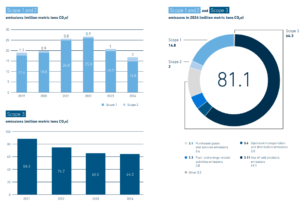
- In 2024, the company reported 14.8 million tonnes of CO2 equivalent (MtCO2e) in Scope 1 emissions, down from 19.7 MtCO2e in 2023.
- Scope 2 emissions from purchased electricity and energy were 2.0 MtCO2e, bringing combined Scope 1 and 2 emissions to 16.8 MtCO2e.
- Scope 3 emissions also declined, falling from 65.5 MtCO2e in 2023 to 64.3 MtCO2e in 2024. However, they remain the largest part of Uniper’s reported carbon footprint.
Emissions from the use of sold products reached 49.1 MtCO2e, mainly linked to the natural gas and other fuels the company sells. Other sources included purchased goods and services at 8.4 MtCO2e and fuel- and energy-related activities at 3.8 MtCO2e.
Uniper said lower coal-fired generation and the closure of coal plants helped reduce Scope 1 emissions. The company also reduced coal trading volumes and ended some trading activities with external parties, contributing to the Scope 3 decline.
By 2024, Uniper’s Scope 1 emissions were 41.9% lower than in 2021, while its carbon intensity from electricity and heat generation had fallen 27.8% over the same period. The company also reported that ending its third-party coal business removed around 5 million tonnes of annual Scope 3 emissions from its portfolio. These figures reflect changes in its business activities as well as operational progress.
Uniper Targets Carbon Neutrality by 2040
The German energy giant aims to achieve carbon neutrality across its Scope 1, 2 and 3 emissions by 2040. However, its Climate Transition Plan states that this goal includes compensation measures, to the extent economically viable.
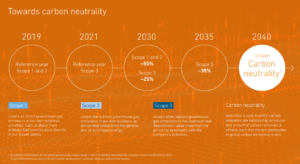
It also says Scope 1 and 2 emissions will move toward neutrality within the EU Emissions Trading System, while Scope 3 reductions will depend partly on market developments, customer behavior and government policies.
The company has established several interim targets:
- Scope 1 and 2: Cut absolute emissions by at least 55% by 2030, compared with a 2019 baseline.
- Scope 3: Reduce absolute emissions by 25% by 2030 and 35% by 2035, compared with a 2021 baseline.
- Coal phase-out: End commercial coal-fired power generation by 2029.
Uniper plans to reduce direct emissions by closing its remaining commercial coal-fired power plants, expanding renewable energy and converting parts of its gas-fired fleet to hydrogen, biofuels or carbon capture technologies. The company estimates that phasing out its remaining 2.1 GW of commercial coal capacity could cut annual Scope 1 emissions by up to 9.5 million tonnes of CO2e compared with its 2019 baseline.
For Scope 3, Uniper plans to expand its portfolio of biomethane, hydrogen and other lower-carbon fuels. It targets a 5% to 10% share of renewable and low-carbon fuels in its gas sales portfolio by 2030. It also aims to develop around 8 GW of ready-to-build solar and onshore wind projects in Europe.
Uniper acknowledges that reducing Scope 3 emissions will depend on factors beyond its direct control, including customer demand, the development of hydrogen markets and the pace of Europe’s energy transition. Its 2040 goal, therefore, depends on both actual emissions reductions and credible compensation for remaining emissions.
Gas Investment Creates a Challenge for Uniper’s Climate Goals
Uniper’s investment plan highlights the difficult balance between energy security, growing electricity demand and emissions reduction.
New gas plants can provide flexible power when wind and solar output is low. They may also support the expansion of data centers and other electricity-intensive industries. Yet, their climate impact will depend on how often they operate, what fuels they use, and whether they can be converted to lower-carbon technologies.
Uniper’s own 2025 report recognizes that additional measures may be needed to meet its Scope 1 and 2 targets if new carbon-emitting assets enter service or existing fossil fuel plants operate more often than expected.
The company’s investment plan also places a smaller share of its growth budget into renewable energy than into flexible generation. This does not mean its renewable projects will stop growing, but it shows where most of its new capital is expected to go. Its 2040 target remains in place, but the €6 billion investment program will test how well Uniper can balance new business growth with its climate commitments.