

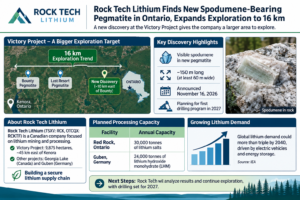
Rock Tech Lithium Inc. (TSXV: RCK) (OTCQX: RCKTF) has discovered a new lithium-bearing rock formation at its Victory Lithium Project in northwestern Ontario, Canada. The discovery extends the project’s known lithium exploration trend from approximately 6 kilometers to 16 kilometers, giving the company a larger area to explore.
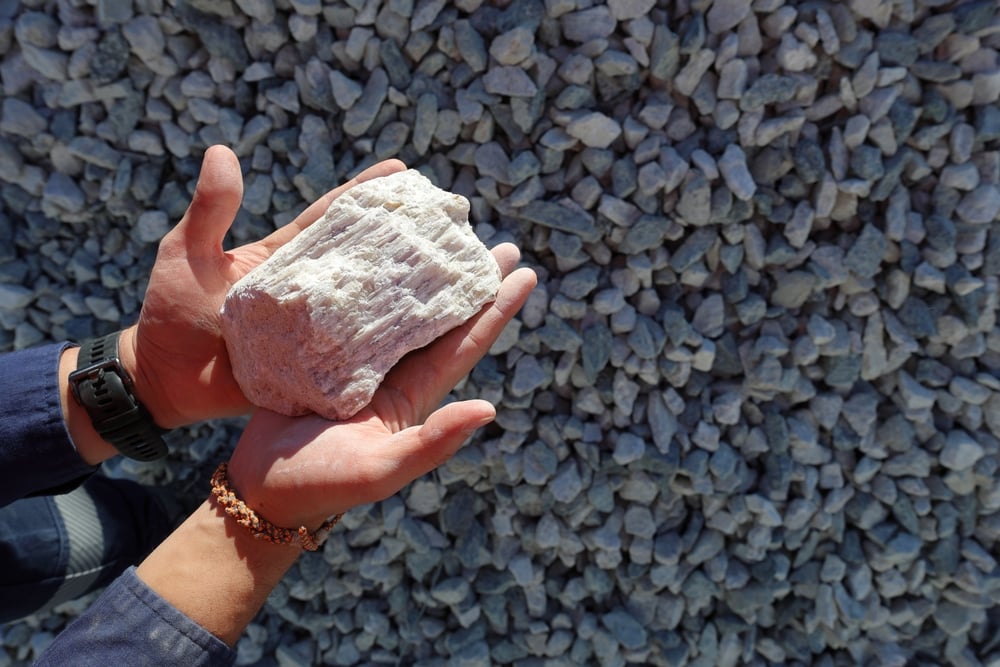
The new discovery contains visible spodumene, a mineral used to produce lithium for electric vehicle (EV) batteries and energy storage systems. Rock Tech identified the pegmatite about 10 kilometers east of its previously known Bounty Pegmatite.
The company announced the discovery on November 16, 2026. It plans to study the new area further and use the results to prepare for its first drilling program at Victory in 2027.
Rock Tech Finds New Spodumene-Bearing Pegmatite at Victory
Rock Tech identified the new pegmatite during its 2026 exploration program. The exposed rock formation measures approximately 150 meters along strike and at least 60 meters across.
The company also used handheld Laser-Induced Breakdown Spectroscopy (LIBS) equipment to check selected crystals for lithium. The initial tests detected lithium, supporting the team’s geological observations.
However, these readings are preliminary. Laboratory tests will provide more reliable information about the lithium content and quality of the mineralization.
Rock Tech has sent samples to Activation Laboratories (Actlabs) in Thunder Bay, Ontario. The laboratory will test the samples for lithium oxide (Li₂O) content and other elements commonly found in lithium-cesium-tantalum (LCT) pegmatites.
These results will help the company understand the mineral composition of the discovery and decide where to focus its next exploration activities.
The Victory Project now has three known spodumene-bearing pegmatite areas:
- Bounty: A previously identified pegmatite and an important exploration target.
- Last Resort: Another known lithium-bearing pegmatite occurrence.
- New discovery: A recently identified pegmatite located approximately 10 kilometers east of Bounty.
The expanded 16-kilometer trend connects the wider exploration area, but it does not mean that lithium mineralization extends continuously across the entire distance. Rock Tech still needs drilling and further testing to establish the size, grade and continuity of the mineralization.
Victory Project Adds to Rock Tech’s Canadian Lithium Portfolio
Rock Tech Lithium is a Canadian company focused on developing lithium resources and processing facilities. Its strategy covers both lithium mining and conversion, which involves turning raw lithium materials into chemicals used in battery production.
The Victory Project covers approximately 9,875 hectares and lies around 45 kilometers east of Kenora, Ontario. Rock Tech secured an option to acquire 100% of the property in June 2026.
The location also offers access to important infrastructure that could support future development.
Key advantages include:
- Access to the Trans-Canada Highway.
- Nearby railway connections for transporting materials.
- Access to electricity transmission lines.
- A natural gas pipeline in the surrounding region.
Rock Tech is exploring Victory as a possible additional source of lithium feedstock for its planned Red Rock Converter in Ontario.
The company also owns the Georgia Lake lithium project in Canada. In Europe, it is developing the Guben lithium converter in Germany.
Rock Tech has outlined the following annual production targets for its processing facilities:

These facilities form part of the company’s plan to supply lithium products to battery manufacturers and the growing EV market in North America and Europe.
However, Victory remains at an early exploration stage. The company must complete further studies and establish the project’s resource potential before it can determine whether the property can support commercial mining.
Rising Lithium Demand Supports New Exploration
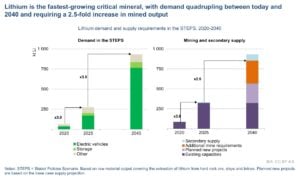
The discovery comes as lithium demand continues to grow. EV manufacturing remains the biggest driver, while battery energy storage systems are creating another important source of demand.
As countries expand renewable energy capacity, utilities need larger battery systems to store electricity and manage changes in power supply. This trend could increase demand for lithium-based batteries over the coming years.
According to the International Energy Agency (IEA), global lithium demand could increase more than threefold between 2025 and 2040 under its Stated Policies Scenario.
Meanwhile, lithium production has also increased as miners expand existing operations and bring new projects online.
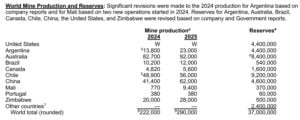
- The U.S. Geological Survey (USGS) estimates that global lithium mine production, excluding U.S. output, reached approximately 290,000 metric tons in 2025. This was a 31% increase from the previous year.
Despite this growth, the industry needs more investment in mining and processing capacity to meet future demand. New projects will also help diversify supply, which remains concentrated in a limited number of countries.
Canada is looking to develop its critical minerals sector to support domestic battery manufacturing and reduce reliance on imported raw materials. Ontario could play an important role because of its mining industry, industrial infrastructure and proximity to North American automakers.
For Rock Tech, developing Canadian lithium resources could strengthen its plans to connect mining operations with processing facilities.
Rock Tech Targets First Victory Drilling Program in 2027
Rock Tech will continue geological mapping and sampling across the Victory Project. Laboratory results should provide more information about the newly discovered pegmatite and help the company select drilling locations.
The planned 2027 drilling program will be an important milestone. It could help determine whether the new discovery contains lithium mineralization at depth and whether it can support future development.
For now, the discovery expands Rock Tech’s exploration opportunities in Ontario. Further testing and drilling will determine whether that potential can translate into a commercially viable lithium resource.