


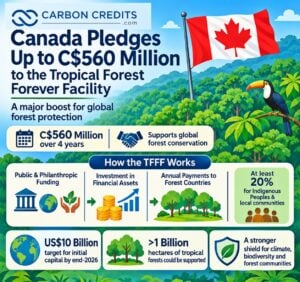
Canada has pledged up to C$560 million over four years to the Tropical Forest Forever Facility (TFFF), a global fund designed to reward countries for protecting tropical forests. Prime Minister Mark Carney announced the commitment on November 15, 2026, during the ASEAN Summit in Manila, following a meeting with Brazilian President Luiz Inácio Lula da Silva.
The pledge adds to growing international support for the facility, which aims to use public and private investment to provide long-term funding for forest protection. The decision comes as tropical forest loss remains a major source of greenhouse gas emissions and a threat to biodiversity.
Prime Minister Mark Carney posted on X:
“Canadians understand our responsibility to protect nature – both in our own backyard and around the world. Today, with President @LulaOfficial, I announced that Canada is putting half a billion dollars behind Brazil’s landmark rainforest conservation initiative to protect some of the most important ecosystems on earth.”
Canada Commits Up to C$560 Million to Forest Protection
Canada’s contribution will take the form of a loan provided over four years. It will come from the country’s existing international climate finance budget, managed by Global Affairs Canada. This means it is not a new grant or a separate additional budget allocation.
The commitment supports Canada’s wider goal of providing more than C$13 billion in climate-related finance to developing countries by 2031. The funding is intended to support climate action and help vulnerable countries protect nature and respond to climate change.
Canada’s pledge represents a maximum loan commitment, not money already paid to the facility. However, it adds to the TFFF’s growing pool of government support and could help attract more private investment.
How the Tropical Forest Forever Facility Works
Brazil launched the TFFF at COP30 in Belém in November 2025, with Norway as a co-leader. The facility aims to reward countries for keeping their tropical forests standing.
- Once fully operational, it plans to support more than 1 billion hectares of tropical forests across more than 70 countries.
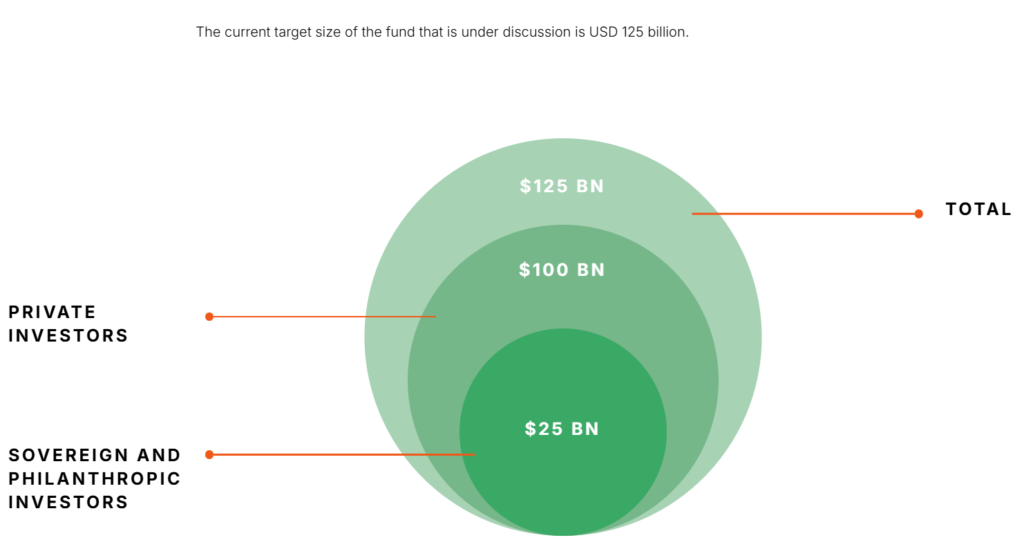
The TFFF uses an investment-based model. Governments and other sponsors provide capital to attract private investors. The facility then invests the money in a diversified portfolio of financial assets.
Investment returns will fund annual payments to eligible tropical forest countries. These payments will depend on verified forest cover and conservation results. Countries that maintain their forests can receive payments, while deforestation and forest degradation can lead to deductions.
National forest monitoring systems and satellite data will help track forest conditions and verify results.
At least 20% of payments must go to Indigenous Peoples and local communities. This requirement recognizes their role in protecting forests and aims to ensure that conservation funding reaches the people who depend on these ecosystems.
TFFF Seeks US$10 Billion in Initial Capital to Attract Private Investment
The TFFF aims to raise US$10 billion in initial sponsor capital by the end of 2026. Its wider financing model seeks to use public and philanthropic funding to attract much larger private investment.
Under the latest target outlined by the Canadian government, US35 billion in sponsor contributions could help mobilize up to US$140 billion in private investment. Returns from these investments would then support payments to countries that meet the facility’s forest protection requirements.
Several countries have already announced commitments. These include US$3 billion from Norway, US$1 billion each from Brazil and Indonesia, €1 billion from Germany, €500 million from France, and £400 million from the United Kingdom.
The Netherlands also pledged up to US$500 million over 10 years in October 2026. These are announced commitments, not necessarily funds already received or invested.
Private foundations are also supporting the initiative. A coalition of philanthropic groups announced plans to commit about US$88 million, while the Minderoo Foundation increased its commitment to US15 million.
Before Canada’s announcement, the TFFF still faced a reported US$2.1 billion gap toward its initial US$ 10 billion target. Canada’s pledge could help close part of that gap, but the facility still needs to secure the remaining capital.
The World Bank will serve as trustee of the TFFF’s Financial Intermediary Fund and host its interim secretariat. Luxembourg will host the investment arm, known as the Tropical Forest Investment Fund.
Tropical Forest Loss Remains a Major Climate Risk
The TFFF comes as tropical forests continue to face pressure from agriculture, logging, fires, and other land-use changes.
According to the World Resources Institute (WRI), the world lost 4.3 million hectares of tropical primary rainforest in 2025. This was 36% less than in 2024 but still 46% higher than the level recorded a decade earlier. The loss was equal to about 11 football fields every minute.
In 2024, tropical primary forest loss reached 6.7 million hectares and caused an estimated 3.1 billion tonnes of greenhouse gas emissions, WRI reported. Tropical forests are important carbon sinks. They absorb and store carbon dioxide while helping regulate rainfall, protect soils, and support biodiversity.
The TFFF’s supporters estimate that tropical forests absorb around 7 billion tonnes of carbon dioxide each year. They also provide food, water, and fuel for about 1.2 billion people.
Continued forest loss, therefore, threatens both climate goals and the livelihoods of communities that depend on these ecosystems.
- RELATED: Canada and Saudi Arabia Sign $1 Billion in Deals to Boost Clean Energy, Mining, and AI Partnership
How TFFF Differs From Carbon Credit Markets
The TFFF is designed to complement existing carbon markets, not replace them. It does not issue carbon credits or biodiversity credits, operate as an offset program, or directly finance individual forest projects.
Instead, it provides payments to countries based on their forest protection results. This differs from programs that generate carbon credits from measured emissions reductions or carbon removals.
For example, REDD+ programs can generate credits from activities that reduce emissions caused by deforestation and forest degradation. These credits may then be sold to governments or companies.
The TFFF takes a broader approach. Its payments are linked to forest protection at the national level rather than the sale of individual credits.
This distinction is important. The facility is not designed to create another source of carbon offsets. Its goal is to make standing forests financially valuable to the countries that protect them.
The model could also help address a major challenge in forest conservation. Many countries face strong economic pressure to convert forests into farmland, plantations, or other commercial uses.
Indigenous Communities and Forest Countries at the Center
The TFFF’s requirement to direct at least 20% of payments to Indigenous Peoples and local communities is a key part of its design.
Indigenous communities have long called for greater access to climate finance and stronger recognition of their land rights. Yet, funding often fails to reach them because of complex rules, limited access to financial systems, and weak benefit-sharing arrangements.
The TFFF’s payment requirement could help address this gap. However, its impact will depend on how countries distribute the money and involve communities in decisions. The facility will also need clear rules to measure forest protection, verify results, and prevent deforestation from simply moving to other areas.
TFFF Faces Funding and Implementation Challenges Ahead of Launch
Canada’s pledge adds momentum to the TFFF as it works toward its initial fundraising target. Its investment model offers a different way to fund forest conservation by using financial returns to support long-term payments.
However, major challenges remain. The facility must secure enough sponsor capital, attract private investors, and build a reliable system to monitor forests across many countries.
It must also ensure that payments reach the communities responsible for protecting these ecosystems. Transparent reporting and strong safeguards will be important to maintain trust among governments, investors, and local groups.
The TFFF cannot replace the need to cut fossil fuel emissions or address the main causes of deforestation. But it could give tropical countries a more reliable financial reason to keep their forests standing.
Canada’s commitment is another step toward that goal. The real test will be whether the facility can turn its funding pledges into lasting forest protection.