

India’s biochar carbon removal market is gaining traction as developers turn agricultural waste into carbon removal credits. Varaha, an Indian climate-tech company, has reached another milestone with its community-led biochar project, Agnisparsh, receiving an A.pre ex ante rating from BeZero Carbon.
The rating, assessed as of October 2026, indicates low project execution risk. It also adds independent support to Varaha’s efforts to scale community-based carbon removal in India.
Located in western India, Agnisparsh will convert agricultural residues collected from smallholder farmers into biochar. Instead of burning crop waste after harvest, the project will use it to produce a carbon-rich material that can be returned to farms.
Varaha plans to begin issuing carbon credits from the project in January 2027. It expects to deliver more than 100,000 tonnes of carbon removals during 2027 alone.
Madhur Jain, Co-founder and CEO, Varaha, said:
“Distributed biochar will only scale if buyers can trust every tonne, and that trust has to be earned through independent scrutiny. While to date, all of our industrial-rated biochar projects have been A-rated, this rating shows that community-led biochar does not need to compromise in quality. The combination of community engagement, quality and affordability will enable us to scale this project quickly and sustainably.”
How Varaha’s Agnisparsh Project Works
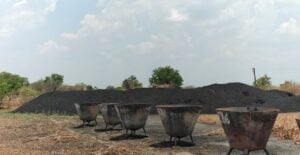
At full capacity, Agnisparsh will operate around 450 Kon-Tiki kilns across multiple mobile sites in western India.
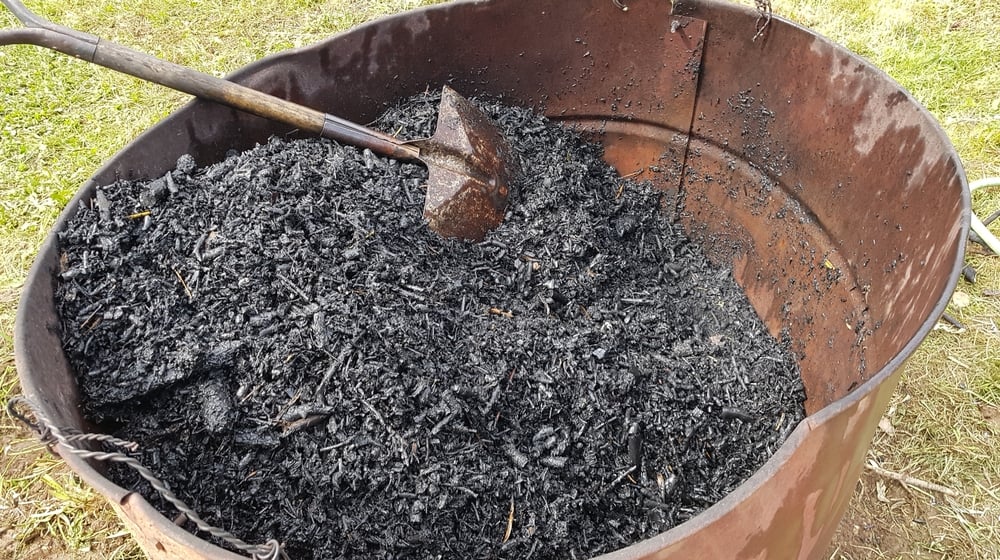
These kilns will turn agricultural waste into biochar through a process called pyrolysis. It involves heating biomass with limited oxygen, which prevents it from burning completely.
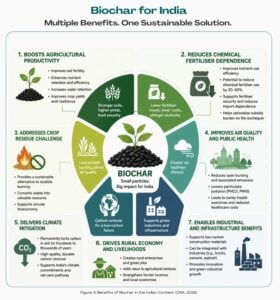
The process converts part of the biomass carbon into a stable form that can remain stored in soil for long periods. Farmers can also use biochar to improve soil quality, water retention, and nutrient availability.
The project follows a community-led model. Local smallholder farmers will supply agricultural residues, and Varaha will return most of the resulting biochar to them free of charge.
This creates two benefits. Farmers get an alternative to open-field crop burning and access to a useful soil amendment. At the same time, the project removes carbon from the atmosphere and creates opportunities for local communities to participate in the carbon market.
Agnisparsh follows Rainbow’s Distributed Open-Kiln Biochar Methodology (Version 1.0). The methodology requires digital measurement, reporting, and verification (dMRV) to track production and carbon removal.
In March 2026, the Integrity Council for the Voluntary Carbon Market (ICVCM) confirmed Rainbow’s eligibility under its Core Carbon Principles (CCPs). However, the specific methodology is still under assessment. If approved, eligible credits from Agnisparsh could carry the CCP label.
Ludovic Chatoux, Co-founder and CEO of Rainbow, said:
“When it comes to carbon removal, distributed biochar is one of the most interesting pathways. It gives smallholder farmers a new source of income and healthier soils, and it can scale fast without heavy upfront investment. Developers like Varaha showed us that strong MRV is possible in the field, so we built a methodology with the rigour to match, including mandatory digital MRV. This rating is a strong signal for the whole pathway.”
What Does BeZero’s A.pre Rating Mean?
BeZero Carbon’s A.pre rating is an independent assessment of a project’s expected carbon removal performance before it issues credits.
The rating considers three important factors: additionality, carbon accounting, and permanence. In simple terms, it assesses whether the project delivers carbon removal that would not otherwise happen, measures it accurately, and stores the carbon for a meaningful period.
For buyers, this assessment provides an early indication of project quality and delivery risks. However, an ex ante rating does not guarantee future credit issuance or actual carbon removal.
The A.pre rating also highlights the potential of distributed biochar projects. They can involve many small production sites and local farmers rather than relying only on large industrial facilities.
India’s Biochar Market and Carbon Credit Issuance
India has significant potential to expand biochar production because of its large agricultural sector and access to crop residues. Rice husks, cotton stalks, sugarcane waste, and other agricultural materials can serve as feedstock.
Converting this waste into biochar offers an alternative to open-field burning while creating a new source of carbon removal credits.
The market is already seeing early commercial activity. A report by the Council on Energy, Environment and Water (CEEW) estimates that Indian projects have issued around 214,000 durable carbon removal credits. Biochar accounts for approximately 114,000 tonnes of this total, based largely on voluntary carbon market registry data.
These figures show that biochar is already an important part of India’s emerging durable carbon removal industry.
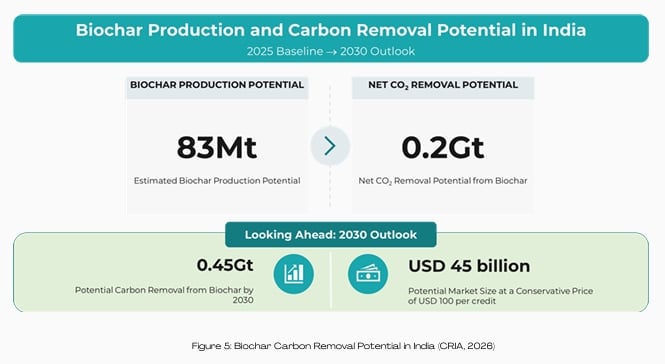
The country also has room to expand beyond its domestic market. The Carbon Removal India Alliance (CRIA) and BioFlux estimate that India could deliver around 0.2 gigatonnes of net carbon removal annually today, potentially rising to 0.45 gigatonnes by 2030. The report estimates a potential market opportunity of up to $45 billion annually under its assumptions. This covers the broader carbon removal industry, not biochar alone.
Corporate demand is another growth driver. In January 2025, Google agreed to purchase 100,000 tonnes of biochar-based carbon removals from Varaha. Microsoft also signed a 100,000-tonne biochar carbon removal agreement with the company in January 2026. These deals show how international buyers are supporting India’s growing carbon removal sector.
Can Community-Led Biochar Scale?
Varaha’s Agnisparsh project highlights how India could combine agricultural waste management with carbon removal and rural development.
However, producing biochar does not automatically qualify a project for carbon credits. Developers must prove additionality, maintain accurate records, and demonstrate that the carbon remains stored.
However, scaling this model will require reliable biomass supplies, consistent biochar quality, and strong monitoring across multiple production sites. Digital MRV and independent verification will remain important for maintaining buyer confidence.
The project plans to begin its first credit issuance in January 2027 and deliver more than 100,000 tonnes during the year. If it meets this target, Agnisparsh could become one of the world’s largest biochar projects.
More importantly, it could show that community-led projects can participate in the growing durable carbon removal market without compromising on quality. Its progress will also offer a useful test of India’s ability to scale biochar production and attract international carbon finance.