


Google is expanding its efforts to reduce transportation-related emissions through a new sustainable aviation fuel (SAF) partnership with Denmark-based logistics company DSV. Under the agreement, DSV will help secure nearly 10 million liters of SAF for Google Cloud’s air freight operations.
The companies will begin with a pilot covering a key air freight route. The initiative could also pave the way for broader cooperation on low-carbon logistics as Google works to reduce emissions across its global supply chain.
The fuel comes from waste and residue feedstocks. According to the companies, it can reduce lifecycle greenhouse gas emissions by approximately 85% compared with conventional jet fuel. The agreement also uses a book-and-claim system, allowing Google Cloud to claim the emissions reductions even when the physical fuel is used elsewhere.
How Will the DSV-Google Cloud SAF Agreement Work?
DSV and Google Cloud will use a book-and-claim approach to track the environmental benefits of the fuel. Under this system, SAF does not need to reach the aircraft carrying Google’s shipments. Instead, the companies allocate the associated emissions reductions to Google Cloud through a separate accounting process.
The agreement also includes third-party certification under the International Sustainability and Carbon Certification (ISCC) scheme. The fuel’s environmental attributes will be recorded, transferred, and retired through the independent Sustainable Aviation Fuel Certificate Registry.
DSV will maintain additional internal tracking to ensure that each emissions reduction goes to a specific shipper. This process also helps prevent double-counting and creates an auditable record for Google’s emissions reporting.
Frank Sobotka, CEO of DSV’s Air & Sea Division, said the partnership would help turn customer sustainability goals into measurable reductions in freight emissions.
Meanwhile, Google Cloud’s logistics leadership described the pilot as a transparent way to address emissions across its global transportation network.
Global SAF Production Grows, but Supply Remains Limited
The agreement comes as the aviation industry struggles to increase SAF production. Although output is rising, the fuel still represents a very small share of global aviation consumption.
According to the International Air Transport Association (IATA), global SAF production reached approximately 1.9 million tonnes in 2025, nearly double the 1 million tonnes produced in 2024. However, this represented only 0.6% of global jet fuel consumption.
IATA expects production to reach around 2.4 million tonnes in 2026, equivalent to just 0.8% of total aviation fuel demand. The association also estimates that airlines will face an additional US$4.3 billion in SAF-related fuel costs in 2026.
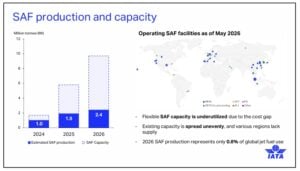
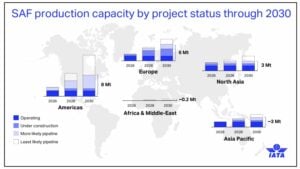
The gap between production capacity and actual output presents another challenge. IATA estimates that global SAF production capacity could exceed 9 million tonnes in 2026. Yet, expected production remains much lower at 2.4 million tonnes. High costs, limited feedstock availability, and uneven policy support continue to hold back the market.
- ALSO SEE: SAF Crisis Deepens: IATA Says Aviation’s Net Zero Goal Is at Risk, but Brazil Offers New Hope
What Is Driving SAF Production and Demand?
Producers can make SAF through several technologies using renewable and waste-based materials. The most established commercial route is Hydroprocessed Esters and Fatty Acids (HEFA). It converts used cooking oil, animal fats, and other waste oils into aviation fuel.
Other production pathways include:
- Alcohol-to-Jet (AtJ): Converts alcohols, including ethanol, into aviation fuel.
- Fischer-Tropsch (FT): Uses synthesis gas from biomass or other suitable feedstocks to produce liquid fuels.
- Power-to-Liquid (PtL): Combines green hydrogen with captured carbon dioxide to create synthetic aviation fuel, also known as e-SAF.
However, each pathway faces different challenges. HEFA currently dominates commercial production, but the supply of waste oils and fats is limited. As a result, the industry needs to develop alternative technologies to increase output.
IATA’s global feedstock assessment estimates that the world could produce around 400 million tonnes of SAF annually by 2050. However, the aviation industry may need approximately 500 million tonnes annually to meet its net-zero emissions target. This leaves a potential 100-million-tonne supply gap.
Regional markets are also making progress. In 2025, the European Union supplied approximately 1.1 million tonnes of SAF, representing 2.8% of aviation fuel supplied at its airports. This exceeded the initial 2% requirement under the EU’s ReFuelEU Aviation rules. The fuel also delivered an estimated 3.77 million tonnes of lifecycle CO₂e savings.
Google Faces Rising Scope 3 Emissions
Google’s SAF investment comes as the company faces growing pressure to control emissions from its expanding AI and data center operations.
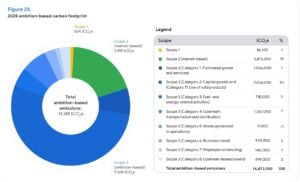
Its 2026 Environmental Report shows that Scope 1 and Scope 2 emissions (market-based) declined 2% year over year in 2025. However, Scope 3 emissions increased 25% to approximately 11.6 million metric tonnes of CO₂e. Higher emissions from hardware manufacturing, logistics, and data center construction contributed to this increase.
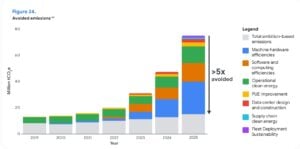
Despite the rise, Google estimates that its decarbonization initiatives avoided more than 58 million metric tonnes of CO₂e in 2025. These efforts included clean energy procurement, hardware efficiency, and improvements in data center operations. Clean energy purchases alone accounted for approximately 12 million tonnes of avoided emissions.
- Meanwhile, the company continues to expand its SAF partnerships to address emissions from business travel and freight.
In 2024, Google joined United Airlines Ventures’ Sustainable Flight Fund. The fund attracted more than US$200 million in commitments from United Airlines and corporate partners to support SAF development and aviation technologies.
Google also signed an agreement with American Airlines covering 35 million gallons of SAF over three years. The deal is expected to deliver nearly 300,000 tonnes of CO₂e emissions reductions.
In addition, its partnership with Amex GBT and Shell Aviation through the Avelia platform supports SAF adoption through book-and-claim certificates.
Can SAF Partnerships Accelerate Aviation Decarbonization?
Corporate purchasing agreements are becoming an important part of the aviation industry’s transition to lower-carbon fuels. By committing to buy SAF, large companies can help producers secure financing, expand facilities, and develop new production technologies.
However, the market still faces major obstacles. SAF accounts for less than 1% of global jet fuel consumption, while production costs remain higher than those of conventional aviation fuel.
Therefore, scaling the market will require more investment, reliable feedstock supplies, improved production technologies, and stronger policy support.
Google’s agreement with DSV adds to the growing list of corporate initiatives supporting SAF demand. Whether these partnerships can make a meaningful difference will depend on how quickly the industry converts purchasing commitments into additional fuel production.