


The aviation industry is making progress toward cutting carbon emissions, but the supply of sustainable aviation fuel (SAF) remains far below what airlines need. According to the International Air Transport Association (IATA), global SAF production is expected to reach only 2.4 million tonnes in 2026. While this marks an increase from previous years, it will cover just 0.8% of the aviation sector’s total fuel demand.
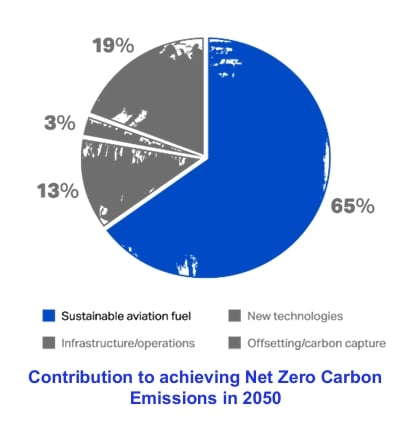
The industry has committed to achieving net-zero carbon emissions by 2050, but IATA believes current production levels are nowhere near sufficient to meet that target. At its 82nd Annual General Meeting in Rio de Janeiro, the airline group warned that slow investment, weak policy design, and high fuel costs are delaying the transition to cleaner aviation.
SAF Production Is Growing, But Too Slowly
IATA estimates that airlines will spend around $4.3 billion on SAF in 2026. However, despite this high cost, the fuel will replace less than 1% of the conventional jet fuel consumed globally.
Production has increased over the past three years, but the pace remains far below what the industry requires.
- 2024: about 1 million tonnes
- 2025: 1.9 million tonnes
- 2026 (forecast): 2.4 million tonnes
Although production continues to rise, growth has started to slow. Even more concerning, global SAF production has largely stagnated since December 2025, despite growing demand from airlines.
IATA Director General Willie Walsh expressed frustration over the industry’s slow progress.
“Five years after committing to achieve net zero by 2050, SAF production will only account for 0.8% of airline fuel use this year,” Walsh said. “The path to meeting 65% of our needs in 2050 is growing more difficult with each year of ineffectively sequenced government policies and oil companies’ manifest lack of interest.”
The industry estimates that around 500 million tonnes of SAF will be needed annually by 2050. Current production remains only a tiny fraction of that requirement.
- FURTHER READING: Doubling SAF Production by 2025: IATA’s Push for Greener Skies Still Faces Big Hurdles
High Costs Continue to Challenge Airlines
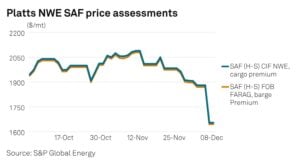
At the same time, SAF has become significantly more expensive. According to IATA, prices climbed from just over $2,000 per metric tonne in February 2026 to around $3,000 per tonne by May, following rising geopolitical tensions in the Middle East.
This sharp increase adds another financial burden for airlines that are already dealing with higher operating costs.
Earlier estimates by S&P Global showed airlines would face roughly $3.6 billion in SAF-related costs during 2025, largely because SAF sells for two to five times more than traditional jet fuel in markets where blending mandates apply.
These higher prices are making it more difficult for airlines to expand SAF use while remaining competitive.
Production Capacity Exists, But It Is Underused
Interestingly, the problem is not simply a lack of production facilities.
IATA estimates that global SAF production capacity has expanded to roughly 9 million tonnes in 2026. Yet actual production is expected to reach only 2.4 million tonnes, leaving much of that capacity unused.
According to Preeti Jain, Head of Net Zero Research and Programmes at IATA, current government policies are partly responsible. She explained that incentives often favor the production of renewable diesel for road transport instead of SAF. At the same time, feedstock availability remains uneven across North America, Europe, and Asia, slowing the expansion of aviation fuel production.
As a result, existing facilities are not operating at their full potential.
IATA Says E-SAF Targets Are Unrealistic
IATA also criticized European mandates requiring the use of electro-SAF (e-SAF), a synthetic aviation fuel made using renewable electricity through power-to-liquid technology.
The European Union and the United Kingdom have set combined targets requiring approximately 600,000 tonnes of e-SAF by 2030.
However, today’s global production capacity is only around 20,000 tonnes, and there is currently just one commercial production facility operating worldwide.
According to IATA, achieving the 2030 target would require roughly 20 large commercial e-SAF refineries. Yet no new final investment decisions have been announced over the past year.
Marie Owens Thomsen, IATA’s Senior Vice President for Sustainability and Chief Economist, believes policymakers have set targets without ensuring production can actually happen. She called the 2030 goals “beyond unrealistic” and said imposing mandates before enabling production capacity “will only drive up the price.”
IATA Wants Governments to Rethink Their Policies
Rather than introducing aggressive mandates first, IATA argues governments should focus on building the market. The association identified four priorities that could accelerate SAF production worldwide. They are:
- Governments should expand renewable energy supplies needed for future fuel production.
- Fuel producers should receive open access to infrastructure such as pipelines, storage systems, and airport fuel networks.
- Production incentives should come before mandatory blending requirements so investors have confidence to build new plants.
- IATA wants governments to support global book-and-claim systems and harmonized sustainability standards that would allow SAF certificates to be traded internationally.
Passengers Still Support Cleaner Flying
Despite higher ticket prices that may result from decarbonization efforts, passengers continue to back cleaner aviation.
An IATA survey conducted in April 2026 found that 89% of travelers believe the aviation industry should continue reducing emissions regardless of government action. This strong public support suggests demand for lower-carbon air travel remains high, even as airlines struggle with the cost of cleaner fuels.
Can Brazil Become a Global SAF Leader?
While many regions face supply challenges, IATA believes Brazil could emerge as one of the world’s biggest SAF producers over the coming decades.
The country has several natural advantages, including abundant agricultural feedstocks, a clean electricity system, and decades of experience producing biofuels.
According to IATA:
- Brazil could produce around 180 million tonnes of biomass feedstock by 2050.
- That biomass could generate approximately 60 million tonnes of SAF.
- By 2030 alone, sustainably sourced sugar-based ethanol, virgin oils, and waste oils could provide 18 million tonnes of feedstock, enough to produce about 12 million tonnes of SAF.
- That potential is five times larger than projected global SAF production in 2026.
- Brazil currently has 15 SAF projects under development. If all move forward, they could add roughly 2 million tonnes of annual SAF production.
Walsh further noted,
“Brazil has all the ingredients to be a global SAF powerhouse. It has one of the cleanest electricity mixes in the world as well as abundant feedstock. Moreover, as the second-largest producer of liquid biofuels in the world, the country benefits from deep expertise and developed infrastructure. Brazil has a real opportunity to be a global leader in aviation’s decarbonization. Embracing this opportunity will create jobs, reduce dependence on foreign fossil fuels, build new energy and agriculture industries, and grow the economy. With the right policies implemented in the right order, Brazil is ready to jump-start the market.”
Strong Economic Advantages
Brazil already has well-established ethanol production, existing refining infrastructure, and significant agricultural expertise. These strengths could support several SAF production pathways, including Hydroprocessed Esters and Fatty Acids (HEFA) and ethanol-to-jet technology.
So, if production expands as expected, Brazil could eventually become a net exporter of sustainable aviation fuel.
Beyond aviation, a larger SAF industry would create opportunities across agriculture, logistics, refining, infrastructure, and fuel exports. It could also strengthen energy security, support rural communities, improve soil management, and generate thousands of new jobs.
Building Brazil’s SAF Industry Will Take Time
Even with its strong advantages, Brazil’s SAF industry is still in its early stages. IATA says several challenges must be addressed before production can scale. The country will need greater investment in conversion technologies, transportation infrastructure, and supply chains connecting feedstock producers with refineries.
Furthermore, governments must also introduce stable production incentives, improve financing mechanisms, and align sustainability standards with international markets.
Finally, IATA supports Brazil’s proposed book-and-claim system under its Fuel of the Future (ProBioQAV) framework. Tradeable SAF certificates would help connect Brazilian producers with global airline demand while supporting international programs such as CORSIA.
However, IATA stresses that sequencing remains critical. Fuel production must increase before mandatory usage targets take effect. Otherwise, limited supply could push prices even higher and slow the industry’s progress toward net zero.