


Airports play a major role in shaping global aviation activity. When airports expand by adding new runways, terminals, and support infrastructure, they encourage more flights, more passengers, and more freight movement. As a result, greenhouse gas (GHG) emissions, air pollution, and noise pollution continue to rise.
Today, there are still no large-scale solutions capable of fully separating aviation growth from pollution. Because of this, airport expansion has become one of the biggest barriers to reducing aviation’s climate impact.
Aviation Emissions Continue to Rise
The aviation industry remains a major source of climate pollution. Air travel emissions are still increasing, and current efforts to cut them are not strong enough. The sector continues to depend heavily on Sustainable Aviation Fuels (SAFs), but these fuels are not yet available at the scale needed to reduce emissions significantly.
At the same time, airlines and airports have adopted weak emission reduction strategies. This has allowed aviation pollution to continue growing even after global climate commitments under the Paris Agreement.
- According to the Airport Tracker 2026 Policy report, airports around the world generated massive levels of pollution in 2023. The tracker studied 1,300 airports and found they produced around 1,022 million tonnes of CO2 emissions.
If the aviation sector were treated as a country, it would rank as the world’s fifth-largest emitter.

Three airports alone — Dubai, London Heathrow, and Los Angeles International Airport — produced more than three times the CO2 emissions of the entire city of Paris in 2023.
London stood out as the most polluting airport system overall. Its six airports ranked highest for several pollutants, including:
- Carbon dioxide (CO2)
- Nitrous oxide
- Carbon monoxide
- Total hydrocarbons
- Particulate matter
The Airport Tracker was created by ODI Global and Transport & Environment (T&E), with data support from the International Council on Clean Transportation (ICCT). The project aims to improve transparency and accountability around aviation emissions.
A Threat to Paris Agreement Goals
The Paris Agreement, adopted in 2015, committed countries to limiting global warming to below 2°C and ideally close to 1.5°C above pre-industrial levels. However, current climate policies are not enough. Experts now project global warming could reach around 2.8°C.
Although international aviation is not directly covered under the Paris Agreement, countries are still expected to include aviation emissions in their climate plans, known as Nationally Determined Contributions (NDCs).
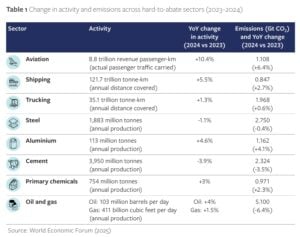
- The aviation sector currently produces around 2.5% of global energy-related CO2 emissions.
- When non-CO2 effects such as contrails and other warming impacts are included, aviation has contributed roughly 4% of total global warming so far.
Compared to sectors like electricity generation and road transport, aviation’s share may appear smaller. Yet there is one major difference: many industries are beginning to decarbonize, while aviation emissions continue to rise steadily.
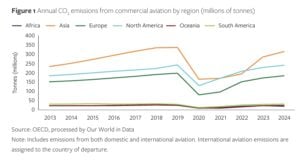
Furthermore, the COVID-19 pandemic temporarily reduced emissions between 2020 and 2022 due to travel restrictions. But by 2024, aviation emissions had nearly returned to pre-pandemic levels across most regions.
Aviation Depends Almost Entirely on Fossil Fuels
Aviation remains one of the most oil-dependent industries in the world.
In 2024, oil supplied about 99% of all aviation fuel demand. This means any increase in air travel almost automatically leads to higher fossil fuel consumption and greater emissions.
Unlike road transport, aviation has limited alternatives. Electric vehicles, public transportation, and high-speed rail are helping reduce oil demand in other sectors. Aviation, however, still lacks scalable low-carbon solutions for long-distance travel.
As a result, aviation is expected to become one of the largest drivers of future oil demand growth.
Industry forecasts also show strong future growth. The International Air Transport Association (IATA) projects passenger demand could rise by 3.3% annually through 2050.
Passenger traffic may grow from 9 trillion revenue passenger-kilometers (RPKs) in 2024 to nearly 22 trillion RPKs by 2050.
Researchers estimate aviation alone could consume 15% of the remaining global carbon budget linked to limiting warming to 1.7°C.
Why Airport Expansion Matters
Airport expansion directly increases aviation activity. Even today, many airports do not operate at full capacity. However, expanding them creates room for more flights and stronger long-term growth in passenger demand.
Authorities around the world continue to plan new airport projects. In 2017 alone, developers planned or built 423 airport expansions and 121 new runways.
These projects have long-term consequences because airports are built to last for decades. Once new runways and terminals become operational, they lock countries into higher traffic levels and greater emissions far into the future.
Expansion also increases dependence on oil-based jet fuels. This creates another problem: countries become more vulnerable to unstable fuel prices and geopolitical tensions.
As global energy markets face increasing uncertainty, this growing reliance on fossil fuels adds financial and energy security risks alongside environmental damage.
- ALSO READ: Greening the Aviation: Lufthansa and Airbus Team Up to Cut Business Travel Emissions Using SAF
Airport Emissions Are Deeply Unequal
The environmental impacts of aviation are not shared equally around the world.
Most aviation emissions come from wealthier countries and frequent flyers. Studies show that just 1% of the global population is responsible for half of all commercial aviation emissions.
Airport-level data reveals an even stronger concentration of pollution.
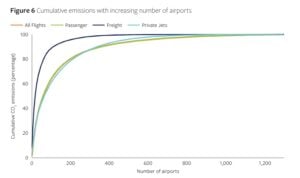
- In 2023, the 20 highest-emitting airports produced 280 million tonnes of CO2. That represented more than 27% of all emissions generated by the 1,300 airports included in the Airport Tracker.
Eighteen of these top 20 airports were located in high-income countries, including eight in the United States.
The Top 5 Airports with the Highest CO2 Emissions Were:
-
- Dubai International Airport
- Heathrow Airport
- Los Angeles International Airport
- Incheon International Airport
- John F. Kennedy International Airport
Earlier studies compared major airports to coal plants that release about 4 million tonnes of CO2 each year. Based on this measure, the largest airports produced emissions equal to at least two coal plants each, while some matched the emissions of four coal plants.
The comparison becomes even more striking when airports are measured against the biggest cities, or even entire countries:
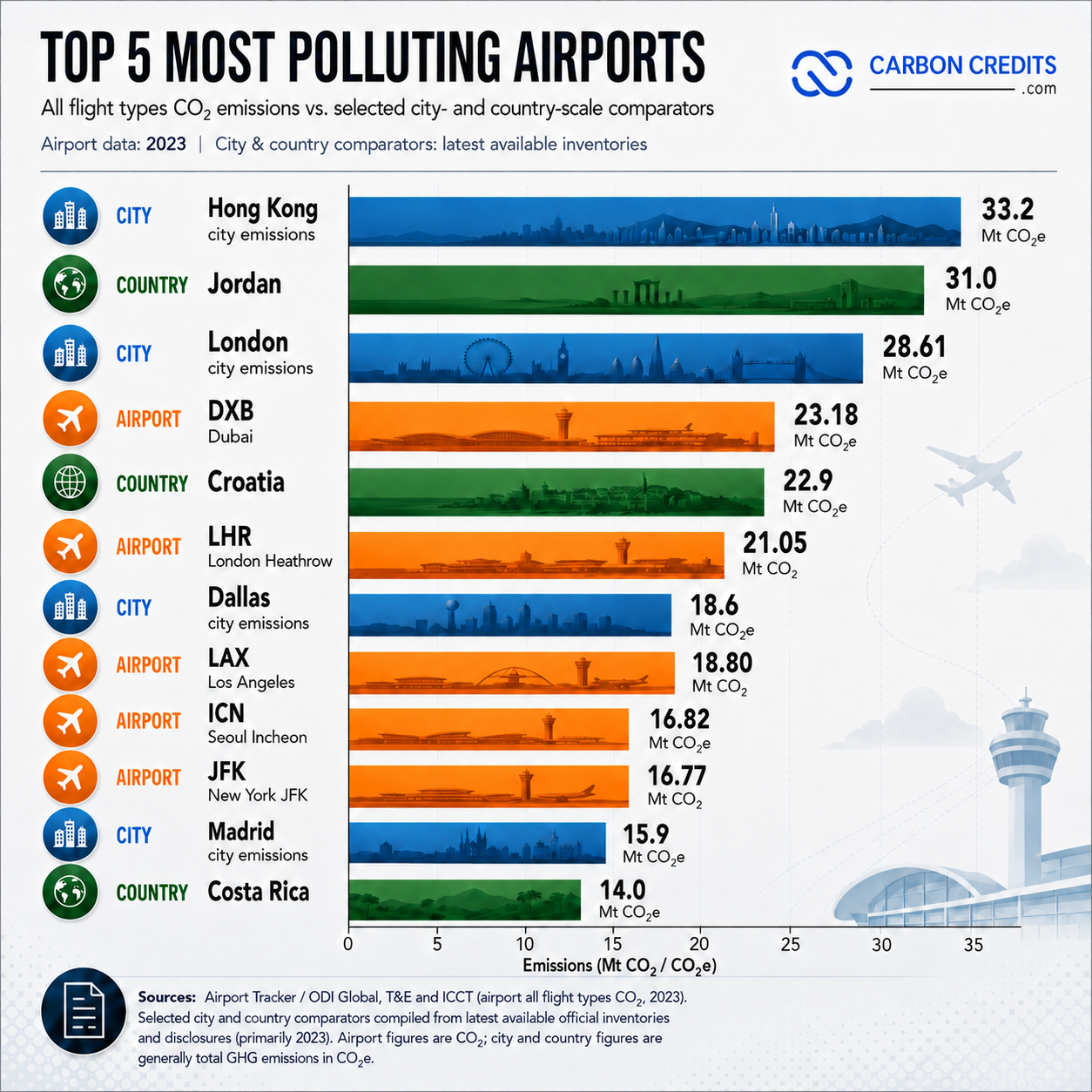
More than half of the world’s most polluting airports created over twice the emissions of Paris in 2023. Dubai, Heathrow, and Los Angeles airports each produced more than triple Paris’ emissions.
Meanwhile, emissions from the Los Angeles International Airport alone equaled about 62% of all other emissions generated across the city of Los Angeles.
Top Airport Cities Produce Huge Emissions and Air Pollution
The United States leads the world in flight activity, especially domestic aviation.
Nine of the 10 busiest airports by flight numbers in 2023 were located in the United States. Each handled more than 230,000 departing flights annually. That equals roughly 630 flights every day.
US airports dominate freight and private jet activity, while major international hubs mainly lead in passenger traffic.
This concentration of flights increases both local pollution and global emissions. Communities living near airports also face worsening air quality and growing noise pollution.

Aviation Faces a Difficult Climate Future
The aviation sector continues to move in the opposite direction of global climate goals. While many industries are slowly reducing emissions, aviation demand keeps growing.
Airport expansion is accelerating this trend by encouraging more flights and locking in fossil fuel use for decades.
Without stronger policies, cleaner technologies, and limits on unchecked airport growth, aviation emissions will remain a major challenge in the fight against climate change.