

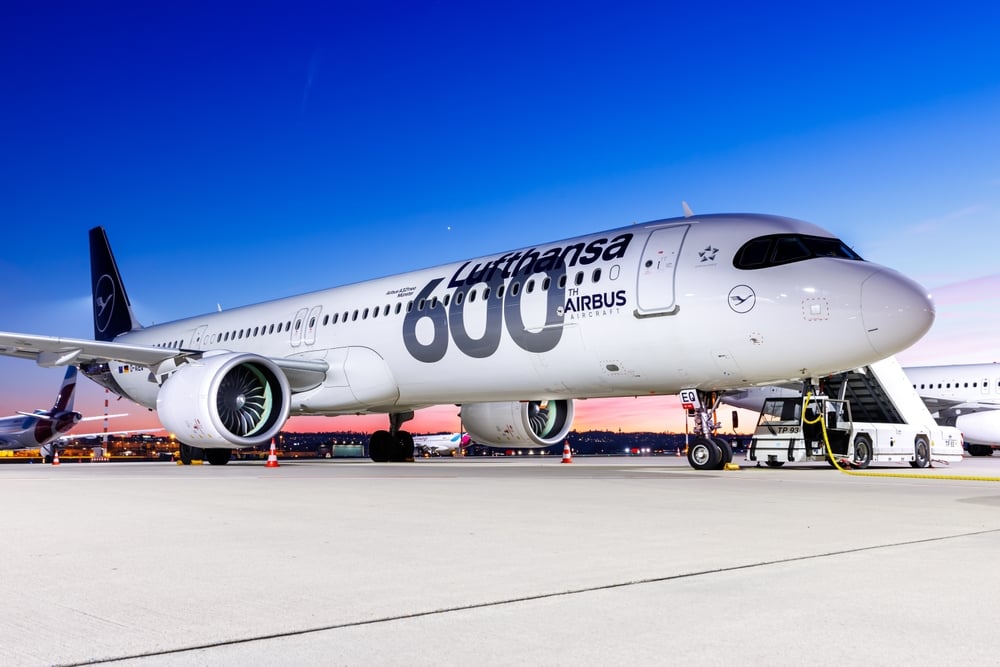
Lufthansa Group is taking a big step to cut emissions in business travel. It has partnered with Airbus to use Sustainable Aviation Fuel (SAF) for all domestic flights of Airbus employees in Germany. This collaboration, which started on June 1, is key to Lufthansa’s climate neutrality goals.
The press release highlights that this partnership uses Lufthansa’s “Sustainable Corporate Value Fare.” This fare helps companies like Airbus offset CO₂ emissions by using SAF in the airline’s fuel operations.
Dieter Vranckx, Chief Commercial Officer of Lufthansa Group, said,
“Together with our customers and strong partners from the industry, we strive towards greater sustainability. I am particularly pleased and thankful that our long-standing partner Airbus has opted for a corporate fare with SAF, demonstrating its leading role also in the field of sustainability. For many companies and its employees, sustainability is becoming an increasingly important factor in travel decisions. As a leading airline group, we are the partner of choice for companies in achieving their goals with tailor-made solutions.”
How It Works: A Smarter Way to Fly Greener
SAF isn’t used directly in individual flights. Instead, it blends with fossil kerosene before reaching airports. As a “drop-in” fuel, SAF fits easily into existing aircraft and fuel systems. Once purchased, Lufthansa ensures that the equivalent SAF related to the customer’s carbon footprint is used within six months.
This method cuts the emissions impact of flying, even if SAF isn’t used on one flight. Over its lifecycle, SAF made from biogenic waste reduces CO₂ emissions by about 80% compared to traditional jet fuel.
Airbus Walks the Talk: Making Employee Travel Sustainable
By adopting the Sustainable Corporate Value Fare, Airbus is making employee travel within Germany more climate-friendly. This reflects a growing trend where more companies choose climate responsibility in travel.
Raphael Duflos, Vice President Corporate Services Procurement at Airbus, also noted,
“We have been working in close cooperation with Lufthansa Group since early 2024 to customize their ‘Sustainable Corporate Value Fare’ to meet the specific needs of Airbus travelers. They have helped us to create a meaningful offer incorporating Sustainable Aviation Fuels, starting in the German domestic market. We are confident that such ‘Sustainable Corporate Value Fare’ is going to be successful across the Business Travel ecosystem.”
For Lufthansa, this shows that its climate-focused travel products attract business customers.
Supports SAF to Cut Emissions and Drive Industry Growth
Airbus is using SAF as a key solution to reduce its aviation emissions. It is promoting SAF not just through internal use, but also by forming partnerships and making targeted investments.
Airbus Sustainability

The aviation giant has been using SAF for nearly a decade and aims to cover at least 30% of its internal fuel use with SAF by 2030. This includes fuel for internal transport and employee business travel. Notably, all current Airbus aircraft can fly on up to 50% SAF.
- By 2030, the goal is for all aircraft and helicopters to be ready for 100% SAF. New single-aisle models are already being designed with this goal in mind.
Since 2024, Airbus has purchased SAF options from Air France-KLM for employee flights between Paris and cities like Hamburg, Madrid, Marseille, Munich, and Toulouse.
Pilot Projects with Airlines
To help scale SAF use, the company launched two pilot projects last year. One with easyJet funded 106 tonnes of SAF for flights between Toulouse and Bristol using a 30% SAF blend. The trial showed how airlines and corporate partners can share SAF costs and build demand.
Another trial with Wizz Air included over 50 flights using blended SAF, with Airbus providing technical support.
Long-Term Partnerships
Airbus has also partnered with TotalEnergies, which has supplied SAF for aircraft deliveries in Toulouse since 2016. By 2024, TotalEnergies met over half of Airbus’s SAF needs in Europe. They are also working together on research to enable 100% SAF use.
In recent years, Airbus signed agreements with Neste and OMV to expand access to SAF, encourage new demand, and support new production sites. It also invested in LanzaJet, a leading SAF producer, to help speed up the transition across the industry.
Lufthansa’s Climate Targets: Big Ambitions, Concrete Steps
The airline has clear climate goals. It plans to cut net CO₂ emissions from flights by half by 2030, compared to 2019 levels. It also aims for net-zero by 2050 and carbon neutrality in its home market by 2030.
SAF Use Grows Across Lufthansa’s Network
- In 2024, Lufthansa cut 71,952 tonnes of fossil CO₂ by using SAF.
The sustainability report shows that the fuel was sourced through co-processing, where biogenic feedstock is refined alongside fossil crude oil. This method helps scale SAF efficiently while maintaining high quality.
Corporate clients can access SAF in two main ways:
-
Sustainable Corporate Value Fare: Business travelers can offset up to 30% of their CO₂ emissions through SAF.
-
SAF Bulk Deals: Companies can invest in larger SAF volumes to maximize their climate impact.

Expanding Green Fares for Leisure and Business Travelers
Lufthansa’s Green Fares product expanded in December 2024 to include intercontinental routes. On these flights, 10% of emissions are offset using SAF, while 90% through certified climate projects. For continental routes, the mix is even more ambitious: 20% SAF and 80% offsets.
The response has been modest but is growing. In 2024, about 4% of customers chose Green Fares on continental routes and 1.5% on long-haul flights.
- These fares led to a total reduction or offset of 143,000 tonnes of fossil CO₂, with 28,000 tonnes saved directly through SAF.
A Multi-Faced Approach to Sustainability
Lufthansa’s climate strategy goes beyond SAF. It combines technology upgrades, operational efficiency, and better ground logistics:
1. Fleet Modernization: The Group has updated its fleet with new aircraft like the Airbus A320neo, A321neo, A350-900, and Boeing 787-9. These planes have new engines and materials that lower emissions and noise.
- In 2024, Lufthansa added 18 new aircraft and retired four older models.
- By 2025, 30 more new aircraft are expected.
- The modernization plan covers around 240 aircraft. 99.6% of the fleet meets ICAO’s Chapter 4 noise standards.
2. Flight Operation Efficiency: Through smarter routing and digital tools, Lufthansa cut 37,000 tonnes of CO₂ in 2024. Innovations like AeroSHARK surface technology saved 12,000 tonnes of kerosene—enough for 142 roundtrips between Munich and New York with an Airbus A350-900.
3. Alternative Transport to Hubs: Lufthansa has reduced short-haul flights by offering over 750 daily connections via rail or bus. In 2024, over 1.1 million passengers chose these low-emission options, cutting unnecessary air traffic.
4. Offsetting Where Necessary: Besides SAF and fuel savings, Lufthansa and its customers actively offset emissions. In 2024, they offset 606,000 tonnes of CO₂ using high-quality climate projects—531,000 tonnes by customers and 75,000 tonnes from Lufthansa’s travel.

Sustainable Travel Becomes Mainstream
The Airbus-Lufthansa agreement signals a shift in aviation’s approach to travel. With scalable SAF programs, new aircraft, and changing passenger expectations, Lufthansa is positioning itself as a sustainability leader.
Real change needs collective effort. For aviation to meet climate goals, it requires increased SAF production and broader adoption by travelers.
Lufthansa and Airbus show that business travel can be planet-friendly. They prove that sustainability can be integrated into flying without sacrificing convenience.