


Amazon (NASDAQ: AMZN) had a strong quarter, fueled by growth in cloud computing, artificial intelligence (AI), advertising, and online retail. The company reported higher revenue and profits for Q2 2026 as demand for AI infrastructure surged.
However, Amazon’s big investments in AI pushed free cash flow into negative territory. The company also noted progress on its long-term sustainability goals, including renewable energy, water conservation, and lower-carbon construction materials for its expanding global data center network.
Amazon’s Revenue Tops $200 Billion in Q2
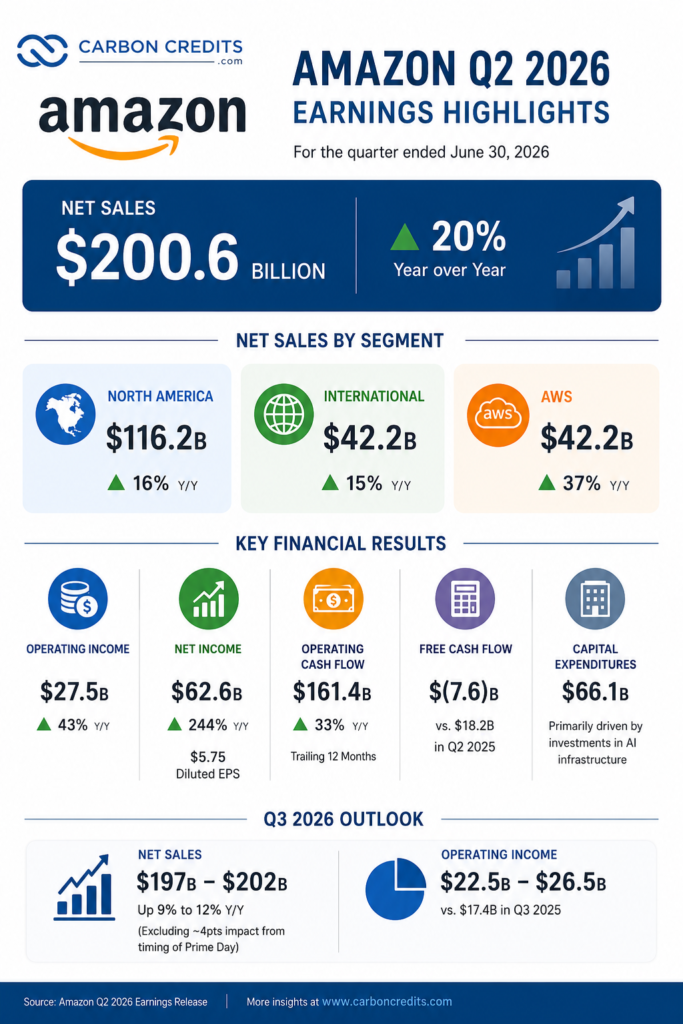
For the quarter ending June 30, 2026, Amazon reported net sales of $200.6 billion, a 20% increase from $167.7 billion last year. Currency fluctuations had little effect, indicating that the business grew by about 20%.
This growth came from all three major segments.
- North America remained Amazon’s largest market, generating $116.2 billion in sales, up 16% year over year.
- International sales rose 15% to $42.2 billion, showing steady growth despite a mixed global economy.
- Amazon Web Services (AWS) led the way with a 37% revenue jump to $42.2 billion, driven by strong demand for cloud computing and AI services.
AWS Continues to Power Amazon’s Growth
AWS was Amazon’s biggest profit driver this quarter.
Operating income from AWS grew to $16.6 billion, up from $10.2 billion a year ago. This division accounted for over half of Amazon’s total operating profit.
- CEO Andy Jassy noted that AWS saw its fastest growth in over four years. He stated that AWS’s AI business now exceeds a $25 billion annual revenue run rate, alongside Amazon’s custom chip business. Both are growing at triple-digit rates.
The company is expanding its AI offerings with custom silicon, cloud infrastructure, and partnerships, including an investment in AI startup Anthropic.
Operating Profit Climbs Despite Heavy Investment
Amazon’s operating income rose sharply to $27.5 billion, compared to $19.2 billion in Q2 2025. Across its businesses:
- North America operating income increased to $9.1 billion, from $7.5 billion.
- International operating income improved to $1.7 billion, from $1.5 billion.
- AWS operating income jumped to $16.6 billion, from $10.2 billion.
Net income reached $62.6 billion, or $5.75 per diluted share, compared to $18.2 billion, or $1.68 per share, last year.
Much of this increase came from a $53.4 billion pre-tax gain, primarily tied to Amazon’s investment in Anthropic. Excluding this one-time gain, operating performance still showed solid improvement.
AI Spending Weighs on Free Cash Flow But AMZN Stock Gains
Despite higher profits, free cash flow turned negative as Amazon ramped up AI infrastructure investments. It showed a $7.6 billion outflow, down from a positive $18.2 billion the previous year.
This decline was largely due to an extra $66.1 billion spent on property and equipment. Most of that went to expanding AI infrastructure, like data centers and custom AI chips.
- However, operating cash flow over the past year rose 33% to $161.4 billion.
Also, Amazon’s stock (NASDAQ: AMZN) reacted positively to the earnings report.
Shares rose about 9% in after-hours trading, following better-than-expected AWS growth and rising AI revenue. Investors responded well to AWS’s fastest growth in 18 quarters and Amazon’s growing AI business. Some analysts, however, noted that rising AI spending and negative free cash flow are areas to watch.

Q3 2026 Forecast
- For Q3 2026, Amazon projects net sales between $197 billion and $202 billion, indicating growth of 9% to 12% compared to last year.
The company mentioned that timing differences for Prime Day affect year-over-year comparisons. Excluding these effects, third-quarter revenue growth would be nearly four percentage points higher.
The retail giant also forecasts operating income between $22.5 billion and $26.5 billion, up from $17.4 billion in Q3 2025. This guidance suggests continued demand for cloud computing, AI services, advertising, and e-commerce despite economic uncertainty.
Amazon Advances Water and Renewable Energy Goals
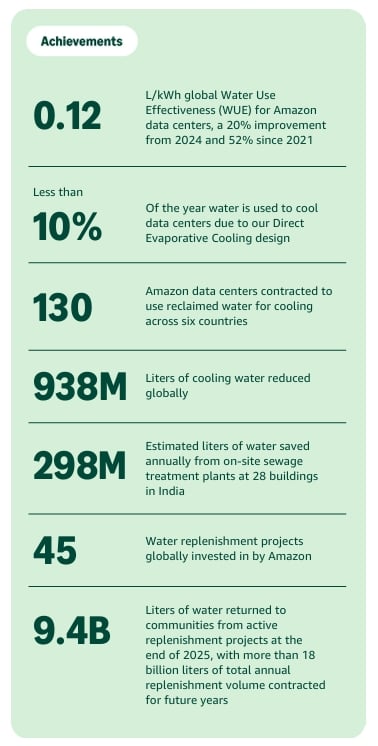
Alongside its financial results, Amazon reported ongoing progress on its environmental commitments. The company stated its global data centers are now more than seven times more water-efficient than the industry average.
It has reached 75% of its goal to become water positive across its global data center operations by 2030. This means returning more water to local communities than the company uses in its operations.
It also announced it achieved water-positive status in India ahead of its 2027 target, marking an important regional milestone.
On clean energy, it matched 100% of the electricity used across its global operations with renewable energy in 2025, reaching this goal five years early. The company has maintained that achievement for three consecutive years, reducing emissions even as electricity demand grows.
Lower-Carbon Materials Help Reduce Construction Emissions
As Amazon expands its global data center footprint, it also aims to lower emissions from construction materials. Some examples include:
- Built 33 data centers using lower-carbon steel, adding to 67 facilities completed since 2023. It also utilized lower-carbon steel in 22 logistics and operations buildings.
- Constructed 39 data centers with lower-carbon concrete in 2025, bringing the total to 74 projects since 2023. Another 14 operations buildings also used this material.
- Increasingly using mass timber in new buildings, with six projects in design or construction in 2025, including a delivery station in Indiana.
- MUST READ: Rio Tinto and Amazon Web Services (AWS) Join Forces to Supply Low-Carbon Copper for U.S. Data Centers
Amazon’s Carbon Emissions Continue to Decline
Amazon’s latest sustainability data show it continues to lower its carbon footprint while expanding its business.
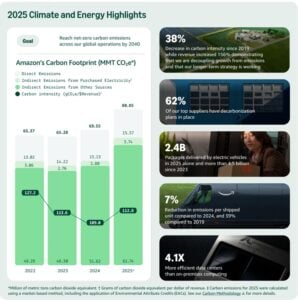
In 2024, Amazon reported 68.25 million metric tons of CO₂e across its operations, down from 70.74 million metric tons in 2023 and nearly 17% below its 2021 peak.
The emissions were distributed across three greenhouse gas categories:
- Scope 1: 4.78 million metric tons CO₂e, mainly from fuel used in transport and operations.
- Scope 2 (market-based): 0.77 million metric tons CO₂e, reflecting electricity purchases after renewable energy matching.
- Scope 3: 62.70 million metric tons CO₂e, making up about 92% of Amazon’s total footprint. These emissions come primarily from purchased goods and services, construction materials, and transportation.
The stark difference between Scope 1 and Scope 3 highlights the challenge for Amazon and other tech firms. While renewable electricity cuts operational emissions, most emissions occur in complex global supply chains.
As Amazon invests billions in AI data centers, reducing embodied carbon in materials like steel and concrete will be crucial for meeting long-term climate goals.
The company aims for net-zero carbon emissions by 2040 under The Climate Pledge, balancing rapid AI growth with investments in renewable energy, water conservation, and lower-carbon infrastructure.