AviationFree EU Carbon Allowances Boosted Airline Profits More Than Green Investment, Report...

Free EU Carbon Allowances Boosted Airline Profits More Than Green Investment, Report Finds

European airlines received billions of euros in free carbon allowances under the EU Emissions Trading System (EU ETS), but most of the benefit appears to have supported airline profits rather than new green investment. That is the key finding of a new CE Delft report examining free aviation allowances between 2013 and 2025.

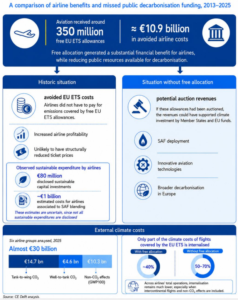
The study estimates airlines received €10.9 billion worth of free EU allowances during the period. By comparison, six major airline groups spent about €1.1 billion on sustainable activities, mainly sustainable aviation fuel (SAF). The findings come as the EU completes its phase-out of free aviation allowances in 2026.

Airlines Received €10.9 Billion in Free Allowances

The EU originally provided free allowances to airlines to limit competitiveness concerns and reduce the risk of carbon leakage. Between 2013 and 2025, airlines received about 350 million free allowances, covering roughly half of the 700 million tonnes of verified aviation emissions reported under the EU ETS during the period.

The value of those allowances increased sharply as carbon prices rose.

CE Delft estimates the average EU allowance price increased from about €4.56 per tonne in 2013 to €73.43 in 2025, measured in 2025 prices. The annual average reached about €87.90 per tonne in 2022.

That made free allowances increasingly valuable to airlines, particularly during the years when carbon prices were high. The largest benefits came in 2022 and 2023, when airlines continued receiving free allowances while EU carbon prices remained elevated.

The author noted:

“We find no strong reason to expect that these expenditures would have been substantially lower without free allocation. EU ETS auction revenues, on the other hand, are largely used for climate and energy transition purposes. Full auctioning of aviation allowances would therefore most likely have made significantly more funding available for the decarbonisation of the European economy.”

Free Allocation Became a Major Profit Booster

CE Delft compared airline profitability with a scenario in which airlines had to purchase all their EU allowances. The six airline groups studied were Ryanair, Lufthansa, Air France-KLM, easyJet, Wizz Air and IAG.

For five major European airline groups that were profitable over the period, the report estimates that free allocation accounted for about 17% of profitability. For Air France-KLM, which recorded cumulative losses, free allowances reduced those losses by about 10%.
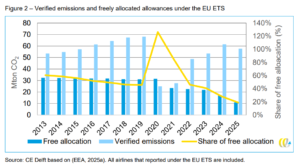
Verified emissions and freely allocated allowances under the EU ETS
Source: CE Delft

The report also finds little evidence that ending free allocation has seriously damaged airline profitability. European airline margins during 2023–2025 were broadly comparable with pre-pandemic levels, even as free allocation declined sharply.

That does not mean airlines would face no costs from buying all their allowances. But it weakens the argument that free allocation was essential to protect the sector’s financial performance.
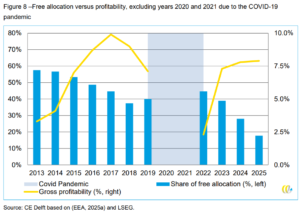
Free allocation versus profitability
Source: CE Delft

Green Spending Fell Far Behind the Carbon Windfall

The biggest concern raised by the report is the gap between the value of free allowances and spending on sustainable activities. The six airline groups spent approximately €80 million on sustainable capital investments during the period studied.

They also spent an estimated €1 billion on SAF purchases. Combined, that is roughly €1.1 billion, compared with the €10.9 billion estimated value of free carbon allowances.

CE Delft also examined 2025 EU Taxonomy reporting from eight airlines. The airlines reported a combined €18.1 billion in capital expenditure. About €9.57 billion, or 52.8%, was classified as taxonomy-aligned.

However, almost all of that spending — €9.55 billion — was classified as transitional activity, mainly conventional aircraft purchases and maintenance.

Only €24 million, or 0.13% of total reported capital expenditure, was classified as genuinely sustainable investment. This consisted of electric ground-handling equipment reported by Air France-KLM.
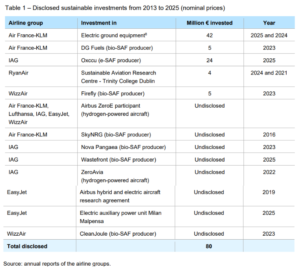
sustainable investments from 2013 to 2025

The distinction matters because newer aircraft can use less fuel than older models but still rely mainly on fossil-based jet fuel.

Could Auction Revenue Have Delivered More?

The report argues that governments could have used auction revenue to support technologies that can cut aviation emissions. CE Delft models several hypothetical uses for the €10.9 billion in free allowances.

If the money had instead been used to purchase HEFA-based SAF, the report estimates it could have supported about 18 million tonnes of COâ‚‚ reductions. Using synthetic SAF could have produced about 4.7 million tonnes of reductions.

The report also estimates that putting the money into the EU Innovation Fund could theoretically have generated up to 815 million tonnes of reductions across sectors. These are not actual historical savings. They are illustrative scenarios based on different technology and investment assumptions.

Still, they highlight the potential opportunity cost of giving carbon allowances to airlines rather than auctioning them.

The wider EU ETS has already become a major source of climate funding. EU ETS auctions generated more than €258 billion between 2013 and 2025, with revenues exceeding €43 billion in 2025, according to the European Commission.

Aviation’s Carbon Costs Remain Partly Unpriced

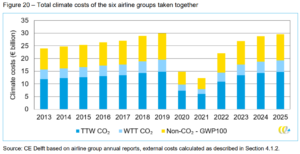
The report also examines aviation’s wider climate impact. For the six airline groups, CE Delft estimates their external climate costs reached almost €30 billion in 2025.

That included about €14.7 billion from direct aircraft COâ‚‚ emissions, €4.6 billion from fuel-production emissions and €10.3 billion from non-COâ‚‚ climate effects. These figures show why aviation’s climate impact extends beyond the COâ‚‚ covered by the EU ETS.

Total climate costs of the six airline groups
Notes: TTW (tank-to-wing), WTT (well-to-tank), Source: CE Delft

CE Delft estimates that carbon pricing has internalized around 40% of the external cost of direct COâ‚‚ emissions within the EU ETS scope in recent years. But the picture changes when international aviation and non-COâ‚‚ effects are included.

For 2025, the report estimates only 16% of COâ‚‚-related external costs were internalized when intercontinental aviation was included. Non-COâ‚‚ effects, including climate impacts linked to aircraft emissions at altitude, remain much less covered by carbon pricing.

Europe Finally Ends Free Airline Allowances

The EU has now entered a new phase for aviation carbon pricing. Under the 2023 EU ETS reforms, free aviation allowances were reduced by 25% in 2024 and 50% in 2025. From 2026, regular free allocation has ended, and aviation allowances are auctioned.

The change means airlines now face a clearer market-based carbon cost for their EU ETS emissions. At the same time, the EU is directing carbon market resources toward aviation decarbonization.

  • Between 2024 and 2030, up to 20 million EU ETS allowances will be used to help narrow the cost gap between eligible SAF and conventional jet fuel.

EASA expects aviation emissions covered by the EU ETS to reach about 59.5 million tonnes in 2026. It estimates airlines could need to purchase about 34.5 million allowances this year. That makes the price of carbon increasingly important to airline costs.
# Philippines Builds Forest Carbon Roadmap as New Climate Target Raises Demand for FinanceThe Philippines is moving to turn its forests into a larger source of climate finance as it takes on a tougher emissions target. The country has adopted a **2026–2030 roadmap for the voluntary forest carbon market** and is building the registry, monitoring systems and policies needed to attract private investment into forests. The move comes just days after the Philippines submitted its updated **2026 Nationally Determined Contribution (NDC)** to the UN climate process. The new NDC keeps the country's **75% emissions reduction and avoidance target**, but changes the structure. The target now covers **2025–2035** and includes forestry and other land use (FOLU). Of the 75% target, **7% is unconditional**, while **68% depends on international support**. That makes forest carbon more than a conservation opportunity. It could become one tool for helping the Philippines secure investment needed to deliver its broader climate targets. ## Philippines Puts Forests at the Center of Its Climate Strategy The Philippines' new NDC gives forests a much larger role in its emissions pathway. The 2026 NDC covers energy, transport, industrial processes, agriculture, waste, and forestry and other land use. Updated government modelling shows the FOLU sector has been a **net carbon sink since 2020**. The NDC estimates that FOLU policies could reduce cumulative emissions by about **2.3 billion tonnes of CO₂e between 2025 and 2035** compared with the business-as-usual pathway. With all identified policies and measures, the country is projected to become a **net sink over the 2025–2035 period**. That makes protecting and expanding the forest carbon sink important to the country's overall climate strategy. The NDC also commits the Philippines to maximizing the potential of that sink through forest protection, reforestation and sustainable land management. ## A Five-Year Roadmap for Forest Carbon The Department of Environment and Natural Resources (DENR) formally adopted its **Roadmap to Readiness in the Voluntary Forest Carbon Market 2026–2030** through Administrative Order No. 2026-02. The roadmap identifies four priorities: 1. **Policy and regulatory frameworks** 2. **Data, monitoring, reporting and verification** 3. **Institutional capacity** 4. **Sustainable financing and market development** The goal is to make the Philippines more attractive for high-quality forest carbon projects while creating safeguards around carbon ownership, benefit sharing and environmental integrity. The roadmap also calls for a **DENR Forest Carbon Credit Database** that will track forest carbon projects and credits. It is designed to connect with a broader national carbon registry being developed under the country's Article 6 framework. This infrastructure matters because buyers increasingly want evidence that credits are real, additional and not counted twice. ## Philippines Has 7.23 Million Hectares of Forest The economic opportunity is significant. The DENR roadmap estimates that the Philippines has about **7.23 million hectares of remaining forest**, equal to roughly **24% of the country's land area**. The document estimates that around one-third is closed-canopy forest and two-thirds is open forest. These forests provide more than carbon storage. They also protect watersheds, reduce soil erosion, support biodiversity and provide livelihoods for local communities. But forest finance remains a major challenge. The roadmap estimates that global investment in forests is only about **$2.2 billion per year**, compared with more than **$450 billion annually** needed to meet international forest and climate goals. Carbon finance could help close part of that gap by creating a revenue stream tied to measurable forest protection and restoration. The Philippines is therefore trying to move from short-term conservation funding toward longer-term investment models. ## The Market Is Still at an Early Stage Despite the potential, the Philippine forest carbon market remains small. The DENR roadmap says there were **no nationally issued carbon credits** at the time of its stocktake. Existing credits had been issued through international standards. The government identified **two projects registered under Verra's Verified Carbon Standard**, with four additional projects in the pipeline. At least **nine other forest carbon projects** were also identified outside the Verra system. Several projects are located in Mindanao, while other opportunities are being explored in areas covered by community forest agreements, ancestral domains and other forest tenure arrangements. The roadmap also identifies **1.2 million hectares of classified forest land** as priority investment areas for reforestation, agroforestry and other forest-based development. Another **1.5 million hectares** are being assessed for possible release for future development. That could significantly expand the potential project pipeline. But land tenure, carbon rights and benefit sharing remain important hurdles. ## CarbonPH Pushes the ASEAN Opportunity This is where the recent **CarbonPH Coalition** initiative becomes important. At a CarbonPH Coalition Education Series session, DENR officials outlined plans to strengthen forest carbon project registration, establish carbon baselines and expand monitoring. The DENR Forest Management Bureau is also developing a registry to track projects and projected credits while using satellite-based monitoring to improve verification. The Philippines is also seeking a stronger position in the **ASEAN Common Carbon Framework (ACCF)**. The country currently participates as an observer, while the regional initiative works on stronger carbon-market infrastructure, supply integrity, demand and interoperability. That could give Philippine forest projects access to a wider pool of regional buyers if standards and systems become more connected. Regional competition is already growing. Malaysia has a government-backed carbon exchange, while Indonesia and Thailand are also developing carbon-market infrastructure. For the Philippines, credible forest projects could become a way to compete on quality rather than simply price. ## Carbon Finance Must Also Deliver for Communities Scaling forest carbon will require more than satellites and registries. The DENR roadmap identifies **benefit sharing** as a major gap. Developers will be required to submit benefit-sharing plans, but the roadmap says further guidance is still needed to determine how revenues should be distributed. That issue is especially important because many potential projects overlap with communities, forest tenure holders and Indigenous Peoples. The roadmap calls for stronger safeguards and recognition of **Free, Prior and Informed Consent (FPIC)** where projects affect ancestral lands and domains. The credibility of Philippine forest credits will therefore depend not only on how much carbon they remove or avoid, but also on whether local communities receive meaningful benefits. ## International Finance Is the Bigger Climate Test The forest carbon roadmap fits directly into the Philippines' broader climate-finance challenge. The new NDC says implementation depends on access to **accessible, predictable and adequate international support**. The government is seeking finance through public and private sources, including innovative financing instruments. It also says climate support should be **highly concessional, non-debt creating and accessible through simplified mechanisms**. The structure of the new NDC makes this particularly important. Only **7% of the 75% target is unconditional**. The remaining **68 percentage points are conditional on international support**. That means finance, technology and capacity building are not secondary issues. They are central to delivering the country's climate commitment. Carbon markets could become one part of that financing mix. The new NDC also recognizes **Article 6** mechanisms as tools for international cooperation and resource mobilisation. Any international transfers, however, will require strong governance, monitoring and safeguards against double counting. ## Forest Carbon Could Link Climate Goals and Investment The Philippines now has two pieces of a potentially important climate-finance strategy. The **2026 NDC** places the country's forest sink directly inside its emissions pathway. The **2026–2030 forest carbon roadmap** is building the policies, data systems, registry and financing mechanisms needed to attract investment into that forest base. The CarbonPH Coalition is adding a private-sector platform to connect those developments with emerging ASEAN carbon markets. But the opportunity is still at an early stage. The country needs clearer carbon rights, reliable monitoring, workable tenure rules and transparent benefit sharing before forest carbon can scale. It also needs international finance to help develop projects that may not be commercially viable on carbon revenue alone. If those pieces come together, Philippine forests could play a larger role in both **emissions reduction and climate finance**. The bigger test is whether the country can turn its **7.23 million hectares of remaining forest** and its expanding carbon-market infrastructure into credible, investable climate assets while ensuring that communities and ecosystems share in the value.
Source: CE Delft

The Next Test for Aviation Carbon Policy

The CE Delft report does not show that free allowances had no value to airlines. Instead, it raises a broader question about whether the policy delivered enough climate benefits for its cost.

The report was commissioned by Opportunity Green, so its policy recommendations should be considered in that context. Its analysis, however, uses EU ETS data, airline financial reports, EU Taxonomy disclosures and other published datasets.

With free allocation now ending, the focus shifts to what happens next. A stronger carbon price can increase the cost of flying while creating revenue for climate investment.

The challenge for Europe is to ensure that those revenues help scale technologies such as SAF, synthetic fuels, and eventually hydrogen and electric aviation.

For the EU’s carbon market, the goal is no longer simply putting a price on aviation emissions. It is turning that price into measurable progress toward cleaner flight.


Most Popular


Ultimate Guide


Loading...


LATEST CARBON NEWS

Brazil Eyes China as Carbon Credit Buyer Ahead of Potential COP31 Accord

Brazil is looking to China as a potential buyer of its carbon credits as it works to build a stronger international carbon market. Brazilian...

Biochar Demand Hits 2.99 Million Tonnes: Can Corporate Buyers Trigger a Supply Crunch?

Biochar is quickly becoming one of the most important technologies in the carbon removal market. But as corporate demand grows, buyers are running into...

Australia’s Forest Carbon Fight: Greens Split as Senate Backs Forest Credits

Australia has taken a major step toward using carbon credits to protect native forests. However, the decision has also exposed a deep split within...

NextEra Energy Secures $1.9 Billion DOE Loan to Restart Duane Arnold Nuclear Plant in Iowa

NextEra Energy (NYSE: NEE) and the U.S. Department of Energy (DOE) have finalized a loan of up to $1.9 billion. This funds the restart...
CARBON INVESTOR EDUCATION

What Does “Net Zero Emissions” Really Mean?

The recent report from climate scientists is crystal clear: the world must act now. That means limiting global warming to 2 or 1.5 degrees...

Planting Trees for Carbon Credits: Everything You Need to Know

As climate change intensifies, nations and industries are seeking innovative ways to cut carbon footprints. Carbon credits have emerged as a key tool in...

What is SMR? The Ultimate Guide to Small Modular Reactors

Energy is the cornerstone of modern life. We need electricity for healthcare, transportation, communication, and more. Many countries are choosing nuclear power because it...

What Is Carbon Dioxide Removal? Top Buyers and Sellers of CDR Credits in 2024

The world must remove 5–16 billion metric tons of CO₂ annually by 2050 to limit global warming to 1.5°C. But with emissions still rising,...