


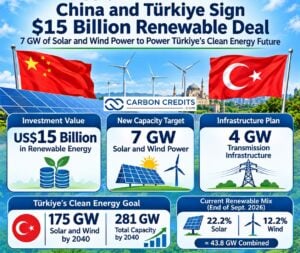
China and Türkiye have signed a preliminary agreement that could bring about US$15 billion in renewable energy investment to Türkiye. Announced during COP31 in Antalya, the deal aims to develop 7 gigawatts (GW) of solar and wind power, new energy storage systems, and 4 GW of electricity transmission infrastructure.
The agreement supports Türkiye’s plan to expand clean energy, improve energy security, and reduce its dependence on imported fossil fuels. It also includes technology transfer and plans to produce wind turbine equipment locally.
However, the US$15 billion is an estimated investment under a preliminary memorandum of understanding (MoU). The governments have not yet disclosed project locations, financing terms, participating companies, or construction schedules.
China–Türkiye Deal Targets 7 GW of New Renewable Capacity
Türkiye’s Ministry of Energy and Natural Resources and China’s National Energy Administration signed the MoU during COP31. Energy Minister Alparslan Bayraktar announced the agreement, which outlines several areas of cooperation.
The proposed investment covers 7,000 megawatts (MW) of combined solar and wind power capacity. It also includes new energy storage systems and 4,000 MW of electricity transmission infrastructure.
The deal goes beyond building new renewable power plants. It also aims to transfer technology and support local production of wind turbine equipment in Türkiye. This could help develop the country’s domestic supply chain and create opportunities for local manufacturers.
China is a major global supplier of solar panels, batteries, and wind power equipment. Its involvement could support Türkiye’s plans to expand renewable energy while building more local manufacturing capacity.
Still, key details remain unknown. The announcement does not identify the companies involved, the amount of storage capacity planned, or when construction could begin. The US$15 billion should be seen as a proposed investment. It is not for money already spent or projects that are under construction.
Türkiye Sets 175 GW Solar and Wind Goal for 2040
The agreement comes as Türkiye prepares for a major expansion of its power system. Under its National Energy 2040 vision, the country aims to increase total installed electricity capacity from about 128 GW to 281 GW by 2040.
Solar and wind are expected to account for 175 GW of that total. The plan also includes 10 GW of nuclear power capacity.
Türkiye’s current renewable energy base gives it a starting point for this expansion. By the end of September 2026, the country had 127,355 MW of installed electricity capacity. Solar accounted for 22.2%, while wind made up 12.2%. Together, they represented about 43.8 GW.
The proposed 7 GW of new solar and wind capacity would equal around 16% of this existing combined capacity. This will be a key step toward the 175 GW target. However, the agreement does not specify how much capacity will be built or when it will start operating.
The government’s wider plan reflects rising electricity demand. Türkiye’s electricity consumption reached 364.8 terawatt-hours (TWh) in 2025. The National Energy Plan expects consumption to reach 455.3 TWh by 2030 and 510.5 TWh by 2035.
Meeting this demand will require more power generation, stronger grids, and systems that can manage a growing share of variable renewable energy.
Fossil Fuels Still Dominate Türkiye’s Power Generation
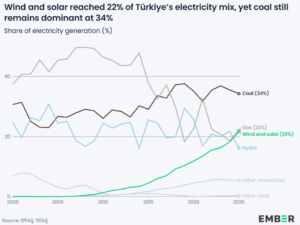
Despite its growing renewable energy capacity, Türkiye still relies heavily on fossil fuels for electricity. Government figures show that the country generated 366.9 TWh of electricity in 2025, an increase of 3.5% from 2024. Coal supplied 33.3% of generation, while natural gas accounted for 22.3%.
Hydropower contributed 15.7%, followed by solar at 11.9% and wind at 10.8%. Geothermal and other sources supplied the remaining share.
- Solar and wind together generated 22.7% of the country’s electricity. Coal and natural gas still provided more than half.
This mix shows why adding renewable capacity matters. More solar and wind power could reduce the role of fossil fuels in electricity generation, especially as demand grows.
Energy security is another major reason for the shift. Türkiye imports much of its oil and natural gas, leaving its economy exposed to global fuel prices and supply disruptions. Expanding domestic renewable energy could reduce some of this exposure and diversify its electricity supply.
The International Energy Agency (IEA) has highlighted Türkiye’s dependence on imported fuels and the need to modernize its energy system. Renewable power, energy efficiency, and stronger electricity networks will all play a role in the country’s transition.
Storage and Grid Investment Will Support Türkiye’s Renewable Expansion
The China–Türkiye agreement also covers energy storage and transmission infrastructure. These investments are important because adding solar and wind farms alone will not ensure a reliable electricity supply.
Solar and wind output changes with weather conditions and the time of day. Solar plants, for example, produce less electricity at night. Wind generation can also rise or fall depending on weather patterns.
Battery storage can help balance these changes by storing excess electricity and releasing it when production falls or demand increases. This can make it easier to use more renewable power without relying as heavily on fossil fuel plants.
Transmission networks are just as important. They carry electricity from power plants to homes, businesses, and industries. Stronger grids can help move renewable electricity between regions and reduce bottlenecks that limit new projects.
Türkiye’s National Energy 2040 vision recognizes the need for more storage, flexible power systems, and stronger grid connections. The China agreement could support these goals, although it has not yet disclosed the storage capacity or specific transmission projects involved.
China Deal Could Boost Türkiye’s Local Wind Equipment Industry
The proposed technology transfer is another important part of the agreement. Türkiye wants to produce more wind turbine equipment locally as it expands renewable energy. Working with Chinese companies could give local manufacturers access to equipment, technical knowledge, and production methods.
This could support domestic businesses and create opportunities across the renewable energy supply chain. These may include turbine components, electrical equipment, engineering, construction, and maintenance.
Local manufacturing could also reduce dependence on imported equipment over time. However, the actual benefits will depend on the final investment agreements, technology-sharing terms, and the role given to Turkish suppliers.
The governments have not yet disclosed specific factories, production targets, or local-content requirements. These details will help show whether the agreement leads to a lasting expansion of Türkiye’s clean energy industry.
COP31 Finance Push Supports Türkiye’s 2053 Net-Zero Target
The China–Türkiye agreement is part of a wider effort to finance the country’s energy transition. At COP31, the European Bank for Reconstruction and Development (EBRD) announced it will invest US$6 billion over five years. This funding will support Türkiye’s Renewable Energy Acceleration and Clean Transition Platform (REACT).
The wider platform aims to mobilize US$300 billion by 2040 for renewable power, grids, storage, manufacturing, and electrification. Separately, the Asian Infrastructure Investment Bank (AIIB) signed a US$1.6 billion climate financing package to support policy reforms and Türkiye’s climate commitments. This funding is not direct financing for the China-backed projects.
These investments support Türkiye’s goal of reaching net-zero emissions by 2053. Its 2025 climate pledge aims for a 2035 emissions target of 643 million tonnes of CO2 equivalent (MtCO2e). This is much lower than the projected business-as-usual emissions of 1,109 MtCO2e.
Expanding solar and wind power could help reduce emissions from electricity generation, while electrification could cut fossil fuel use in other sectors. However, Türkiye must also address its continued reliance on coal and natural gas and strengthen its power grid.
The proposed 7 GW of solar and wind capacity, along with storage and transmission upgrades, could support these goals. But the agreement’s impact will depend on implementation. The governments must still confirm project financing, participating companies, and construction plans before the investment can translate into new clean energy capacity and measurable emissions cuts.