

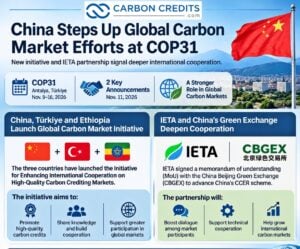
China is taking steps to expand its role in global carbon markets through two new developments announced at COP31 in Türkiye. The country has joined Türkiye and Ethiopia in launching an initiative to strengthen international cooperation on high-quality carbon credits. It has signed a memorandum of understanding (MoU) with the International Emissions Trading Association (IETA), which aims to boost the growth and global reach of its domestic voluntary carbon market (VCM).
Both announcements were made on November 11, 2026, in Antalya. Together, they signal China’s growing interest in international carbon market cooperation and the rules under Article 6 of the Paris Agreement.
The new initiative aims to improve cooperation between countries and promote high-quality carbon credit markets. The IETA agreement will boost dialogue, technical cooperation, and knowledge sharing. This will connect China’s market operators with international participants.
The developments come as China works to strengthen its domestic carbon market and build closer links with global trading systems.
China, Türkiye, and Ethiopia Launch Global Carbon Market Initiative
China, Türkiye, and Ethiopia jointly launched the Initiative for Enhancing International Cooperation on High-Quality Carbon Crediting Markets at the COP31 China Pavilion. The initiative aims to encourage cooperation on developing and using high-quality carbon credits. It also provides a platform for countries to exchange knowledge and experience as they expand their carbon market systems.
China’s Vice Minister of Ecology and Environment, Li Gao, highlighted the country’s support for multilateral cooperation during the launch. He also described carbon credits as a global public good, saying:
“We welcome governments, international organizations and relevant institutions to join us in delivering a new global public good for climate action.”
The partnership brings together China, the host of COP31, and Ethiopia, which is set to host COP32 in 2027. Türkiye’s participation also connects the initiative with the current climate conference presidency.
The three countries are seeking to promote greater cooperation in carbon credit development and market practices. This includes improving the quality of credits and encouraging wider participation in international carbon markets.
However, the initiative should not be confused with a new international carbon trading agreement. Its launch doesn’t automatically allow cross-border credit transfers. It also doesn’t create a system that connects the carbon markets of the participating countries. Instead, it creates a basis for further cooperation and dialogue.
IETA and Beijing Green Exchange Target Greater CCER Cooperation
On the same day, IETA and the China Beijing Green Exchange (CBGEX) signed a MoU. This agreement will help develop and internationalize China’s Certified Emission Reduction (CCER) scheme.
Under the agreement, the two organizations will promote dialogue among policymakers, regulators, and domestic and international market participants. They will also work together on technical cooperation, knowledge sharing, and high-integrity carbon market practices.
The partnership could help international market participants better understand China’s domestic crediting system and its rules. It may also support greater cooperation between Chinese institutions and global carbon market organizations.
CBGEX plays a central role in this effort. China’s Ministry of Ecology and Environment (MEE) allows it to run the national voluntary greenhouse gas emission reduction trading system.
The exchange manages the trading platform for CCERs, which are credits generated by approved domestic emissions reduction projects. These credits can boost income for projects that follow China’s rules on measurement, verification, and registration.
The MoU is a strategic cooperation agreement. It does not automatically make CCERs eligible for international trading or use under Article 6. Any cross-border transfer would still need to meet the relevant national and international rules.
China’s Domestic Carbon Markets Gain Trading Activity
The two COP31 announcements build on China’s efforts to strengthen its domestic carbon market. China operates two main systems. Its national emissions trading system (ETS) covers major industrial emitters and requires them to manage their emissions allowances.
The separate national voluntary carbon market allows eligible projects to generate CCERs from verified emissions reductions or removals.
China restarted its national voluntary crediting market in January 2024. It had paused new project registrations in 2017 to review its rules and methods.
The first batch of new CCERs was registered in March 2025. According to the MEE, these credits came from nine offshore wind and solar thermal projects. They totalled 9.48 million tonnes of carbon dioxide equivalent (CO2e).
- Trading has since increased. In 2025, the voluntary market had 8.84 million tonnes of CCER transactions. This totaled 626 million yuan, roughly $89 million. The average transaction price was 70.76 yuan per tonne.
China’s compliance market has also grown. In 2025, its national ETS covered 3,378 key emitters across the power, steel, cement, and aluminum sectors. Trading volume reached 235 million tonnes of emissions allowances, worth 14.63 billion yuan.
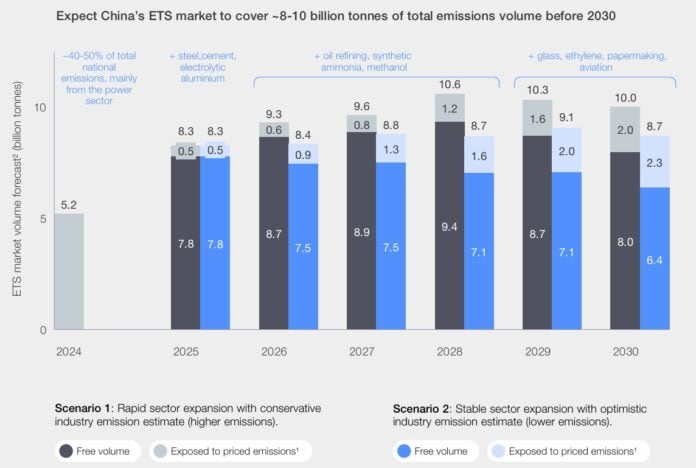
These figures show the scale of China’s domestic carbon market. They also provide a foundation for its efforts to increase international cooperation.
Article 6 Could Create New Opportunities for China
China’s growing international engagement comes as countries work to implement Article 6 of the Paris Agreement. Article 6 allows countries to cooperate in meeting their climate targets.
Under Article 6.2, countries can transfer internationally transferred mitigation outcomes (ITMOs) through bilateral or other cooperative arrangements. Article 6.4 establishes a UN-supervised crediting mechanism for eligible emissions reduction and removal projects.
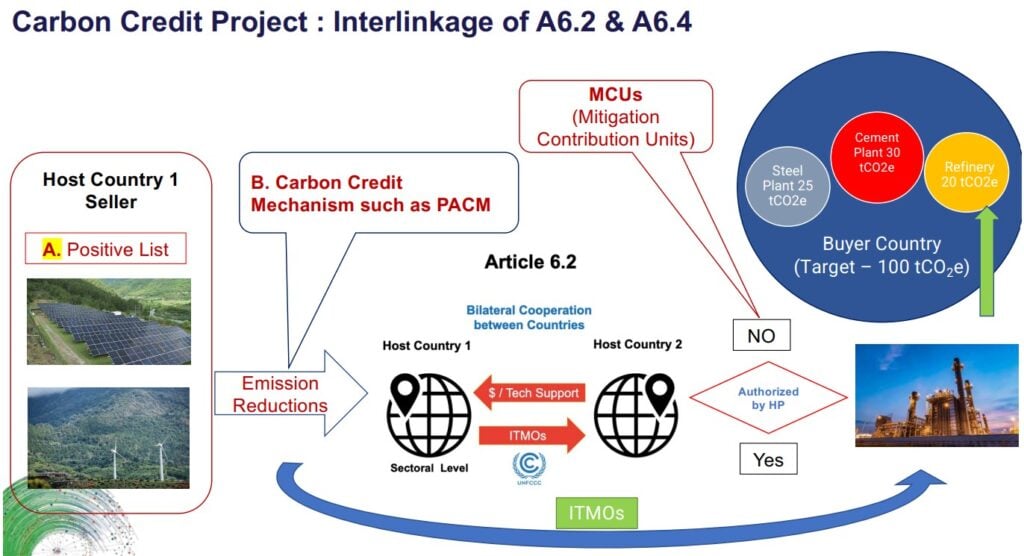
These mechanisms require clear rules for authorizing credits and tracking their use. Adjustments are also needed under Article 6.2. This prevents the same emissions reduction from counting toward two countries’ climate targets.
China’s new initiative and its partnership with IETA could support discussions on these issues. They may also help Chinese market institutions engage more closely with international buyers, developers, and policymakers.
However, the announcements do not confirm that China has begun transferring CCERs internationally under Article 6. Its domestic voluntary credits remain subject to China’s own rules. International use would require the relevant authorizations and accounting arrangements.
This distinction is important for carbon credit buyers. Domestic certification does not automatically mean that a credit can be used toward another country’s climate target or under international compliance programs.
China Targets Wider ETS Coverage by 2027
China’s international outreach also supports its wider plans to strengthen its carbon pricing system. In August 2025, the Chinese government issued guidelines to expand the national carbon market and improve its voluntary crediting system.
The policy aims to bring all major industrial sectors into the national ETS by 2027. It also calls for broader coverage of key sectors under the voluntary market.
By 2030, China plans to build a more advanced carbon market. This will include stricter rules, more participants, and better alignment with global standards.
The guidelines also call for deeper international exchanges and cooperation. This includes work toward greater recognition of carbon market methods, standards, technologies, and data across countries.
The COP31 initiative and IETA partnership fit within this broader direction. They give China additional channels to share its market experience and build relationships with international institutions.
What the Developments Mean for Global Carbon Markets
China’s announcements could have wider implications for the VCM and international climate cooperation. As one of the world’s largest emitters, China has significant potential to influence the future development of carbon trading. Its domestic market also offers a large base of industrial participants, project developers, and potential credit buyers.
Closer cooperation with IETA could help improve communication between Chinese market institutions and international businesses. It may also support the exchange of technical knowledge and stronger approaches to credit quality.
The new initiative with Türkiye and Ethiopia adds another platform for international dialogue. Its progress could help countries share experience, strengthen market systems, and explore opportunities for cooperation.
Still, the impact will depend on what follows the announcements. The partners still need to show how the initiative will lead to projects, investments, or international credit deals. The IETA MoU also needs to lead to practical cooperation before its market benefits can be measured.
For now, the two developments show that China wants a more active role in international carbon market discussions. As Article 6 moves from rulemaking toward implementation, China’s ability to connect its domestic crediting system with global market practices will be an important development to watch.