

China is proposing a major expansion of its domestic carbon credit market, with 11 new methods that could allow more industries to generate credits for cutting greenhouse gas emissions. The proposals cover clean fuels, battery storage, electric mining vehicles, plastic recycling, and food waste treatment. They could widen the range of projects eligible to earn credits under China’s national voluntary emissions reduction program.
China’s Ministry of Ecology and Environment (MEE) published two groups of draft methods: One contains five proposals, while the other contains six. The ministry is seeking public feedback until October 23. The methods have not yet been approved.
The move comes as China continues to develop its carbon market. If adopted, the new methods could open more ways for companies to earn carbon credits while supporting the country’s wider efforts to cut emissions.
11 New Methods Target Clean Fuels, Batteries and Waste
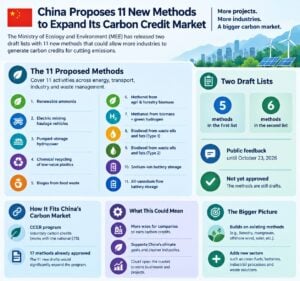
The proposed methods cover 11 activities across energy, transport, industry and waste management. Five drafts focus on renewable ammonia, electric mining haulage vehicles, pumped-storage hydropower, chemical recycling of low-value plastics, and biogas production from food waste.
The other six include:
- Methanol from agricultural and forestry biomass.
- Methanol from biomass mixed with green hydrogen.
- Two types of biodiesel from waste oils and fats.
- Energy storage with sodium-ion batteries.
- Energy storage with all-vanadium flow batteries.
These activities target different sources of emissions. Some could replace fossil fuels with lower-carbon alternatives. Others could improve energy storage, reduce fuel use in mining, or turn waste into useful products.
The proposed methods would set rules for how eligible projects are designed, assessed, and monitored. They would also establish how projects calculate their emissions reductions and how those results are checked.
That standardization matters because carbon credits need a consistent way to measure the emissions avoided or reduced by a project. Without clear rules, it becomes harder to compare projects and judge whether their claimed climate benefits are real.
New CCER Methods Could Broaden China’s Carbon Credit Market
China’s voluntary carbon credit program is known as China Certified Emission Reduction, or CCER. It works with the country’s national emissions trading system (ETS). This system requires companies to manage and give up emissions allowances based on government rules.
The CCER program resumed trading in January 2024. It provides a route for eligible projects to generate credits under China’s domestic system. These credits can be used under applicable market rules, including to meet part of the compliance needs of covered companies.
Before this latest proposal, China approved 17 methods under the current CCER framework. This information comes from a June 2026 overview by Columbia University’s Center on Global Energy Policy. The 11 new drafts would represent a substantial expansion if they are all approved.
The proposals also reflect a wider effort to bring more types of emissions-reduction projects into the system. Previous methods included:
- Forest planting,
- Mangrove restoration,
- Offshore wind power,
- Solar thermal power,
- Energy-saving highway tunnel lighting, and
- Using low-concentration coal mine gas.
The new proposals extend this approach into areas such as alternative fuels, industrial processes and energy storage. That could give more businesses a path to participate in carbon credit generation, although eligibility will depend on the final rules.
RELATED: China’s Farmland Could Remove 350 Million Tonnes of CO₂ a Year, Study Finds
China’s Wider Carbon Market Is Also Growing
China operates two connected but distinct systems: a national emissions trading system (ETS) for covered emitters and the China Certified Emission Reduction (CCER) program, which allows eligible projects to generate carbon credits.
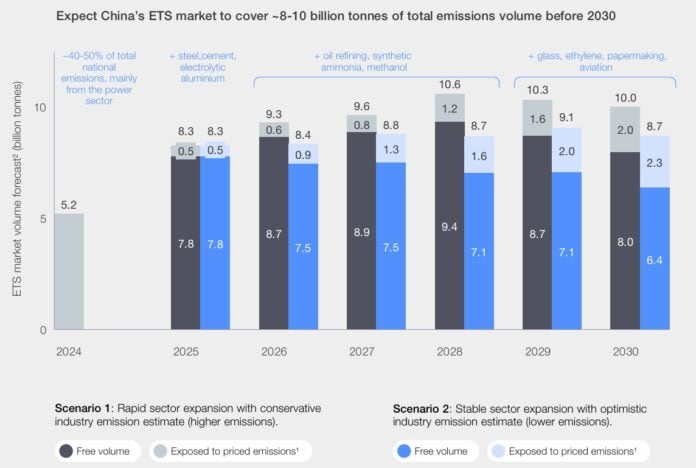
The national ETS is China’s main compliance carbon market. Its trading activity has continued to grow. Cumulative allowance trading exceeded 930 million tonnes by the end of July 2026, according to figures reported by Xinhua and cited by Carbon Herald.
On October 21, Vice-Minister of Ecology and Environment Li Gao announced that cumulative trading had passed 1 billion tonnes. The system covers about 8.3 billion tonnes of CO₂ emissions, representing more than 65% of China’s total carbon dioxide emissions.
China also plans to extend the ETS to major emitting industries, including petrochemicals and chemicals, by 2027. The government said its policies helped reduce emissions in the thermal power sector by about 530 million tonnes of CO₂ during 2021–2025.
These developments provide important context for the 11 proposed CCER methods. While the ETS regulates emissions through allowance trading, the CCER program creates a route for eligible projects to earn credits. The proposed methods could expand the types of projects that qualify, but their impact will depend on final approval and the verified emissions reductions they deliver.
Carbon Credit Quality Will Depend on Strong Measurement Rules
More methods could create more routes for companies to seek carbon credits. But expanding the list of eligible activities does not guarantee that every project will deliver the emissions reductions it claims.
The final methods will need clear rules for setting emissions baselines, measuring results, and checking project performance. A baseline estimates what emissions would have occurred without the project. The difference between that baseline and the project’s actual emissions helps determine how many credits it may qualify to generate.
The rules also need to account for emissions created during production and operation. For example, a fuel made from waste or biomass is not automatically emissions-free. Its overall climate benefit depends on factors such as how the feedstock is sourced, how much energy production uses, and what emissions the new fuel replaces.
Energy storage projects also need sound accounting. Their climate benefits can depend on when and how the stored electricity is generated and used. If a battery charges with high-emissions electricity, its benefit may be smaller than if it stores power that would otherwise go unused from a lower-carbon source.
These issues make measurement, reporting, and verification essential. Strict rules can help ensure that credits reflect real emissions reductions rather than overstated estimates.
Public Consultation Is the Next Step
China’s consultation period for all 11 draft methods closes on October 23, 2026. The MEE will consider feedback before the proposals can move forward. The ministry has not yet confirmed that all 11 will be approved.
For project developers, approval could create new opportunities to seek crediting under the CCER program. For companies that buy credits to meet applicable obligations, the new methods could eventually broaden the range of available projects.
However, the number of proposed methods is only one measure of progress. The next milestones will be final approval, clear eligibility rules, project registration, and verified emissions reductions.
China’s proposal signals a wider scope for its domestic carbon credit system. Whether that expansion leads to a meaningful increase in high-quality credits will depend on how the methods are finalized and applied in practice.