

Global demand for transition metals is expected to grow as electric vehicles (EVs), renewable energy, battery storage and electricity networks expand. However, supply risks vary across commodities, with some markets facing potential shortages while others could experience oversupply.
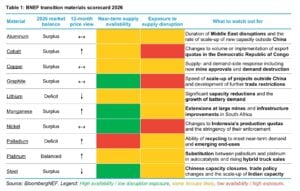
BloombergNEF’s (BNEF) Transition Metals Outlook 2026 highlights these differences. Copper faces the biggest long-term supply challenge, while lithium demand could triple by 2050. However, new mining capacity could ease lithium shortages in the near term and put pressure on prices as supply expands.
The outlook presents both opportunities and risks for mining companies and investors. Demand for battery materials is growing, but rising consumption does not automatically guarantee higher prices or stronger returns for producers.
Transition Metals Demand Will Rise Through 2050
BNEF’s report examines 10 materials: aluminum, cobalt, copper, graphite, lithium, manganese, nickel, palladium, platinum and steel. Under the report’s Economic Transition Scenario, demand for eight of these materials is expected to rise by 2050.
Copper presents the biggest long-term challenge. Demand could rise 61% between 2026 and 2050, reaching nearly 46 million metric tons annually. Without additional supply, the market could face a deficit of 20 million metric tons by 2050, equivalent to 44% of projected demand. BNEF estimates that bridging this gap could require $332 billion in new mine investment.
Graphite is another major growth market, with demand expected to more than double by 2050 as battery production expands. Meanwhile, changes in battery chemistry, particularly the growing adoption of lithium iron phosphate (LFP) batteries, have reduced BNEF’s demand projections for cobalt and nickel compared with previous estimates.
Recycling Will Help Close Supply Gaps
China dominates the refining of several transition metals, leaving manufacturers in other regions exposed to trade restrictions and supply disruptions. Governments and companies will need to diversify sourcing and expand recycling to strengthen supply security.
BNEF expects recycling to become essential for six of the 10 materials by 2035 and eight by 2050. Battery recycling is projected to expand faster than primary production between 2026 and 2050.
Recycling could help companies:
- Recover valuable metals from used batteries.
- Reduce reliance on newly mined materials.
- Diversify supply chains and limit exposure to trade disruptions.
- Support demand growth as more EV batteries reach the end of their useful lives.
Lithium Demand Could Reach 4.8 Million Tonnes
Lithium is a key material in rechargeable batteries used in electric cars, consumer electronics and grid-scale energy storage. Demand is expected to increase as transport electrification accelerates and power systems require more storage to balance variable renewable electricity generation.
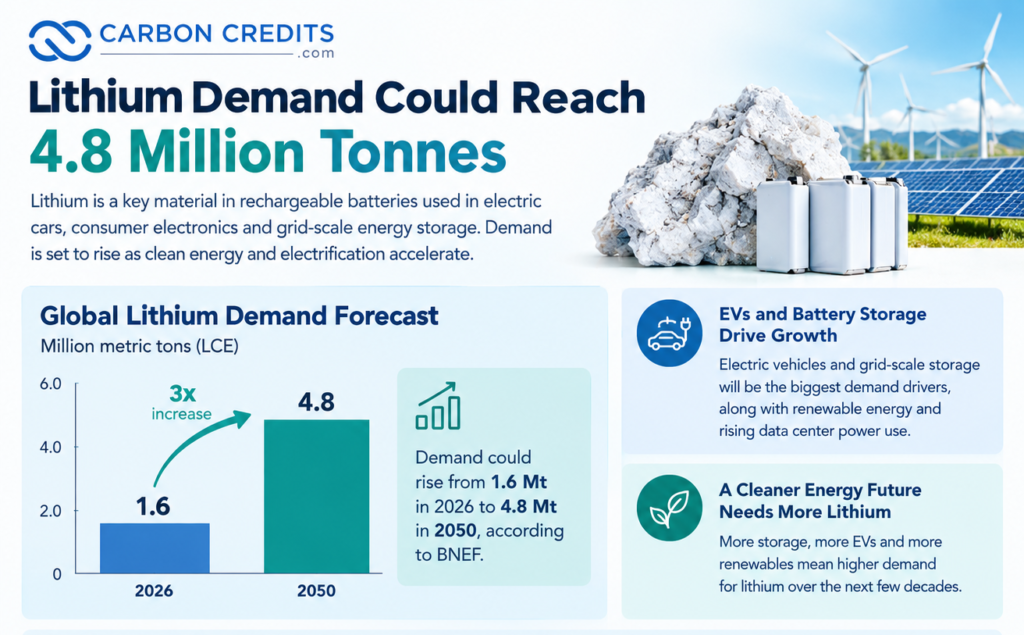
According to BNEF, global lithium demand is projected to rise from 1.6 million metric tons of lithium carbonate equivalent (LCE) in 2026 to 4.8 million metric tons in 2050. This represents a threefold increase over the period.
EVs and Battery Storage Drive Growth
Electric vehicles remain a major source of lithium consumption, but stationary battery storage is becoming increasingly important. Utilities are installing batteries to balance electricity supply and demand, support grid reliability, and store excess solar and wind power. Rising electricity consumption from data centers could also strengthen the need for storage.
The main demand drivers include:
- Electric vehicles: Automakers continue to expand their EV offerings and battery manufacturing capacity.
- Grid-scale storage: Utilities use lithium-ion batteries to improve grid flexibility and integrate renewable power.
- Renewable energy: Solar and wind projects need storage to help manage changes in electricity generation.
- Battery technology: Advances in battery design could improve performance and change lithium requirements.
However, the pace of demand growth will depend on EV sales, energy storage investment, government policies and battery technology. Improvements in battery efficiency and the adoption of alternative chemistries could change how much lithium manufacturers need for each unit of storage capacity.
Lithium Production Expands as New Projects Advance
Despite strong long-term demand, lithium supply has expanded rapidly following earlier price increases. Producers developed new mines and processing capacity, contributing to oversupply and a sharp price correction in 2023–2025.
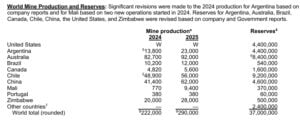
The U.S. Geological Survey (USGS), in its Mineral Commodity Summaries 2026, estimated that global lithium mine production outside the United States rose 31% in 2025 to approximately 290,000 metric tons of lithium content, up from 222,000 tons in 2024. Global consumption reached an estimated 263,000 tons, a 20% increase from 220,000 tons in 2024.
These figures use lithium content rather than LCE, so they are not directly comparable with BNEF’s demand forecast. They nevertheless illustrate the rapid expansion in mining output and consumption.
- INTERESTING READ: Every Lithium Stock Just Woke Up From a 3-Year Coma – Katusa Research
Which Countries Supply Lithium?
Australia, Chile, China and Argentina remain important lithium producers. New projects and capacity expansions in countries such as Brazil, Canada and Zimbabwe could add further supply. However, permitting, financing, infrastructure, and processing constraints can delay new production.
Producers face several challenges as they expand capacity:
- Securing financing for new mines and processing facilities.
- Managing production costs when lithium prices fall.
- Obtaining permits and developing infrastructure.
- Meeting environmental requirements and local community expectations.
- Bringing projects online before market conditions change.
A Near-Term Deficit Could Give Way to Surplus
BNEF expects the lithium market to face a near-term deficit in 2026. New supply capacity coming online in 2027 could help resolve the shortfall. Over the longer term, additional production could push the market toward surplus conditions.
For investors, the distinction between a temporary deficit and a structural shortage matters. Delayed projects or production cuts could tighten the market, while rapid capacity growth could limit producers’ pricing power.
Lithium Prices Remain Under Pressure
Lithium prices have been volatile as the market responds to changes in production, demand, and inventory levels.
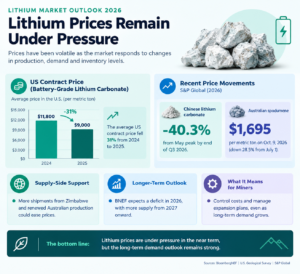
USGS estimated that the average US contract price for battery-grade lithium carbonate fell to $9,000 per metric ton in 2025, down 31% from $11,800 in 2024. Stronger EV sales in China and Europe, along with growing demand for battery storage, later helped support a market recovery.
Latest data for Lithium Carbonate pricing: 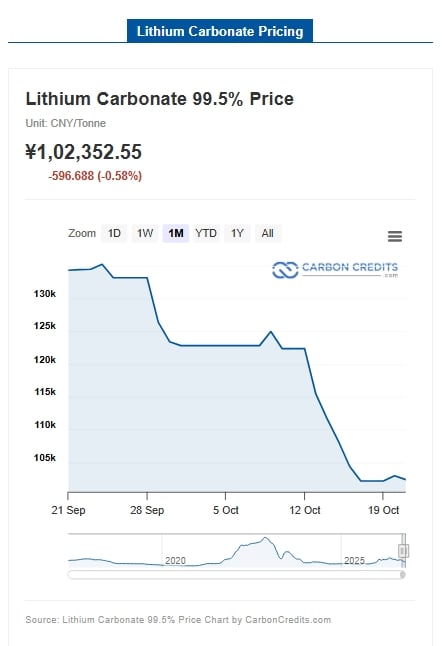
Recent Price Movements Signal Volatility
S&P Global reported recently that, in 2026, Chinese lithium carbonate prices had fallen 40.3% from their May peak by the end of the third quarter. It also assessed Australian spodumene at $1,695 per metric ton on October 9, down 28.5% from July 1.
The reseach firm expects additional shipments from Zimbabwe and the resumption of Australian production to improve feedstock availability, potentially putting further pressure on prices. Shipment delays and strong spot demand could still trigger renewed volatility.
BNEF’s outlook also points to longer-term pricing pressure as supply capacity expands. Although the market could experience a deficit in 2026, additional production may ease supply conditions from 2027 onward.
For mining companies, this means that controlling costs and managing expansion plans will remain critical, even as long-term demand grows.
Lithium Prices Outlook summarized:
What Could Change the Lithium Outlook?
Several factors will influence the balance between lithium demand and supply.
- Faster battery storage growth: More grid-scale projects could increase demand beyond current expectations.
- Mine delays or closures: Supply disruptions could tighten the market and support prices.
- Faster capacity expansion: New mines could create surplus supply and limit price recovery.
- Battery innovation: Alternative chemistries and more efficient designs could change lithium consumption.
- Recycling growth: Recovering lithium from used batteries could reduce reliance on primary production over time.
What the Outlook Means for Investors
Lithium offers long-term demand growth but also significant price risk. Producers with competitive costs, reliable processing capacity and strong balance sheets may be better positioned to withstand market downturns.
The broader transition metals outlook reinforces an important point: growing demand does not automatically lead to sustained shortages or higher prices. Copper faces a potentially widening structural supply gap, while lithium could move from a near-term deficit toward a more balanced or oversupplied market.
Investors should therefore monitor production costs, project timelines, recycling capacity and battery storage deployment alongside demand forecasts. These factors will help determine which companies can turn the energy transition’s growing need for metals into sustainable returns.