

Lithium’s recovery is giving Australia’s largest independent lithium producer a reason to become more aggressive about growth. PLS Group, formerly Pilbara Minerals, expects the lithium market to tighten in the coming years and is preparing to expand its flagship Pilgangoora operation in Western Australia.
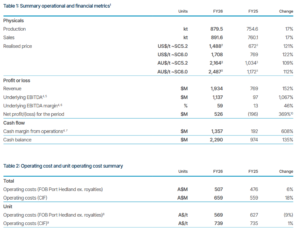
The company also returned cash to shareholders for the first time since 2023 after higher lithium prices helped drive a sharp recovery in FY2026 earnings. PLS reported an A$526 million net profit for the year ended June 30, compared with an A$196 million net loss a year earlier.
Revenue reached A$1.934 billion, while underlying EBITDA, a measure of operating earnings, climbed to A$1.137 billion.
The stronger results reflect both higher lithium prices and record production. They also show how quickly lithium miners can recover when prices turn after a prolonged downturn.
Lithium Price Rebound Puts PLS Back on the Front Foot
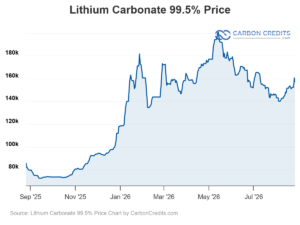
Lithium prices have staged a major recovery in 2026 after several years of weak conditions. It reached about CNY 157,000 per tonne on August 26, down 2.18% from the previous day but still 92% higher than a year earlier. The price had also gained about 7.2% over the previous month.
The recovery has changed the outlook for producers such as PLS.
The company’s FY2026 results clearly show the effect. PLS increased spodumene production by 17% to 879,500 tonnes and sales by 17% to 891,600 tonnes. Higher realized prices and tighter cost control helped push revenue to almost A$1.93 billion.
The company also ended FY2026 with A$2.29 billion in cash, giving it more room to invest in new capacity.
PLS Sees a Stronger Lithium Cycle Ahead
PLS CEO Dale Henderson has taken a bullish view of the market. He said the company believes lithium has entered a new part of its cycle, supported by strong demand and limited supply growth. He specifically noted:
“Lithium is a volatile market, and our strategy is designed to use that cycle to our advantage rather than as a limitation.”
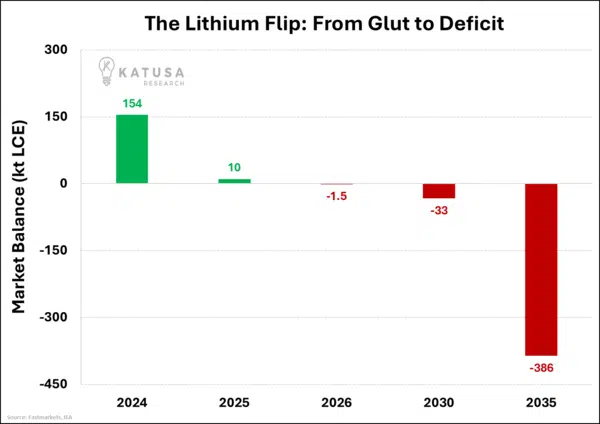
PLS expects a supply shortfall to develop in the coming years, according to Bloomberg’s report on the company’s results. That view contrasts with the oversupply that weighed on lithium prices through much of 2024 and 2025.
The recent improvement has come as battery demand strengthens, while some producers remain cautious about bringing capacity back online after the price downturn.
PLS has already responded by restarting idled capacity and moving growth projects forward. The company said it entered FY2027 “larger, lower-cost, and financially stronger” than a year earlier.
Still, lithium remains a highly cyclical commodity. A new wave of supply could again pressure prices if production grows faster than battery demand.
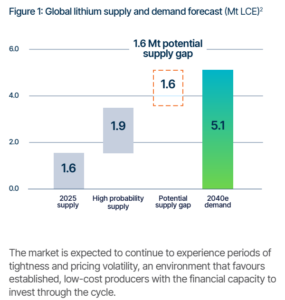
The Australian miner estimates that there would be around 1.6 Mt potential supply gap to meet the 2040 demand, growing from 1.5 million tonnes of lithium in 2025 to 5.1 million tonnes by 2040.
PLS Plans to Double Pilgangoora Capacity
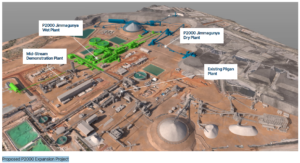
The biggest growth opportunity is P2000, a proposed expansion of the Pilgangoora operation. PLS is studying a brownfield expansion that could lift spodumene concentrate capacity to about 2 million tonnes per year. The company expects to complete its feasibility study in the December quarter of 2026.
PLS has already approved about A$175 million in pre-final investment decision spending to keep the project moving. The spending covers engineering, long-lead equipment, early site work, and infrastructure.
A final investment decision could follow the feasibility study, subject to the results, funding capacity, and market conditions. If approved, P2000 could produce its first ore in mid-2029.
The lithium miner estimates the project may need over A$1.2 billion in investment. It could create more than 1,000 construction jobs and support around 500 ongoing operational roles. The expansion would give PLS substantially more exposure to a stronger lithium market.
The Company Is Bringing Capacity Back Online
PLS is not relying only on P2000. During FY2026, the company restarted the Ngungaju processing plant, which had been placed on care and maintenance during the lithium downturn. It is also progressing the Colina lithium project in Brazil and other growth initiatives.
This marks a clear change from the defensive strategy PLS used when lithium prices were weak.
During the downturn, producers focused on reducing costs, preserving cash, and cutting production where needed. As prices recovered, PLS began bringing capacity back and preparing for longer-term growth.
The company’s financial position now gives it more flexibility to do so. Its FY2026 cash balance reached A$2.29 billion, while it also completed its first US$600 million bond offering during the year.
That combination of stronger prices, higher production, and a larger cash position puts PLS in a stronger position to fund expansion.
First Dividend Since 2023
The lithium recovery is also flowing back to shareholders. PLS declared a fully franked final dividend of 5 Australian cents per share, representing a distribution of about A$161 million. It is the company’s first dividend since 2023.
The full-year dividend suggests the board now has greater confidence in cash generation. However, PLS still needs to balance shareholder returns against the large capital requirements of P2,000 and its other growth projects.
EVs, Batteries and the Next Wave of Lithium Demand
The long-term case for lithium rests heavily on demand from electric vehicles and energy storage. PLS has also pointed to growing demand from stationary batteries and emerging electric mobility markets, including electric trucks.
In April, CEO Henderson said customer discussions in China showed a broader recovery in lithium demand.
Energy storage is becoming particularly important. As grids add more solar and wind power, batteries can store electricity and supply it when renewable generation falls. That creates another source of lithium demand beyond electric cars.
The market, however, remains exposed to changes in battery chemistry, technology, and regional EV demand.
China’s growing use of sodium-ion batteries also creates a longer-term competitive risk for lithium in some applications, particularly lower-cost energy storage.
The Supply Crunch That Could Keep Lithium Prices Rising
PLS’s bullish outlook depends on supply failing to keep pace with demand. That is possible, but it is not guaranteed.
The lithium market has shown how quickly new supply can change prices. When prices surged in 2022 and 2023, producers and developers rushed to expand. The resulting supply growth helped push prices sharply lower.
Now, years of weak prices have forced some projects to slow, suspend, or delay development. That creates the potential for a tighter market if demand rises faster than producers can respond.
PLS is positioning itself for that possibility. Its P2000 project could eventually double Pilgangoora’s capacity to about 2 million tonnes a year, but the company will make the final investment decision only after completing its feasibility work.
This gives PLS some flexibility if market conditions weaken again.
PLS Shares Ride the New Lithium Bull Case
Investors have also responded to the stronger lithium outlook. PLS shares rose as much as 8.1% in Sydney on August 24 after the company released its FY2026 results, reversing an early decline.
The move reflects renewed confidence in lithium prices, PLS’s stronger earnings and its expansion plans. The stock’s performance also shows how closely PLS remains tied to the lithium cycle.
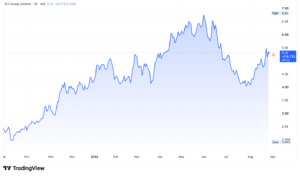
Stronger prices can quickly lift revenue and margins, while another supply-driven downturn could have the opposite effect.
The Hard Part: Can Lithium Stay Tight?
PLS’s FY2026 results show how much the lithium market has changed in a year. Production reached a record 879,500 tonnes, revenue climbed to A$1.934 billion, net profit reached A$526 million, and the company restored its dividend.
At the same time, PLS is preparing for a potential supply shortage and considering a major expansion that could take Pilgangoora to about 2 million tonnes of annual capacity.
The key question now is whether lithium demand can stay ahead of new supply.
If it does, PLS could enter a stronger growth phase with the balance sheet and production base to benefit. If new supply returns faster than expected, the company could again face the price pressure that defined the previous downturn.
For the broader lithium market, PLS’s decision to expand is itself a sign of how quickly sentiment has shifted from oversupply and cost-cutting toward tighter supply and renewed investment.