

The global battery industry is moving fast, and China’s battery giant CATL is already looking beyond today’s technologies.
At the 2026 Forum on Building China Into an Equipment Manufacturing Power, CATL Chief Scientist Wu Kai highlighted lithium-air batteries as one of the most promising technologies for the future. While the technology is still far from commercial use, its potential could transform electric vehicles (EVs) and energy storage systems over the next decade.
At the same time, CATL is pushing ahead with sodium-ion batteries and expanding its energy storage testing capabilities, showing that the company is working on both near-term and long-term battery solutions.
Why Lithium-Air Batteries Are Creating Excitement
Battery makers constantly search for ways to store more energy in smaller and lighter packages. This is where lithium-air batteries stand out.
- According to Wu Kai, lithium-air batteries could theoretically achieve an energy density of up to 3,500 watt-hours per kilogram (Wh/kg). That is several times higher than today’s commercial lithium-ion batteries.
Higher energy density means a battery can store more power without increasing weight. For electric vehicles, this could translate into significantly longer driving ranges. For energy storage systems, it could mean more power in a smaller footprint.
The concept itself is not new. Scientists first discussed lithium-air batteries in the 1970s, and rechargeable versions appeared in the 1990s. Since then, researchers worldwide have worked to unlock the technology’s potential.
Major companies and research groups have continued exploring the field. Around 2010, IBM conducted extensive lithium-air battery research. More recently, U.S. researchers reported important breakthroughs, including improved cycle life and energy density under laboratory conditions.
However, despite decades of research, lithium-air batteries remain largely confined to laboratories.
How Lithium-Air Batteries Work
Unlike conventional lithium-ion batteries, lithium-air batteries use metallic lithium as the anode.
The biggest difference lies on the cathode side. Instead of relying on heavy solid materials, lithium-air batteries use oxygen from the surrounding air. The oxygen enters through a porous carbon structure and participates in the battery’s chemical reactions.
This design reduces the amount of material required inside the battery, helping create an extremely lightweight system.
Because the battery draws oxygen from the atmosphere, it can theoretically achieve much higher energy density than existing battery technologies.
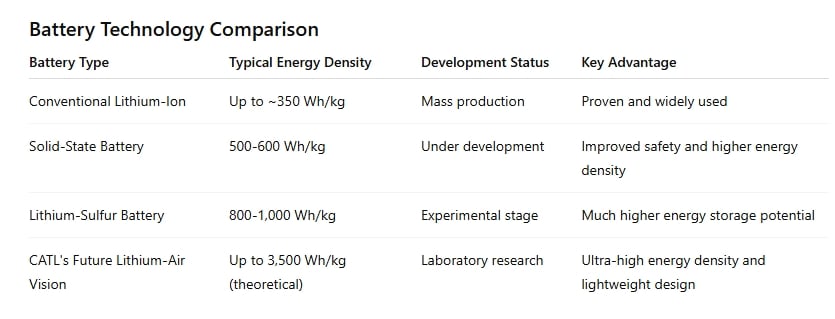
The table shows why lithium-air technology attracts so much attention. Even compared with advanced solid-state batteries, the theoretical energy storage potential is dramatically higher.
Significant Challenges Still Remain
Despite its promise, lithium-air technology faces several major obstacles.
One challenge involves lithium peroxide, a material that forms during discharge. This compound acts as an electrical insulator, making battery operation less efficient.
In addition, scientists still struggle with slow reaction speeds inside the battery. Catalysts designed to improve these reactions have yet to deliver consistent results.
Another issue is electrolyte stability. Current electrolytes tend to degrade over time, limiting battery lifespan. Furthermore, lithium metal anodes can develop dendrites—tiny needle-like structures that may reduce performance and create safety concerns.
Because of these technical barriers, industry experts generally believe large-scale commercialization remains at least a decade away.
- READ MORE: CATL’s Profit Surges 42% With Global Battery Demand and the Shift to a Zero-Carbon Future
Sodium-Ion Batteries Are Much Closer to Reality
While lithium-air batteries represent a long-term goal, CATL is making faster progress with sodium-ion technology.
The company unveiled its sodium-ion battery platform last year and expects large-scale production to begin in 2026.
Sodium-ion batteries use abundant sodium instead of lithium. Although they generally store less energy than lithium-based batteries, they offer several advantages:
- Lower material costs
- Greater resource availability
- Better performance in cold weather
- Reduced dependence on lithium supply chains
To support commercialization, CATL recently launched Phase VI expansion of its Fuding manufacturing base in Fujian Province.
The company plans to invest approximately RMB 5 billion ($725 million) in a new production line capable of adding 40 gigawatt-hours (GWh) of annual sodium-ion battery capacity.
Meanwhile, CATL and Changan Automobile have announced plans to launch the world’s first mass-produced passenger vehicle powered by sodium-ion batteries. The vehicle is expected to reach customers in mid-2026.
CATL Continues to Dominate Global EV Batteries
CATL’s investment strategy comes as the company strengthens its position in the global battery market.
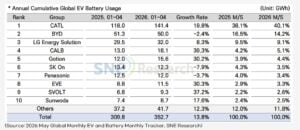
According to data from SNE Research, CATL installed 141.4 GWh of batteries worldwide during the first four months of 2026. That represented nearly 20% growth compared with the same period last year.
- The company’s global market share climbed to 40.1%, reinforcing its leadership in the EV battery sector.
Chinese battery manufacturers continue to gain ground across the industry. Companies such as CALB, Gotion, EVE Energy, SVOLT, and Sunwoda all reported strong year-over-year growth.
Meanwhile, BYD maintained its position as the world’s second-largest battery supplier. Although its battery installations declined slightly, the company’s overseas EV expansion and battery innovations could support future growth.
CATL Opens World’s Largest Energy Storage Validation Center
Beyond batteries themselves, the company is also investing heavily in energy storage reliability. It recently opened the CATL Xiamen Energy Storage Validation Research Institute (ESVL), which it describes as the world’s largest and most comprehensive energy storage testing and validation platform.
The facility covers roughly 10 hectares and required an investment of around RMB 3 billion ($440 million).
Importantly, CATL says the platform will operate as open infrastructure available to the broader energy storage industry.

Why Real-World Testing Matters
As energy storage installations expand worldwide, performance and reliability have become major concerns.
Many storage projects fail to perform exactly as expected after deployment. Delays in grid connection and operational challenges can increase costs and reduce returns for developers and investors.
CATL believes the industry must move beyond testing individual components and focus on validating entire systems under real operating conditions.
The ESVL facility is designed to evaluate:
- Safety performance
- Grid-support capabilities
- Long-term reliability
- Station-level operational performance
According to Wu Kai, scientific testing and rigorous validation will become increasingly important as energy storage projects grow larger and more complex.
The facility also works with international certification organizations, including TÜV SÜD, TÜV Rheinland, China General Certification Center, and CSA Group.
Looking Ahead
CATL’s latest moves reveal a two-track strategy. On one hand, the company is preparing for the future through advanced technologies such as lithium-air batteries. On the other hand, it is accelerating the commercialization of sodium-ion batteries and expanding energy storage infrastructure today.
Lithium-air batteries may still be years away from reaching consumers. Nevertheless, their enormous theoretical energy density makes them one of the most intriguing battery technologies under development.
Meanwhile, sodium-ion batteries and advanced energy storage systems are already moving toward commercial reality. Together, these efforts could help CATL maintain its position at the center of the rapidly evolving global battery industry.