

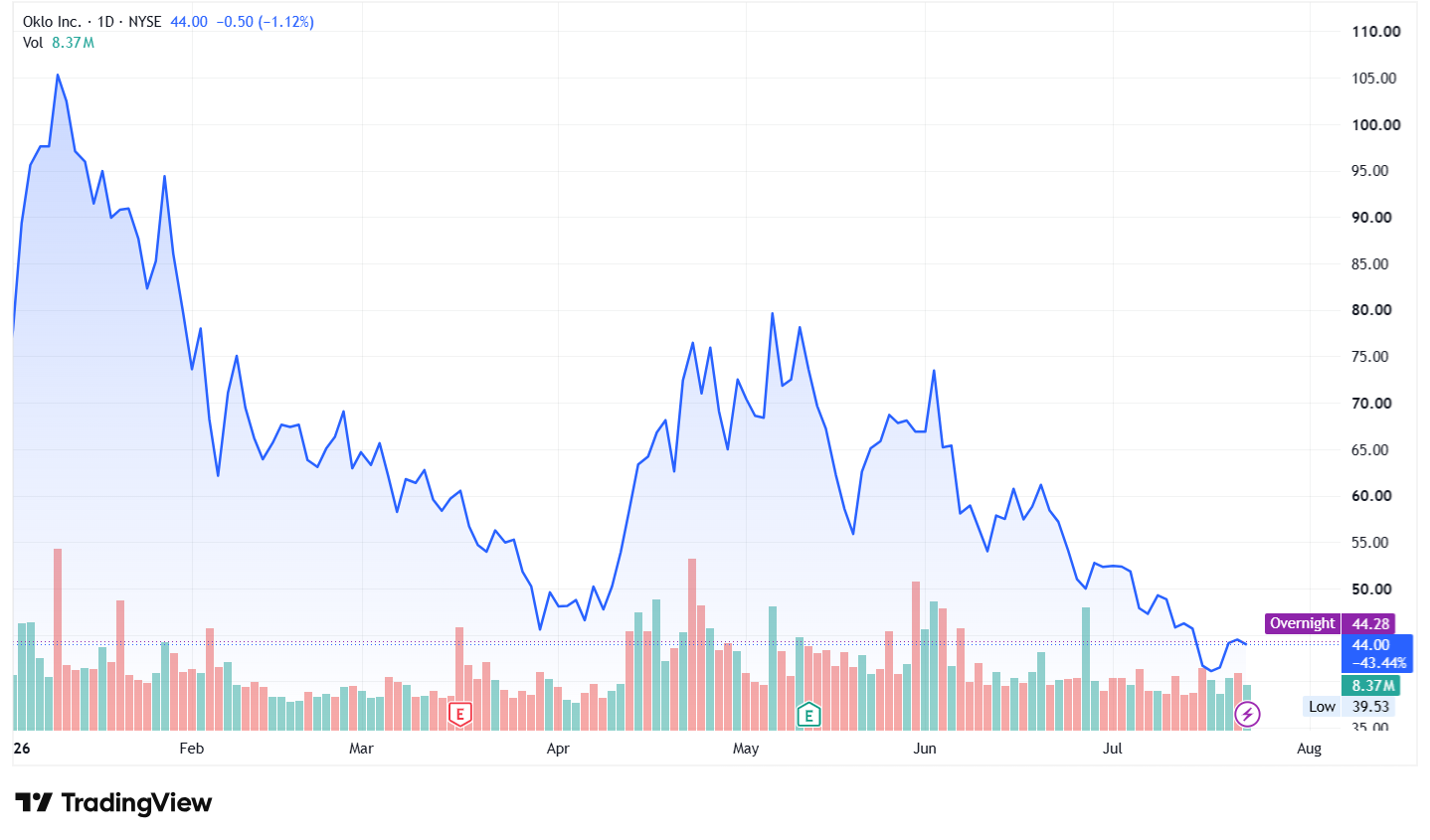
The race to power artificial intelligence (AI) has entered a new stage, and nuclear energy is moving to the center of it. Shares of Oklo (NYSE: OKLO) rose sharply. This came after news that the company was chosen for a $200 million U.S. government program.
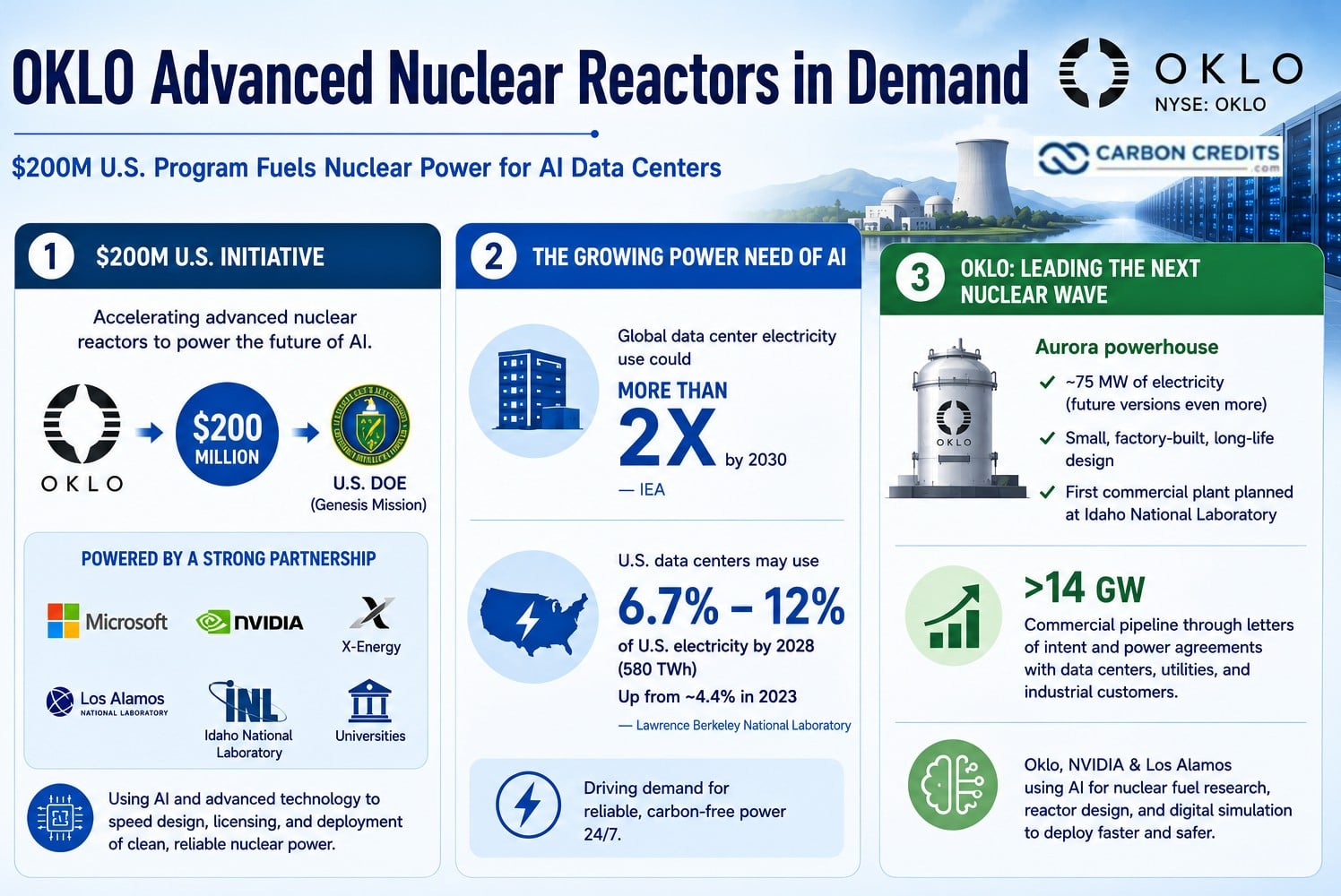
The initiative aims to speed up the use of advanced nuclear reactors for AI data centers. The program unites Oklo, Microsoft, Nvidia, X-Energy, national labs, universities, and the U.S. Department of Energy (DOE). Their goal is to create cleaner and more reliable power for future AI infrastructure.
Why Washington Is Investing $200M in AI-Powered Nuclear
The news highlights a growing shift in the energy sector. AI companies are no longer looking only for faster chips. They also need reliable electricity that runs around the clock without producing large amounts of carbon emissions.
For Oklo, the announcement strengthens its position as one of the leading developers of advanced nuclear reactors. For investors, it signals growing government and industry support for small modular reactors (SMRs), which many see as a key source of clean, reliable power.
The new initiative is part of the Trump administration’s broader effort to strengthen U.S. leadership in both AI and advanced energy.
The $200 million public-private program will help speed the design, licensing, construction, and operation of advanced nuclear reactors using AI tools. It also supports research on nuclear fuels and digital technologies that can lower costs and shorten development times.
The program brings together over $200 million from the industry and federal support that comes through the DOE’s Genesis Mission. This national effort uses AI to speed up scientific discovery and develop critical infrastructure.
Microsoft and Nvidia excel in cloud computing and AI. Oklo and X-energy add cutting-edge nuclear technologies. Los Alamos National Laboratory and Idaho National Laboratory are among several DOE national laboratories joining in.
The partnership sends a clear message: advanced nuclear energy is becoming part of America’s long-term AI strategy.
One Growing Challenge: Finding Enough Clean Power
The move also reflects a broader energy trend. According to the International Energy Agency (IEA), electricity use from data centers worldwide could more than double by 2030 as AI adoption accelerates.
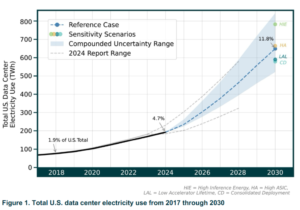
The Lawrence Berkeley National Laboratory estimates that U.S. data centers may use 6.7% to 12% of the country’s electricity by 2028, hitting 580 TWh. This is a big jump from around 4.4% in 2023. Those forecasts are driving interest in reliable, carbon-free power sources that can operate day and night.
Inside Oklo’s Fast-Rising Nuclear Growth Story
Oklo has become one of the best-known companies developing advanced nuclear reactors in the United States. Its flagship Aurora powerhouse produces around 75 megawatts of electricity. Future versions may generate even more.
Unlike traditional nuclear plants, Aurora is much smaller, factory-built, and designed to operate for years before needing refueling. The company plans to build its first commercial plant at the Idaho National Laboratory, one of the country’s leading nuclear research sites.
Demand is also growing.
Oklo reports it has created a commercial pipeline exceeding 14 gigawatts (GW). This was achieved through letters of intent and power agreements with various customers. These customers include data centers, utilities, and industrial companies.
That represents a sharp increase from just a few years ago and suggests that interest in advanced nuclear power continues to grow.
The company has also expanded its work with Nvidia beyond electricity supply. Earlier this year, Oklo, Nvidia, and Los Alamos National Laboratory announced a collaboration to use AI for nuclear fuel research, reactor design, and digital simulation. The goal is to speed reactor deployment while improving safety and efficiency.
Together, these developments show that Oklo is becoming more than a nuclear startup. It is increasingly at the crossroads of clean energy and artificial intelligence. These two sectors are set to drive economic growth in the next decade.
The program reflects a broader trend. AI is pushing electricity demand sharply higher as companies build larger data centers. The IEA projects global data center electricity use will more than double by 2030. That is increasing interest in reliable, carbon-free power sources such as advanced nuclear, alongside renewables and battery storage.
Small Nuclear Reactors Are Gaining the Spotlight
Oklo is part of a growing industry focused on small modular reactors, or SMRs.
Unlike traditional nuclear plants, SMRs are smaller, faster to build, and designed to be manufactured in factories before being assembled on site. Supporters say this can lower construction costs and shorten project timelines.
Governments around the world are increasing support for the technology.
The International Atomic Energy Agency (IAEA) states that nuclear power supplies around 9% of the world’s electricity. It also accounts for nearly one-quarter of global low-carbon electricity.
- More than 440 nuclear reactors operate worldwide, while more than 60 reactors are under construction.
The International Energy Agency reports that nuclear generation grew by 1.2% year-on-year. The active reactors produce about 10% of the world’s electricity.
The agency further predicts that global nuclear electricity generation will hit a new record soon. This growth comes as countries focus on energy security and clean power.
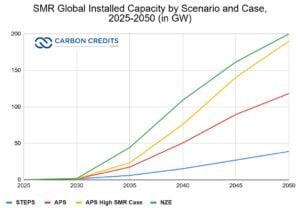
Right now, countries are building a massive pipeline of new plants. Over 70 gigawatts of new nuclear capacity is currently under construction. This is the highest level of development the world has seen in 40 years.
SMRs could play an important role because they can be built near industrial sites, factories, and large data centers that require reliable electricity. And tech giants will greatly benefit from this.
Big Tech’s Nuclear Bet Gets Bigger
For Microsoft, the partnership fits into a much bigger climate strategy.
The company has pledged to become carbon negative by 2030 and remove all the carbon it has emitted since it was founded by 2050. But reaching those goals is becoming harder as AI data centers use more electricity.
That is why Microsoft is investing in several types of clean energy, including wind, solar, battery storage, geothermal, and nuclear power.
Last year, Microsoft signed a landmark agreement with Constellation Energy to help restart Unit 1 of the Three Mile Island nuclear plant in Pennsylvania. The plant is expected to supply carbon-free electricity to Microsoft’s operations for 20 years once it returns to service.
Joining the new AI-nuclear initiative adds another piece to that strategy. It allows Microsoft to help develop the next generation of advanced reactors that could power future AI data centers.
Nvidia also has a strong reason to participate.
Although the company does not operate data centers itself, its AI chips power many of the world’s largest AI systems. As demand for those chips grows, so does the need for reliable electricity.
Nvidia has committed to achieving 100% renewable electricity for its offices and data centers by the end of fiscal 2025 where possible. The company also aims to reach net-zero greenhouse gas emissions across its value chain by 2050.
Supporting advanced nuclear research gives Nvidia another way to help build the clean energy infrastructure that future AI systems will need.
Could Nuclear Become AI’s Most Valuable Power Source?
The latest announcement is about more than one company’s share price. Governments, tech companies, and energy developers are teaming up. They aim to tackle one of AI’s biggest challenges: securing enough clean electricity.
For years, most clean energy investment focused on solar panels, wind farms, and electric vehicles. Those technologies remain essential. However, the rapid growth of AI is creating demand for reliable, 24-hour electricity that renewable energy alone cannot always provide.
Advanced nuclear is now entering that conversation.
If companies like Oklo can successfully bring small modular reactors to market, they could help power the next generation of AI while supporting global climate goals. That would make nuclear energy not only a source of clean electricity but also a key part of the digital economy’s future.