

Artificial intelligence (AI) is driving a surge in electricity demand worldwide. Now, NVIDIA is taking its AI platform into an unexpected area: geothermal energy.
This week, NVIDIA (NVDA) teamed up with Fervo Energy (FRVO) and the U.S. Department of Energy’s Pacific Northwest National Laboratory (PNNL). Together, they are creating a new AI-powered digital twin platform named EGS-Twin.
The platform will merge real-time field data, physics-based modeling, and AI forecasting. This will boost the performance of enhanced geothermal systems (EGS).
The goal is to help operators understand underground conditions better. This way, they can improve drilling efficiency, increase power output, and lower project risks. Fervo’s CTO and co-founder, Jack Norbeck, remarked:
“We believe that digital twins will expedite the learning curve for geothermal development as we build and operate our GeoBlock assets. Integrating high-fidelity physics-based models with AI-driven forecasting has the potential to reshape reservoir management, improve heat recovery, and enhance system reliability.”
Why AI Companies Are Looking Beyond Solar and Wind
The announcement shows a strong link between two fast-growing industries: artificial intelligence and clean energy. The rapid growth of AI is creating unprecedented pressure on electricity systems.
According to the U.S. Energy Information Administration (EIA), data centers accounted for about 5% of total U.S. electricity consumption in 2024. That share could rise to between 6.7% and 12% by 2028 as AI adoption accelerates.

Recent research suggests electricity use from major AI companies could more than double by 2030. A study predicts that the six biggest AI companies could boost power use from about 118 terawatt-hours (TWh) in 2024 to between 239 TWh and 295 TWh by 2030.
This growing demand is creating a challenge for technology companies.
Solar and wind power continue to expand rapidly, but they depend on weather conditions. AI data centers, by contrast, require electricity around the clock. That is why interest is growing in “firm” clean energy sources that can operate 24 hours a day.
Geothermal energy fits that profile.
The Department of Energy estimates that geothermal power plants reach capacity factors of about 95%. This allows them to produce electricity nearly all year long. For data center operators, that reliability is becoming increasingly valuable.
Building a Digital Twin 10,000 Feet Underground
The new EGS-Twin platform aims to solve one of geothermal energy’s biggest challenges: understanding what happens deep underground.
Enhanced geothermal systems work by drilling wells into hot rock formations and circulating fluids through engineered reservoirs. The technology can access geothermal resources in many more places than traditional plants. However, subsurface conditions are still hard to predict.
The partnership hopes to change that.
PNNL researchers will use Fervo’s operational data to train AI models on NVIDIA’s accelerated computing platform. The models will join NVIDIA Omniverse libraries. This will create a digital twin that simulates geothermal operations in real time.
The platform is designed to:
- Predict underground reservoir behavior.
- Optimize heat extraction.
- Improve drilling decisions.
- Increase power generation efficiency.
- Reduce operational risks.
The partners think AI can help operators react faster to underground changes. This could shorten development timelines and boost project economics. For geothermal energy, that could be a major breakthrough.
The Startup Leading America’s Next-Generation Geothermal
The project also shines a spotlight on Fervo Energy, one of the fastest-growing geothermal developers in the United States. The company is building Cape Station in Utah, which is expected to become one of the world’s largest enhanced geothermal developments.
Phase I of the project includes approximately 100 MW of capacity and remains on track to begin delivering power in late 2026. A second phase will expand the site to approximately 500 MW.
Fervo recently got over $421 million in project financing for Cape Station. They plan to invest about $1.2 billion between mid-2026 and early 2027 as construction speeds up.
Investor interest has been strong.
The company completed its public listing in 2026 and has attracted significant attention from markets betting on growing demand for clean, reliable electricity. Reuters previously reported that Fervo sought a valuation of up to $6.5 billion during its IPO process.
The company has also strengthened ties with major technology firms. Earlier this year, Fervo made a deal with Google. This agreement could lead to up to 3 GW of geothermal capacity by 2033. The first phase includes 1 GW of proposed projects.
Geothermal Is Back in the Spotlight
For decades, geothermal energy remained a niche part of the renewable energy sector. Today, that is beginning to change.
New drilling techniques adapted from the oil and gas industry are making enhanced geothermal systems more practical and scalable. These advances allow developers to access underground heat in regions previously considered unsuitable for geothermal power.
Governments are also paying closer attention.
The U.S. DOE sees next-generation geothermal as a key technology for supporting grid reliability while reducing emissions. Unlike wind and solar, geothermal can provide constant power without requiring large-scale battery storage.
Interest is also growing among technology companies.
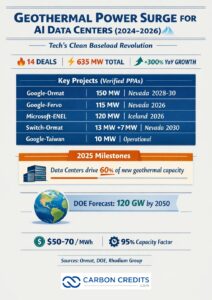
Google helped launch one of the first commercial enhanced geothermal projects with Fervo in Nevada. Microsoft, Meta, and other large technology firms have also explored geothermal opportunities as they seek dependable clean energy supplies for data centers.
As AI expands, geothermal’s value proposition becomes stronger.
NVIDIA’s Sustainability Strategy Extends Beyond Chips
The geothermal partnership aligns with NVIDIA’s broader sustainability goals. The company aims to match 100% of its global electricity use with renewable sources. It reached this goal in the fiscal year 2025.

NVIDIA also emphasizes energy efficiency as a key part of its climate strategy.
The tech giant claims its latest Blackwell AI systems offer over 50 times more energy efficiency than traditional CPU systems. This boost is specifically for large language model inference workloads.
However, efficiency improvements alone may not offset the rapid growth of AI demand.
As data centers continue growing, access to reliable carbon-free electricity is becoming a strategic priority across the technology sector. That makes partnerships like the one with Fervo increasingly important.
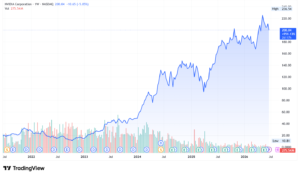
However, NVIDIA’s stock showed only a modest reaction to the announcement, as investors remain primarily focused on AI chip demand and data center growth. Still, the partnership highlights NVIDIA’s expanding influence across the broader AI ecosystem.
The company uses AI and digital twin technologies for geothermal energy. This suggests that it’s not just a hardware provider but also aims to be a key player in creating the energy infrastructure for future AI growth.
AI and Clean Energy Are Becoming One Story
The partnership between NVIDIA, Fervo, and PNNL highlights a major shift taking place across the energy industry. Artificial intelligence is no longer just a consumer technology story. It is becoming an energy story as well.
Growing AI workloads require massive amounts of electricity. Meeting that demand while maintaining climate goals will require new sources of reliable clean power.
Geothermal energy offers one possible solution. By combining AI, advanced drilling techniques, and geothermal resources, companies hope to unlock a new generation of carbon-free electricity that can operate around the clock.
For the broader energy transition, it shows how AI and clean energy are becoming increasingly interconnected as the world builds the next generation of digital infrastructure.