

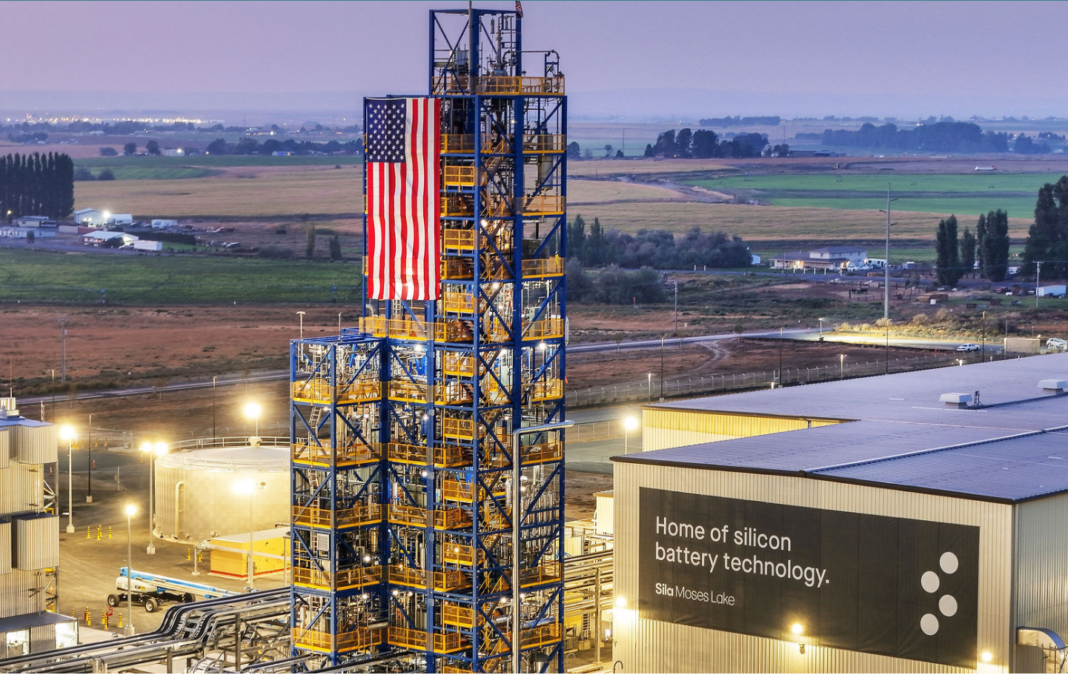
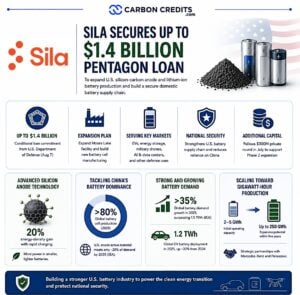
Sila Nanotechnologies has received a conditional loan commitment of up to $1.4 billion from the U.S. Department of Defense to expand production of silicon-carbon battery anodes and lithium-ion battery cells. The funding could accelerate one of the largest efforts to build a U.S.-based alternative to China’s dominant battery supply chain.
Sila plans to expand its Moses Lake, Washington, facility and develop a new battery-cell manufacturing operation. The project will serve various markets. This includes electric vehicles (EVs), energy storage, military drones, and other defense applications.
The deal comes as battery demand grows and governments focus more on supply security. It also shows how advanced battery materials are becoming important for both the clean energy transition and national security.
$1.4 Billion Loan Supports U.S. Battery Production
The Pentagon announced the conditional loan commitment on August 7. The financing will support the expansion of Sila’s silicon-carbon anode facility in Moses Lake and a new lithium-ion battery cell facility.
The battery-cell operation could serve specialty markets, including industrial, agricultural and military drones. The project will also support battery applications in energy storage, AI and data centers.
The $1.4 billion is a conditional commitment, not money that Sila has already received in full. The company must meet additional requirements before the financing can close.
The announcement follows a $300 million private funding round announced by Sila in July. The company said the funding would support its Phase 2 expansion and the ramp-up of its Moses Lake operations.
Together, the private financing and federal commitment give Sila significant capital to move from early commercial production toward larger-scale manufacturing.
Silicon Anodes Could Pack More Power Into Smaller Batteries
Sila’s main technology is its Titan Silicon silicon-carbon anode. Silicon can store more lithium than graphite, which gives it the potential to increase battery energy density.
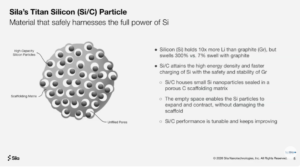
Sila says Titan Silicon can deliver a 20% energy-density gain while also supporting rapid charging. The company markets the technology for EVs, defense systems, data centers and robotics.
Higher energy density can allow an EV to travel farther without increasing battery size. It can also allow manufacturers to use smaller and lighter batteries for the same amount of energy. That is especially useful for drones and other defense systems, where weight and operating time can affect performance.
Silicon, however, has a technical problem. It expands when it absorbs lithium and contracts when lithium is removed. This can damage the material and shorten battery life. Sila’s silicon-carbon design aims to control this swelling while retaining silicon’s energy storage advantage.
Sila Targets a Weak Spot in China’s Battery Dominance
The strategic importance of Sila’s expansion goes beyond battery performance.
The International Energy Agency says China accounted for more than 80% of global battery cell production in 2025. It also held an even larger share of production for several battery materials. The concentration extends to anode materials, a key component of lithium-ion batteries.
The IEA says U.S. domestic production of anode active material could meet only about one-quarter of U.S. demand by 2035 under its Stated Policies Scenario. The remaining supply would continue to rely on imports from China, Southeast Asia, and South Korea. This dependence has turned battery materials into a strategic issue for governments.
For the U.S., expanding domestic anode production could reduce exposure to trade restrictions, geopolitical tensions, and supply disruptions.
Sila’s technology also offers a different approach. Instead of simply expanding conventional graphite production, it aims to replace part of the graphite anode market with silicon-carbon materials.
- RELEVANT: BMW Brings AI-Driven Battery Production to the U.S. But Can It Lower EV Manufacturing Emissions?
Global Battery Demand Continues to Rise
The investment comes as battery demand expands across several markets. The IEA reported that global battery demand grew by more than 35% in 2025, surpassing 1.5 terawatt-hours (TWh). Battery storage was a major driver of that growth, while lithium demand increased by about 25% per year on average over the previous two years.
Industry reports, like the one from the WEF below, project battery demand could increase more than fourfold by 2030 under current policy settings.
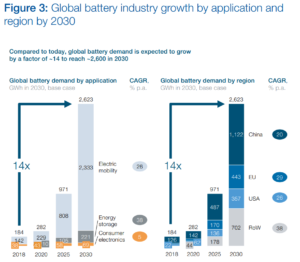
EVs remain the largest source of battery demand. Global EV battery deployment reached 1.2 TWh in 2025, up almost 30% from 2024. The IEA expects it to reach almost 3 TWh by 2030 and around 4 TWh by 2035 under its Current Policies Scenario.
Energy storage adds another major source of demand. This wider market creates opportunities for technologies that can store more energy in smaller and lighter battery systems.
For Sila, that means its potential market extends beyond passenger vehicles. Its technology is also being positioned for drones, robotics, data centers, and other applications where weight, space, and reliable backup power matter.
Sila Is Scaling Toward Gigawatt-Hour Production
Sila’s Moses Lake facility began operations in 2025. The plant covers about 160 acres and more than 600,000 square feet.
The facility initially supports 2–5 GWh of capacity and has been designed to expand to as much as 250 GWh within five years, according to Sila.
The difference between those figures is important. The 2–5 GWh figure refers to the initial operating phase, while 250 GWh is the plant’s longer-term expansion potential.
Sila has built commercial ties with companies like Mercedes-Benz and Panasonic. These partnerships help Sila expand Titan Silicon into larger battery applications. The company now needs to prove that it can scale production while maintaining quality, cost, and reliability.
That will be critical because battery manufacturing is highly competitive. A technology can offer better performance in testing but still faces challenges when production reaches commercial scale.
The Project Has a Lower-Carbon Power Advantage
The Moses Lake facility also has an environmental angle. Sila selected the Washington location partly because of access to hydropower, which supplies the plant’s electricity. Using low-carbon electricity can reduce the emissions linked to battery material production compared with facilities powered mainly by fossil fuels.
The U.S. Department of Energy finished an environmental assessment of the Moses Lake project in 2024. They issued a Finding of No Significant Impact for the project.
However, the project should not be viewed as emissions-free. Battery materials still require industrial processing, raw materials, and energy.
Sila’s public materials reviewed do not identify a corporate net-zero target. Its environmental positioning instead focuses on lower-carbon electricity at Moses Lake and the performance benefits of its battery technology.
Washington’s Battery Push Is Becoming a National Security Strategy
Sila’s $1.4 billion commitment reflects a wider change in how governments view batteries. Batteries are no longer used only in consumer electronics and EVs. They are increasingly important for energy storage, drones, robotics, AI infrastructure, and military systems.
The U.S. government is therefore supporting domestic battery production as part of a broader effort to strengthen critical supply chains.
For Sila, the opportunity is significant. The company is working to commercialize a silicon-carbon technology. This tech could boost battery performance and reduce reliance on traditional graphite supply chains.
The challenge is now execution.
Sila has an operating plant and a technology that has moved beyond the laboratory. Its Moses Lake facility can initially support 2–5 GWh, while the long-term design allows for expansion to as much as 250 GWh.
If that expansion succeeds, Sila could become an important U.S. supplier of advanced battery materials for EVs, energy storage, and defense.
The Pentagon’s commitment is therefore more than a financing deal. It is part of a broader effort to build a domestic battery industry, strengthen national security, and reduce reliance on a supply chain that remains heavily concentrated in China.