

China’s lithium market is sending a mixed signal. Lithium prices have dropped to their lowest level in five months as traders look ahead to a possible oversupply in 2027. Yet, demand from electric vehicles (EVs) and battery storage remains strong.
The market is no longer reacting to today’s conditions. Instead, traders are pricing in what the industry could look like over the next two years.
The shift marks a new phase for the lithium industry. After years of worrying about shortages, investors are asking whether new mines and processing plants will produce more lithium than the market needs. Even so, analysts remain confident that global electrification will continue to support long-term demand.
Lithium Prices Drop as Traders Look Beyond 2026
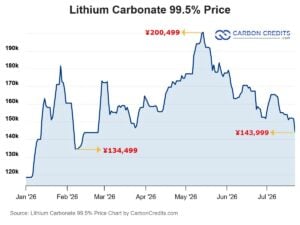
China’s most-active lithium carbonate futures contract on Guangzhou Futures Exchange fell to 143,999 yuan (US$21,282) per tonne, its lowest level since February. Prices now sit about 31% below their May high level.
The decline does not reflect weaker demand. Instead, traders are focusing on a possible supply surplus in 2027. New lithium projects will add more material to the market over the next two years.
China will also introduce a 2% battery consumption tax in September 2026, then raise it to 4% a year later. Some analysts say the higher tax may slow battery demand over time, although it could encourage buyers to make purchases earlier.
Supply expectations are changing, too. China’s battery giant CATL plans to restart production at its Jianxiawo lithium mine. The restart will add up to 45,000 tonnes of lithium supply during the second half of the year and help narrow the current supply gap.
Despite weaker prices, market fundamentals remain healthy. Lithium inventories continue to fall, while demand from EV makers and energy storage projects stays resilient.
EVs and Battery Storage Keep Demand Strong
While lithium prices have weakened, demand continues to grow.
The International Energy Agency (IEA) reports that global electric car sales topped 21 million vehicles in 2025. EVs accounted for about 25%, or one in four, of all new passenger car sales worldwide. The agency also forecasts continued growth as battery prices decline and more affordable EV models enter the market.
China remains the world’s largest EV market. According to the China Association of Automobile Manufacturers (CAAM), EVs made up 58.5% of all new vehicle sales in June 2026, the highest monthly share on record.
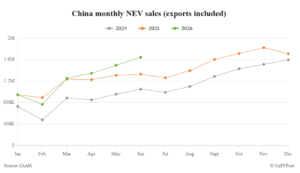
First-half EV sales reached 7.45 million vehicles, up 7.3% from a year earlier. EV exports climbed 120% year over year during the same period.
Energy storage has also become a major driver of lithium demand.
As countries add more solar and wind power, they need batteries to store electricity and balance the grid. Reuters reports that lithium demand from energy storage could grow 55% in 2026, following 71% growth in 2025. By 2026, the sector could consume nearly one-third of the world’s lithium, making demand less dependent on EV batteries alone.
These trends explain why many analysts view the recent price decline as a response to future supply, not weaker demand. Even if the market moves into surplus in 2027, global lithium consumption will continue to grow as countries expand clean transport and renewable energy.
- SEE MORE: CATL Bets on Lithium-Air Batteries While Expanding Sodium-Ion and Energy Storage Leadership
More Supply Is Coming Online
More supply is driving the weaker price outlook. The IEA reports that global investment in critical minerals reached a record high in 2024, with lithium remaining one of the fastest-growing sectors. Producers in Australia, Argentina, Chile, China, and Africa are expanding existing mines while bringing new projects online.
Chile, the world’s second-largest lithium producer, is increasing output. Codelco and SQM are expanding operations in the Salar de Atacama, while Argentina continues to attract billions of dollars in new lithium investments.
The country’s two largest producers are planning a major expansion that could increase output from their joint venture by more than 70%. Moreover, as part of a $3 billion upgrade in the Atacama Desert, the Novandino venture said it aims to raise annual lithium production to 470,000 metric tons, up from the 270,000 tons expected in 2026.
Benchmark Mineral Intelligence forecasts that new supply will outpace demand growth in 2027. That imbalance would put additional pressure on lithium prices even as global consumption keeps rising.
Lower Prices Could Speed Up the Energy Transition
Lower lithium prices also create opportunities.
Cheaper lithium reduces battery costs, making electric vehicles and energy storage systems more affordable. According to the IEA, average battery pack prices fell below US$100 per kilowatt-hour (kWh) for the first time in 2024, reaching about US$97/kWh.
According to the benchmark BloombergNEF (BNEF) Lithium-Ion Battery Price Survey, global average battery pack price dropped to a record low of US$108/kWh in 2025. Lower lithium prices helped drive that milestone.
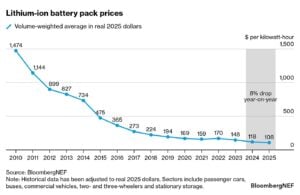
Lower battery costs also support grid-scale energy storage. BloombergNEF forecasts rapid growth in energy storage installations through the end of the decade as countries expand renewable energy and strengthen electricity grids.
Lower lithium prices may reduce miners’ profits, but they also make clean energy technologies more affordable for consumers and businesses.
Miners Face a More Competitive Market
Lithium producers face a tougher business environment. Higher-cost mines may struggle if prices stay low. Several companies have already slowed expansion plans or delayed new projects after lithium prices fell sharply over the past two years.
At the same time, the industry’s largest producers continue investing for long-term growth. They see strong demand from EVs, batteries, and energy storage well beyond 2030.
That shift will reward low-cost producers with high-quality resources while putting greater pressure on higher-cost operations.
A Short-Term Correction, Not a Long-Term Slowdown
The latest price drop reflects changing market expectations, not weaker demand.
Traders are preparing for a larger supply pipeline in 2027. Meanwhile, the long-term drivers of lithium demand remain strong. Governments continue promoting transport electrification. Utilities are building more battery storage. Automakers are launching new electric models every year.
The lithium market has always moved in cycles. Lower prices often encourage more demand while pushing producers to improve efficiency and control costs.
For investors and the broader clean energy industry, today’s price weakness looks less like a warning sign and more like a market adjustment. As supply catches up with demand, lower lithium prices can help accelerate the global shift to electric mobility and renewable energy.