

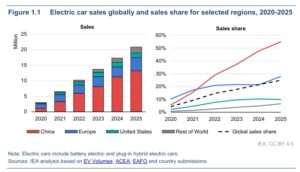
The global transition to electric vehicles is gaining momentum faster than expected. According to the International Energy Agency’s Global EV Outlook 2026, electric cars are projected to make up nearly 30% of worldwide vehicle sales this year, with total EV sales expected to hit 23 million units.
Oil Shock Makes EVs the Smarter Choice for Consumers
Rising oil prices and growing energy security concerns are accelerating this shift. Fuel costs surged after tensions involving Iran disrupted oil shipments through the Strait of Hormuz, pushing petrol and diesel prices sharply higher. As a result, consumers and businesses increasingly turned to EVs to reduce long-term transportation expenses.
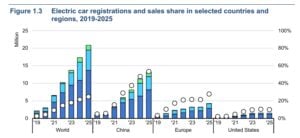
- Although global EV sales fell 8% year-over-year to 3.9 million units during the first quarter of 2026, the IEA described the slowdown as temporary. The decline was largely tied to policy and incentive changes in China and the United States.
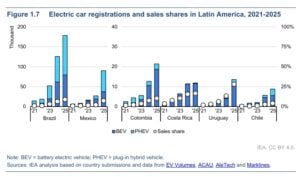
Outside those two markets, EV demand expanded rapidly. Sales rose 80% across the Asia-Pacific region excluding China, increased 75% in Latin America, and climbed 30% in Europe, highlighting broader global adoption trends.
Higher fuel prices have also improved the cost advantage of EV ownership. The IEA said annual fuel savings from electric vehicles increased by 35% compared to 2025 levels.
At the same time, online car marketplaces and automakers reported stronger interest in EVs following the oil market disruption.
Falling Battery Cost Boosts EV Adoption
Falling battery costs are also helping accelerate adoption. The IEA said lower battery prices, combined with improvements in charging speed and driving range, are making EVs increasingly competitive with gasoline-powered cars.
Automakers are also investing heavily in smart charging and vehicle-to-grid (V2G) systems. These technologies allow EVs to charge during off-peak hours or even send electricity back to the power grid, helping reduce strain on energy infrastructure.
China Tightens Its Grip on the Global EV Supply Chain
China continued to dominate nearly every part of the electric vehicle industry last year.
- The country produced almost three-quarters of the world’s EVs and exported more than 2.5 million vehicles globally. This doubled overseas shipments compared to the previous year.
China also strengthened its control over battery manufacturing and critical materials. The IEA said the country now produces more than 80% of the world’s battery cells and an even larger share of key battery processing materials.
This leadership has allowed Chinese automakers to lower EV costs and expand aggressively into emerging markets.
Affordable Chinese-made EVs are becoming especially important in developing economies, where lower-cost models are helping accelerate adoption. Around 60% of EV sales in emerging markets outside China now come from imported Chinese vehicles.
The commercial vehicle market is also changing quickly. Global electric truck sales more than doubled last year, with electric trucks accounting for roughly one in every 10 new truck sales worldwide. China remained the largest contributor to that growth.
North America Faces a Different EV Challenge
The United States continues to stand apart from Europe and China because of its strong preference for larger vehicles. According to the IEA, more than 85% of electric models available in the U.S. are SUVs or large vehicles.
Large vehicles also dominate overall U.S. car sales, accounting for more than 80% of the market. Internal combustion engine (ICE) vehicles still represent about 60% of available models, while EVs make up nearly 30% and hybrids account for around 10%.
Policy uncertainty has also slowed adoption. Changes in emissions standards and fuel economy regulations created hesitation among both automakers and consumers earlier this year.
Canada, however, is seeing EV demand rebound after restoring federal purchase incentives. Electric vehicles represented 12.2% of all new vehicle sales in March, compared to 6.5% a year earlier.
Several provinces posted strong growth:
- Quebec EV sales rose 136%
- British Columbia increased 53%
- Ontario climbed 40%
Policy experts say both government rebates and rising fuel costs are driving the recovery in Canadian EV demand.
Emerging Markets Become Key Growth Drivers
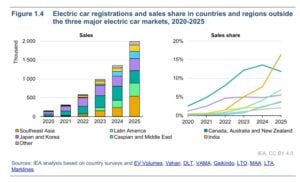
Outside China, Europe, and the United States, EV sales reached nearly 2 million units in 2025, up from 1.3 million the previous year.
Emerging markets and developing economies accounted for much of that increase. Sales across these regions surged roughly 80% to nearly 1.2 million units, setting a new record.
Southeast Asia: The EV Growth Hotspot
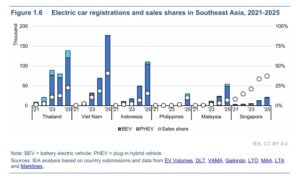
In markets like Brazil and Uzbekistan, hybrids still maintain a larger presence, but fully electric models are steadily gaining market share.
S&P Global Sees Oil Demand Weakening
The rapid rise in EV adoption is beginning to affect oil demand forecasts.
S&P Global recently cut its 2026 global oil demand forecast by 700,000 barrels per day, citing weaker fuel consumption linked to the ongoing conflict and economic uncertainty.
The IEA also projected a steep drop in oil demand during the second quarter of 2026. The agency expects global oil demand to decline by 1.5 million barrels per day — the sharpest quarterly drop since the COVID-19 pandemic.
These forecasts highlight growing concerns about the long-term outlook for fossil fuel demand as electric transportation expands globally.
Still, analysts remain divided on whether the current EV boom will continue once oil prices stabilize. Previous energy crises created short-term increases in fuel-efficient vehicle sales that later slowed when fuel costs dropped.
Improved Technology and Climate Policies Drive Next Phase of EV Growth
This time, however, the market conditions look different. EV technology has improved significantly, charging networks are expanding quickly, and governments worldwide are tightening climate and emissions policies.
IEA Executive Director Fatih Birol said electric vehicle sales already set records in nearly 100 countries last year. He added that falling battery prices and supportive energy policies could push adoption even higher over the coming years.
Countries are already adjusting their policies to support the transition. Vietnam, for example, is considering extending EV tax incentives through 2030 to maintain low tax rates between 1% and 3%.
The latest data suggests the global auto industry may be entering a long-term structural shift rather than a temporary reaction to high fuel prices. Rising energy costs may have accelerated the transition, but improving technology, lower battery prices, and expanding global supply chains are now making electric vehicles a mainstream option across both developed and emerging markets.