


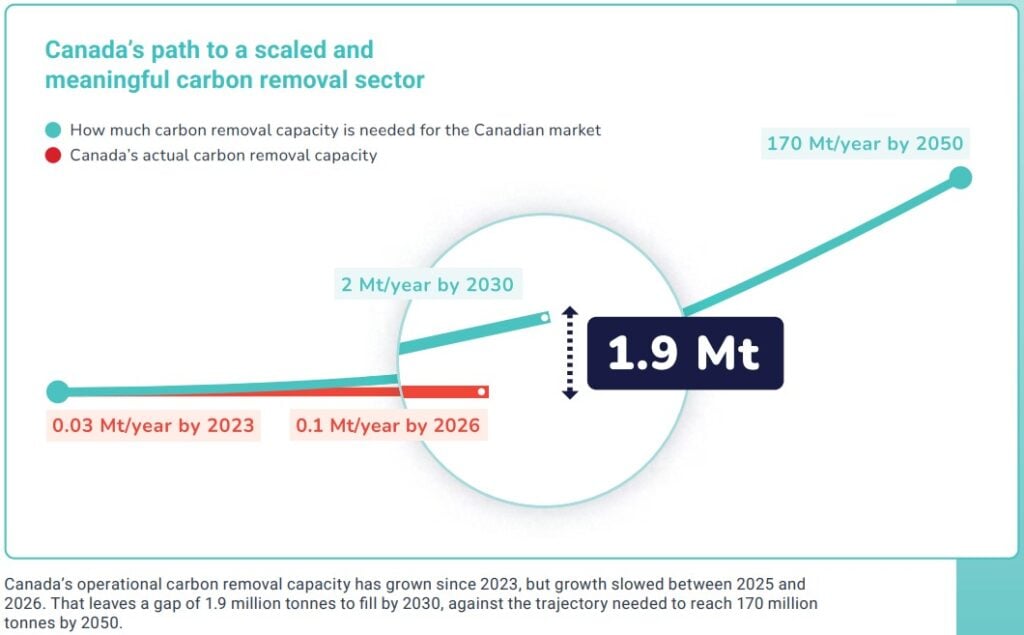
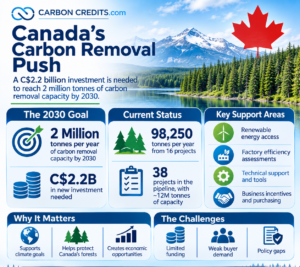
Canada needs about C$2.2 billion in new investment to grow its carbon dioxide removal (CDR) industry by 2030, according to a new report by Carbon Removal Canada. The report, Tracking the Tonnes 2026, says Canada needs to reach 2 million tonnes of annual carbon removal capacity by 2030. However, its 16 operating projects can currently remove only 98,250 tonnes of CO₂ each year.
Canada has a growing project pipeline and strong natural resources. However, limited funding, weak buyer demand, and policy gaps are slowing the industry’s growth.
The report warns that Canada could fall behind other countries unless it creates stronger demand and helps projects secure the money they need to grow.
Canada’s Operating Carbon Removal Capacity Remains Small
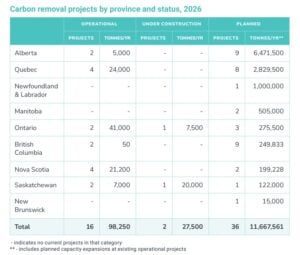
As of November 1, 2026, Canada had 16 operating carbon removal projects across six provinces. Together, they had the capacity to remove 98,250 tonnes of CO₂ per year. That is nearly three times the capacity reported in 2023.
However, growth has slowed. Operating capacity increased by only 150 tonnes between 2025 and 2026. Canada now needs to add about 1.9 million tonnes of annual capacity to reach its 2030 target.
The project pipeline offers room for growth. The report identifies 38 projects, including two under construction. Together, they represent nearly 12 million tonnes of planned annual capacity and about C$9 billion in estimated investment. But planned capacity is not the same as operating capacity. Many projects still need funding, buyers, permits, or other support before they can move ahead.
The two projects under construction, in Ontario and Saskatchewan, are expected to add 27,500 tonnes of annual capacity by the end of 2027. If completed on time, they could raise Canada’s current operating capacity by nearly 30%.
Why Canada Needs C$2.2B in New Investment
Carbon Removal Canada estimates that reaching the 2030 target will require about C$2.2 billion in new public and private investment.
The report says this is less than 0.5% of the C$500 billion that Canadian financial institutions have committed to the wider economy. Yet getting money to carbon removal projects remains a challenge.
Many companies can attract early funding from venture investors. But they often struggle to raise the larger sums needed to test their technology at a commercial scale.
This creates a funding gap between early development and full commercial operations. Projects at this stage may be too costly for startup funding but still too risky for traditional lenders.
The report found that 13 of the 15 equity deals recorded in Canada’s carbon removal sector since 2024 took place at or before Series A funding. The number of deals also fell from six in 2025 to three in 2026.
Carbon Removal Canada says the industry needs more support for demonstration projects. It also recommends a mix of government purchases, grants, equity, debt, and long-term purchase agreements.
These tools could help companies prove their technology works, attract private investors, and move projects toward commercial operations.
Corporate Demand for Carbon Removal Remains Weak
More projects will not guarantee industry growth. Canada also needs more companies willing to buy carbon removal credits.
A 2025 report by the Pembina Institute, Growing Curiosity: 2025 Scan of Carbon Dioxide Removal Buyers in Canada, surveyed 247 organizations operating in the country. It found that only 4% were engaged buyers with active plans to purchase durable carbon removal credits. Another 8% were interested but had no current purchase plans. The remaining 88% were not engaged.
High prices remain a major barrier for companies considering their first purchases. Still, there are signs of growing interest. Among engaged buyers, 67% planned to purchase carbon removal credits before the end of 2026.
Corporate purchases can give developers a source of revenue and help them attract investment. Some buyers also agree to purchase future removals before a project is built. These deals can give developers more certainty when raising funds.
The Canadian government has also started supporting demand. In March 2026, it launched a C$10 million standing offer to buy carbon removal credits from Canadian projects.
Carbon Removal Canada recommends turning this into a larger, multi-year program. Regular government purchases could give developers a more reliable source of demand.
Canada Has Strong Resources But Needs Clearer Policies
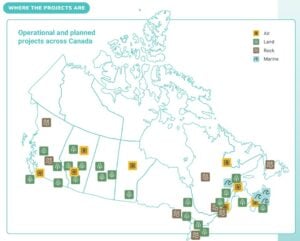
Canada has several advantages that could support a larger carbon removal industry. These include low-carbon electricity, geological storage sites, biomass, coastlines, and an established mining sector.
A January 2026 report by the Canada Energy Regulator identified 78 carbon removal companies and 48 active and planned projects in the country. It also reviewed the costs of different removal methods.
These include direct air capture, which pulls CO₂ from the air, and bioenergy with carbon capture and storage. Other methods include biochar, enhanced rock weathering, and carbon mineralization.
The estimated costs vary widely. Direct air capture could cost US$100 to US$300 per tonne once scaled. Enhanced rock weathering could cost US$50 to US$200 per tonne, while biochar could cost US$10 to US$345 per tonne.
These are estimates for scaled operations, not prices for every project today. Actual costs depend on the technology, location, energy needs, and storage method.
Policy gaps also create problems. Canada’s provinces and territories have different rules for carbon storage, incentives, and carbon markets. This can make it harder for companies to plan projects and attract investors.
In September 2026, the federal government said it was exploring a framework for international carbon market cooperation under Article 6 of the Paris Agreement. This could help Canadian projects sell eligible credits to buyers in other countries.
Carbon Removal Canada recommends including carbon removal in this framework and in existing compliance programs, such as the Clean Fuel Regulations. It also calls for wider investment tax credits and more funding for demonstration projects.
Canada Faces Growing Competition Abroad
The report compared Canada’s policies with those in the European Union, Germany, the United Kingdom, Japan, and the United States.
Canada has made progress through its government purchase program, investment incentives, and provincial rules for carbon storage. However, the report says the EU, Germany, and the UK are moving faster to create long-term demand.
The EU has introduced a carbon removal certification framework and proposed including large-scale removals in its emissions trading system. Germany supports carbon removal research and industrial projects. The UK is also working toward including carbon removal in its emissions trading scheme.
These policies can give developers more confidence that buyers will be available when projects begin operating.
The global market is growing, too. The third edition of The State of Carbon Dioxide Removal, published in June 2026, estimated that newer carbon removal methods remove about 2 million tonnes of CO₂ each year. Deployment is growing by around 40% annually, but much faster growth will be needed to meet climate targets.
For Canada, the opportunity goes beyond its own climate goals. Carbon removal could support industries such as mining, forestry, steel, agriculture, and energy. It could also help Canadian producers serve markets that place greater value on lower-carbon products.
Funding and Policy Will Determine Whether Canada Meets Its 2030 Goal
Carbon Removal Canada says the next few years will be critical. Its recommendations focus on five areas: expanding access to international carbon markets, including removals in compliance programs, funding demonstration projects, widening tax incentives, and increasing government purchases.
The report estimates that about 20 Canadian companies could begin building demonstration projects in 2027 if the right support is available. Canada has many of the resources needed to build a strong carbon removal industry. But its project pipeline alone will not deliver the 2030 target.
The estimated C$2.2 billion is the additional investment needed to reach the target. It is not money already committed or guaranteed. Canada’s progress will depend on whether it can attract that funding, build a stronger base of buyers, and give developers clear rules to move projects from plans to operations.