


Canada is exploring a new policy framework that could let Canadian companies participate in international carbon markets by trading internationally transferred mitigation outcomes (ITMOs).
The federal government announced the initiative on September 24, saying an ITMO framework could attract investment into Canadian climate projects, expand demand for carbon removal and nature-based solutions, and create new export opportunities for Canadian companies.
The move comes as international carbon markets develop under Article 6 of the Paris Agreement. At the same time, countries and companies are looking for ways to finance emissions reductions and carbon removals as they work toward net-zero targets.
For Canada, the opportunity is particularly significant because the country combines large natural resources, geological storage capacity, clean electricity and established expertise in energy and industrial infrastructure.
Canada’s Emissions Create a Large Decarbonization Challenge
Canada still has a substantial emissions-reduction challenge.
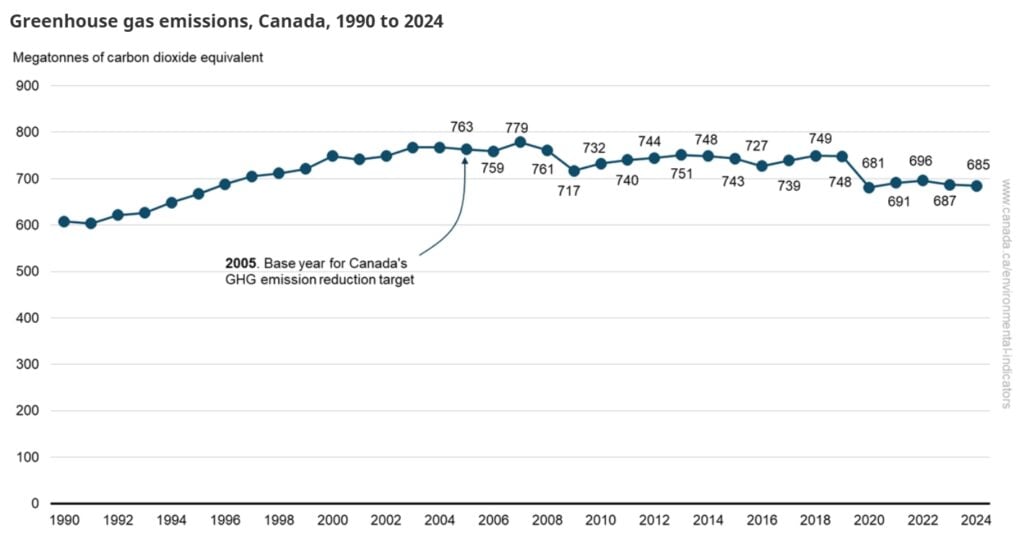
The country emitted about 685 million metric tons (Mt) of greenhouse gases in 2024, excluding emissions and removals from the land-use, land-use change and forestry sector. That was down 0.3% from 2023 and 10.3% below 2005 levels.
Oil and gas remained Canada’s largest source of emissions. The sector accounted for 208 Mt in 2024, although emissions have declined from their 2014 peak. Electricity emissions have fallen much more sharply, dropping 57% between 2005 and 2024 as Canada reduced coal-fired generation.
- Canada’s government projects that emissions could fall to 600 Mt by 2030 under its “With Measures” scenario. Under a more ambitious “With Additional Measures” scenario, emissions could reach 546 Mt by 2030.
These figures show why Canada will need a combination of emissions reductions, carbon removal and other climate solutions to reach net zero.
An international market could provide another source of capital for some of those activities.
What Are ITMOs and Why Do They Matter?
ITMOs are internationally transferred mitigation outcomes created under Article 6.2 of the Paris Agreement.
In simple terms, one country can authorize the transfer of an emissions reduction or removal to another country under a cooperative approach. The receiving country can then use the mitigation outcome toward its climate target, subject to the applicable Article 6 accounting rules.
The system is designed to prevent the same emissions reduction from being counted toward the climate targets of both countries. This process, known as a corresponding adjustment, is central to maintaining the environmental integrity of international transfers.
Canada’s proposed framework would establish how these transfers could operate in the Canadian context.
The government said it will work with provinces and territories, Indigenous organizations and other stakeholders while developing the potential framework. It also said any ITMO trading would have to follow Article 6 rules, including requirements related to additionality, verification, permanence and avoiding double counting.
International Carbon Markets Are Expanding
Canada is considering the framework as carbon pricing and carbon-credit systems expand globally.
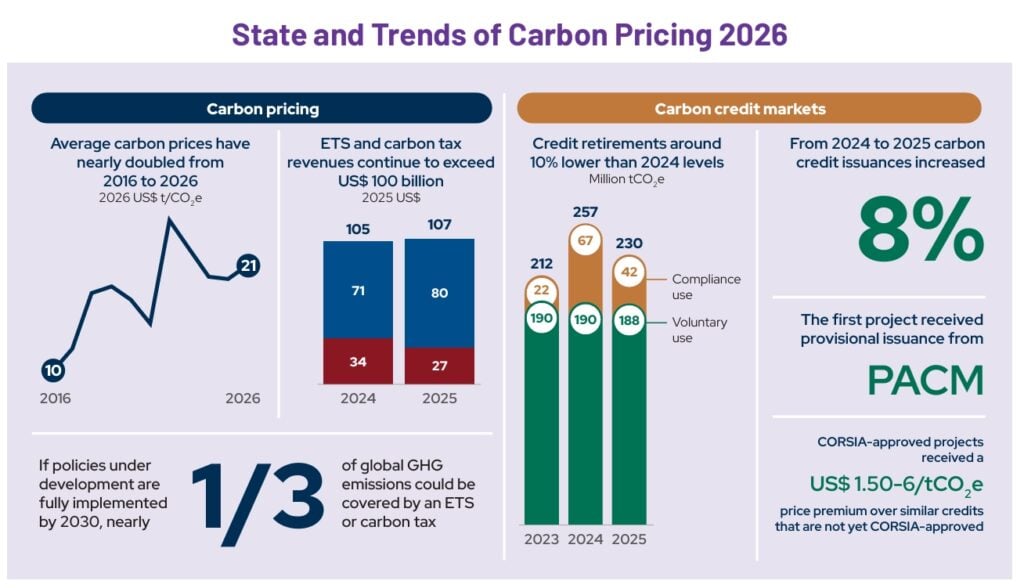
The World Bank’s 2026 State and Trends of Carbon Pricing report found that 87 carbon-pricing policies were operating worldwide, seven more than the previous year. Direct carbon pricing now covers nearly 30% of global greenhouse gas emissions, while carbon pricing generated more than $107 billion in public revenue in 2025.
The broader carbon-credit market is also attracting investment. The World Bank estimates that annual capital committed to future carbon-credit projects ranged from $12 billion to $16 billion in 2025.
The estimated annual value of traded carbon credits was about $535 million in 2024, although this figure covers a narrower segment of the overall carbon market than carbon taxes and emissions trading systems.
The growth opportunity extends beyond today’s market.
The World Bank’s international carbon-market research has highlighted the potential for carbon markets to mobilize climate finance, particularly where domestic public funding cannot cover the investment needed for emissions reductions and removals.
Other market research has projected that voluntary carbon-credit demand could grow several-fold by 2030, while the World Bank’s Emission Reduction Program has cited estimates of a $10 billion to $40 billion voluntary carbon market by 2030 under one industry scenario.
This expanding market could create opportunities for countries that can supply credible emissions reductions and carbon removals.
Canada Sees Carbon Removal as an Economic Opportunity
Carbon removal is one area where Canada could potentially benefit from international demand.
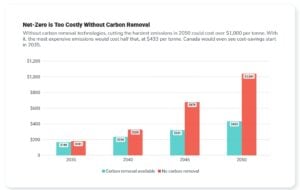
- Carbon Removal Canada has estimated that a large-scale domestic carbon removal industry could generate significant economic activity by 2050.
- Its earlier modelling suggested that a Canadian industry capable of removing more than 300 Mt of CO₂ annually could create more than 330,000 jobs and add about $143 billion to GDP.
- More recent modelling from the organization estimates that carbon removal could add $78 billion to Canada’s annual GDP by 2050 and create or support about 300,000 jobs.
Canada has several resources that could support this expansion. These include geological formations suitable for CO₂ storage, clean electricity, agricultural and forestry resources, industrial infrastructure and a workforce with experience in engineering, energy and large-scale construction.
Carbon removal technologies such as direct air capture and bioenergy with carbon capture and storage could therefore become part of Canada’s emerging clean-technology export industry.
ITMOs Could Bring More Capital Into Canadian Projects
The proposed ITMO framework could give developers another potential route to monetize verified emissions reductions and removals.
For example, a Canadian project could generate an eligible mitigation outcome, receive the required authorization, and transfer it internationally under an Article 6.2 agreement. Revenue from that transfer could help support project development and potentially improve the economics of technologies that remain expensive at early stages.
Nature-based projects could also benefit if they meet the requirements.
However, international transfers require more than simply creating a carbon credit. Countries need systems to authorize activities, track units, report transactions, and apply corresponding adjustments. These requirements are intended to ensure that a transferred mitigation outcome is not counted twice.
That accounting framework could also provide greater certainty for investors and buyers.

Canada Wants to Turn Climate Technology Into an Export Opportunity
The Honourable Julie Dabrusin, Minister of the Environment, Climate Change and Nature, said international ITMO trading could help Canadian companies attract capital and expand climate technologies.
She quoted:
“The trading of ITMOs under the Paris Agreement can unlock greater global climate action by making it easier to transfer emission reductions and removals between countries. This is about turning our natural advantages and homegrown climate innovation into investment, good jobs, and new export opportunities. A clear framework for international carbon credit transfers can help Canadian companies scale, attract capital, and bring more innovative technologies to market, strengthening our position as a leader in the global clean economy.”
$13 Billion in International Climate Finance
The government is also linking the initiative to more than $13 billion in international climate finance announced through the Spring Economic Update.
For Canada’s carbon market, the proposed framework could therefore represent more than a new trading mechanism. It could connect Canadian climate projects and technologies with international sources of demand and finance.
The framework is still under development, and its final rules will determine which projects and mitigation outcomes can participate. Canada will need to balance market access with rigorous accounting and environmental safeguards as it develops the system.
If implemented, the framework could give Canadian carbon removal developers, technology companies, and nature-based projects another potential pathway into the growing international market for emissions reductions and removals.