


The direct air capture (DAC) industry has reached an important turning point in North America. Deep Sky, a Canadian carbon removal developer, has issued the continent’s first certified DAC carbon credits. This shows that a leading climate technology is advancing from pilot projects to commercial use.
Deep Sky Alpha in Alberta generated the first credits, where carbon dioxide was captured from the air and stored underground for good. Isometric, an independent carbon registry, verified the removals via its Direct Air Capture Protocol. Then, it issued credits for Microsoft and the Royal Bank of Canada (RBC), which are part of long-term purchase agreements already announced.
The credits also became the world’s first DAC credits carrying the Core Carbon Principles (CCP) label issued through Isometric. The first delivery may have a small carbon removal volume, but its importance goes well beyond the credits issued.
Deep Sky CEO Alex Petre said in an interview:
“This shows Canada is building, is taking the risks, and it puts us on the map for innovation in carbon removal… People really want this to work because they continue to sign contracts. However, very few projects have actually been delivered.”
Deep Sky Is Building Canada’s Carbon Removal Future
For years, the carbon removal industry has announced billion-dollar investments and large future purchase agreements. Few projects, however, have actually delivered verified carbon credits. Deep Sky has now crossed that gap, showing that permanent carbon removal can move from promise to verified supply.
The milestone also strengthens Canada’s position in one of the fastest-growing climate technology sectors. Unlike most DAC developers that rely on a single capture technology, Deep Sky has adopted a different strategy.
The Montreal-based company describes itself as the world’s first technology-agnostic carbon removal project developer. It combines several DAC technologies in one place and then tests which one works best in real conditions. After that, it deploys the top performer at a commercial scale.
Its flagship facility, Deep Sky Alpha, located near Innisfail, Alberta, moved from project design in late 2024 to commissioning in 2025. In about 18 months, it injected atmospheric CO₂ underground. This created North America’s first certified DAC credits.
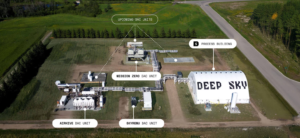
The pilot facility can capture roughly 3,000 metric tons of CO₂ annually while serving as a testing ground for several leading DAC companies. Even more, the company has much bigger ambitions.
Deep Sky aims to build about 100 carbon removal facilities in Canada. They will use the country’s plentiful renewable electricity and geological storage. Plus, they’ll tap into Canada’s carbon management know-how. Commercial projects are expected to scale toward one million tons of CO₂ removal per year per site over time.
That long-term vision could position Canada as a major supplier of durable carbon removal credits.
Why Delivering Credits Matters More Than Selling Them
Carbon removal has attracted record corporate investment over the past three years. Microsoft, Google, Stripe, Shopify, JPMorgan Chase, and Frontier have signed purchase agreements. These deals are worth hundreds of millions of dollars, which aim to finance new removal technologies. Yet, many contracts involve future deliveries that may not begin for several years.
Deep Sky’s announcement is different because the credits have already been produced, independently verified, and issued. The project was certified under Isometric’s Direct Air Capture Protocol, which requires developers to:
- account for all project emissions,
- verify net carbon removal, and
- demonstrate permanent underground storage through long-term monitoring.
The certification process gives buyers more confidence. It ensures that each credit stands for one metric ton of CO₂ permanently removed from the atmosphere. The first deliveries also begin Deep Sky’s previously announced carbon removal agreements running through 2034.
Microsoft and RBC were among the company’s founding buyers. Their initial agreement included 10,000 tonnes of carbon removal. They also have options to buy up to one million more tonnes from Deep Sky’s future projects.
RBC Director, Brian Hong, noted:
“This is exactly the kind of action our climate strategy is designed to advance: climate solutions that are scientifically measurable with the potential to scale. Deep Sky has moved with remarkable speed to bring this project to life, and the fact that it’s happening in Alberta—a region central to Canada’s energy future—makes it even more meaningful.”
Deep Sky has since grown its customer base to include TD Bank Group, Lufthansa Group, ENGIE, and Sumitomo Mitsui Banking Corporation. This shows that the need for permanent carbon removal goes beyond just tech companies.
The Race to Scale Direct Air Capture Begins
Deep Sky’s milestone comes as the global DAC industry enters a new growth phase.
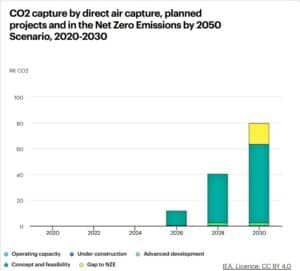
The International Energy Agency (IEA) reports over 30 direct air capture plants worldwide. However, they only remove about 0.01 million metric tons of CO₂ each year. That is tiny compared with what climate models suggest will be needed.
The IEA’s Net Zero Emissions by 2050 pathway says that DAC capacity needs to grow to over 60 million metric tons each year by 2030. By mid-century, it should reach hundreds of millions of tons annually.
The Intergovernmental Panel on Climate Change (IPCC) also concludes that carbon dioxide removal will be necessary alongside deep emissions cuts to limit global warming to 1.5°C.
Cost remains the industry’s biggest obstacle.
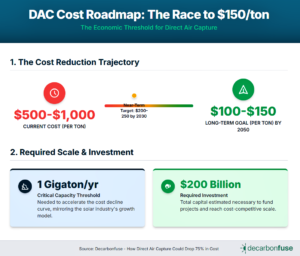
Today’s DAC projects generally remove carbon at costs ranging from $500 to more than $1,000 per metric ton, depending on technology and scale. Developers expect costs to drop significantly. This will happen as facilities grow larger, manufacturing increases, and learning curves get better.
Governments are helping accelerate that process.
The United States offers the 45Q tax credit, while Canada has introduced major investment tax credits for carbon capture and clean technology projects. These policies aim to cut project costs. They also encourage private investment in carbon removal infrastructure.
RBC and Microsoft’s purchases from Deep Sky illustrate a broader market trend. Corporate buyers want carbon removals that are independently verified. They also prefer solutions that are permanently stored and based on strict scientific standards.
Why Canada Could Lead the Carbon Removal Economy
Deep Sky’s success also highlights Canada’s growing role in the global carbon removal industry. The country combines several competitive advantages.
Canada has abundant renewable electricity, favorable geology for permanent CO₂ storage, an experienced energy workforce, and government policies that support carbon management technologies.
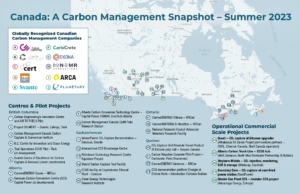
Alberta, in particular, has become one of North America’s leading regions for carbon storage. Existing expertise from the oil and gas industry is helping accelerate new carbon capture and storage projects.
These advantages are attracting growing investment from carbon removal developers seeking locations that can support large-scale deployment. As more commercial projects move forward, Canada could become one of the world’s largest exporters of durable carbon removal credits.
A Turning Point for the Carbon Removal Industry
Deep Sky’s first certified DAC credits represent more than a technical achievement. They show that direct air capture is beginning to transition from research and demonstration into commercial delivery.
The industry still faces major challenges. Costs remain high, and global removal capacity must increase dramatically over the coming decades. Yet, verified deliveries like this help build confidence among buyers, investors, and policymakers.
For Deep Sky, the next goal is no longer proving that direct air capture works. It is scaling from thousands of tons to millions.
If the company succeeds, Canada could become a global leader in permanent carbon removal. More importantly, the industry’s focus may shift from announcing future carbon removal purchases to delivering verified climate results.