


The world is not removing enough carbon dioxide from the atmosphere to meet the goals of the Paris Agreement. According to the latest State of Carbon Dioxide Removal (CDR) Report 2026, current plans leave a massive gap between what countries have pledged and what scientists say is needed to limit global warming to 1.5°C.
The report, prepared by more than 50 international researchers, finds that global carbon removal efforts must expand rapidly over the next two decades. While progress is being made, current commitments remain far below the level required to avoid the worst impacts of climate change.
Why 2050 Carbon Removal Targets Are Off Track
Carbon dioxide removal refers to activities that remove CO2 from the atmosphere and store it for long periods. These methods range from restoring forests to advanced technologies that capture carbon directly from the air.
The report estimates that countries’ current climate pledges would deliver about 3.6 billion tonnes of CO2 removal annually by 2050. However, climate models consistent with the Paris Agreement require around 8.75 billion tonnes per year by mid-century.
- And this leaves a shortfall of 5.2 billion tonnes annually.
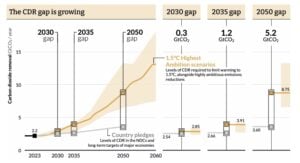
Researchers note that this gap has widened since the previous assessment because global greenhouse gas emissions continue to rise. The longer emissions remain high, the more carbon will need to be removed later.
The challenge becomes increasingly difficult over time. The gap is relatively small in 2030 but grows quickly through the following decades, reaching its largest level by 2050.
Forests Still Do Almost All the Work
- Today, global carbon removal totals approximately 2.2 billion tonnes of CO2 per year, accounting for about 5% of total global emissions.
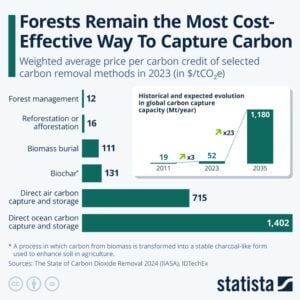
Almost all of this removal comes from conventional land-based approaches. Forest restoration, tree planting, improved forest management, and ecosystem recovery account for 99.9% of total carbon removal worldwide.
- Major contributors include China, the United States, Brazil, Russia, and the European Union.
While forests remain essential climate tools, researchers caution that relying too heavily on them creates risks. Forests can burn, suffer from drought, or be cleared for agriculture and infrastructure projects. These threats can release stored carbon back into the atmosphere.
Brazil illustrates this challenge. Although Amazon deforestation has recently declined, concerns remain about future land-use changes linked to agriculture, transportation projects, and economic development. Scientists warn that continued pressure on forests could limit their ability to serve as reliable long-term carbon sinks.
- READ MORE: BTG Pactual Closes Record $1.24B Reforestation Fund as Forest Carbon Markets Enter the Big Leagues
Emergence of Novel Carbon Removal Technologies
Novel carbon removal technologies receive significant attention, but their contribution remains extremely small.
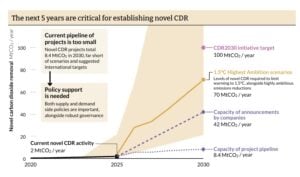
- Methods such as biochar, enhanced rock weathering, and direct air capture with carbon storage currently remove only about 2 million tonnes of CO2 per year globally. That amount represents a tiny fraction of what climate models suggest will be needed in the coming decades.
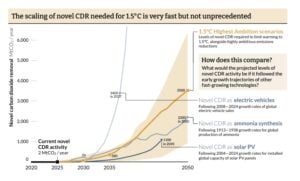
The good news is that these technologies are growing quickly. The report estimates annual growth rates of around 40%, comparable to the early years of the solar power industry.
However, researchers say even this rapid growth is not enough. To meet climate goals, many carbon removal technologies would need to expand at rates comparable to, or even faster than, those of the world’s fastest-growing clean energy technologies.
Heavy Reliance on Big Buyers Raises Risks
Another major concern is the concentration of investment and demand.
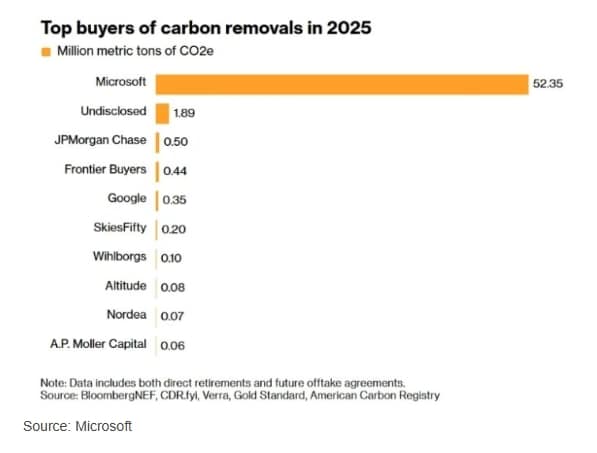
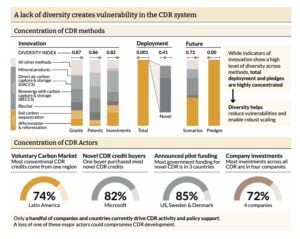
The report finds that a small number of companies and governments currently drive much of the carbon removal market.
- For example, Microsoft accounted for roughly 82% of purchases of novel carbon removal credits. Meanwhile, around 85% of government funding for large-scale demonstration projects is concentrated in the United States, Sweden, and Denmark.
Geographic concentration is also evident in voluntary carbon markets. More than two-thirds of conventional carbon removal projects supplying these markets are located in Latin America.
This concentration creates vulnerability. If a major buyer reduces purchases or a government changes climate policies, the entire sector can feel the impact.
Researchers point to recent shifts in U.S. climate policy and changes in corporate procurement strategies as examples of how fragile current support systems can be.
Governments Shift Focus Toward Carbon Removal Markets
While technological development continues, experts say future demand remains uncertain.
Many governments have focused on supporting carbon removal supply through research funding, pilot projects, and innovation programs. However, fewer policies create guaranteed long-term demand for removals.
This matters because companies are unlikely to invest heavily in expensive technologies without confidence that customers will buy their services in the future.
However, the voluntary carbon market has helped stimulate growth.
- During the past year, contracts covering approximately 40 million tonnes of future removals were signed. Yet this volume remains small compared with future needs.
Several regions, including the European Union, the United Kingdom, and Switzerland, are exploring ways to integrate carbon removal into climate regulations. Such policies could provide stronger and more predictable demand signals.
Without them, large-scale deployment may remain difficult.
Emissions Cuts Must Remain the Priority
The report delivers a clear message: carbon removal cannot replace emissions reductions.
Researchers emphasize that at least 80% of the effort required to reach net-zero emissions must come from reducing emissions at their source. Carbon removal should address the remaining emissions that are difficult or impossible to eliminate.
Some policymakers and businesses have promoted carbon removal as a future solution that could offset delayed climate action. The report strongly warns against this approach.
A ten-year delay in emissions reductions would dramatically increase future carbon removal needs. Scientists estimate that such a delay could require the world to remove an additional 150 billion tonnes of CO2 from the atmosphere compared with the most ambitious emissions-cutting pathway.
That level of removal would place enormous pressure on land, water resources, ecosystems, and industrial infrastructure.
The Next Five Years Are Critical
Researchers describe the period from 2026 to 2030 as a decisive window for carbon removal.
During these years, governments must establish policies that encourage investment, build public trust, and create reliable markets for carbon removal services. The sector also needs to prove that its methods are effective, durable, and environmentally responsible.
At the same time, countries must accelerate emissions reductions. Faster cuts today would reduce future dependence on large-scale carbon removal and ease pressure on natural resources.
The report concludes that carbon removal has an important role in achieving climate goals, but it cannot succeed alone. Strong policies, stable demand, continued innovation, and rapid emissions reductions must work together. Without that combination, the world risks falling far short of the carbon removal levels needed to keep the Paris Agreement’s 1.5°C target within reach.