

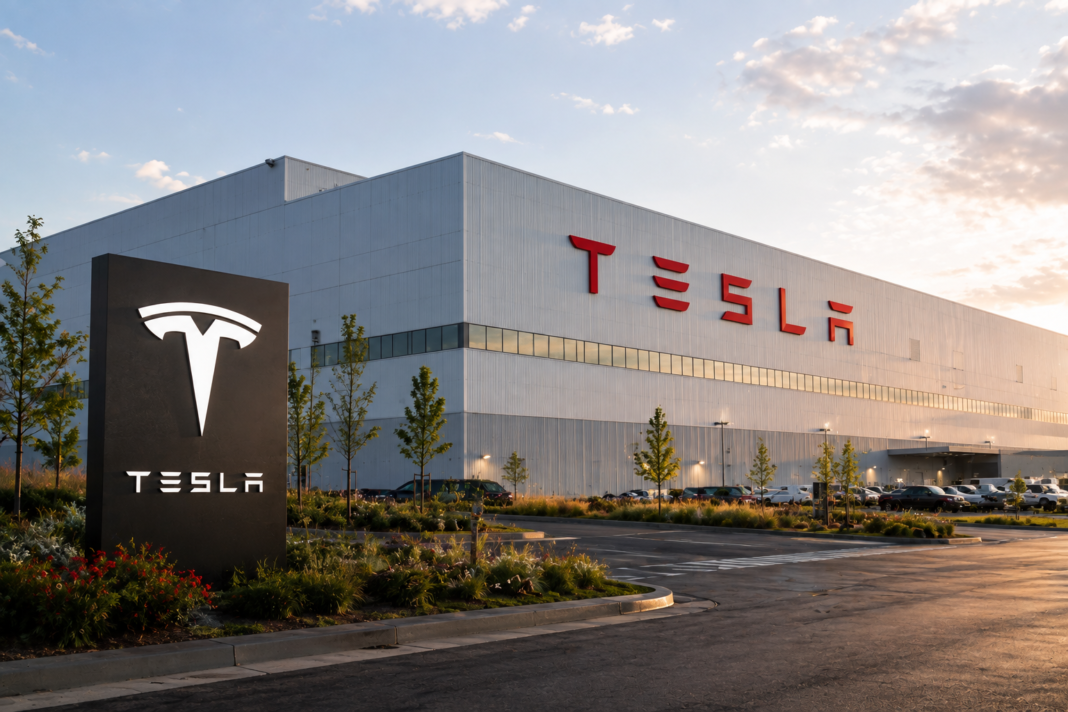
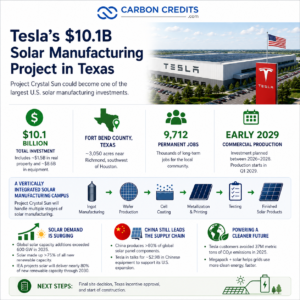
Tesla is planning a massive solar manufacturing project in Texas that could reshape its energy business and strengthen U.S. solar supply chains. The company has filed for tax incentives for Project Crystal Sun, a proposed $10.1 billion solar manufacturing campus in Fort Bend County, southwest of Houston. The project could create 9,712 permanent jobs and begin commercial production in early 2029, according to documents filed with Texas authorities.
The filing is still an early step. Tesla says it is also considering other sites in the U.S. That means the $10.1 billion investment is not yet a final construction commitment.
Still, the proposal is significant. It would give Tesla a much larger role in solar manufacturing at a time when the U.S. is trying to build more domestic clean energy supply chains.
Inside Tesla’s $10.1B Solar Manufacturing Campus
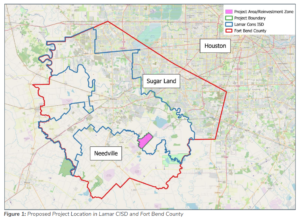
Project Crystal Sun would cover about 3,050 acres near Richmond, Texas. Tesla’s filing puts the total investment at $10.116 billion, including about $1.5 billion in real property and $8.6 billion in equipment.
Tesla plans to spend the money between 2026 and 2028. Commercial production would then begin in the first quarter of 2029.
The proposed site would be vertically integrated. The facility would handle several stages of solar production, including ingot manufacturing, wafer production, cell coating, metallization, printing, and testing. It would also include cleanrooms and equipment for producing finished solar products.
Tesla has not disclosed the plant’s planned annual output in the filing. That makes it difficult to compare the project’s future production directly with existing U.S. solar factories.
However, the size of the investment is clear. At $10.1 billion, Project Crystal Sun would become one of Tesla’s largest manufacturing projects outside its vehicle and battery operations.
Tesla Wants to Build a Homegrown Solar Supply Chain
The proposed factory also fits Tesla’s wider push to expand solar manufacturing in the U.S. CEO Elon Musk has said Tesla and SpaceX are working toward 100 GW of solar manufacturing capacity per year in the U.S. by 2028. Reuters reported in February that Tesla was hiring to support this target.
That goal is far larger than Tesla’s current solar manufacturing base. The carmaker has already started customer deployments of its first in-house designed solar panel from Gigafactory New York.
The company said the panel has 18 individual power zones, or three times as many as a conventional residential panel. This design allows the panel to keep producing energy in shaded conditions.
The company has also been expanding its energy manufacturing network. Its Q1 2026 update listed 40 GWh of installed annual Megapack capacity in California and 20 GWh in Shanghai. A new Megafactory outside Houston was under construction, with production of Megapack 3 expected to begin later in 2026.
Project Crystal Sun would add another major piece to that energy strategy.
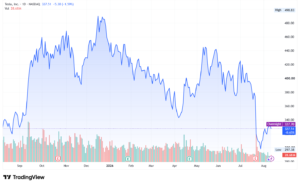
Tesla (TSLA) stock was trading lower around the time of this massive solar project news, reflecting broader investor pressure on the stock. The move was not directly tied to the solar factory filing, and market attention has also focused on Tesla’s heavy spending plans and its broader AI, robotics, and energy strategy. Thus, the stock movement can be viewed as part of a wider market reaction rather than a direct response to the $10.1 billion solar project.
Solar’s Global Boom Creates a Bigger Manufacturing Race
Tesla’s move comes as solar power continues to expand at record speed.
The International Energy Agency (IEA) said global solar PV capacity additions surpassed 600 GW in 2025. Solar accounted for more than 75% of all new renewable power capacity added worldwide that year. Global solar PV capacity reached about 2,800 GW.
The outlook remains strong. The IEA expects renewable power capacity to grow by almost 4,600 GW between 2025 and 2030. Solar PV is expected to provide nearly 80% of that expansion.
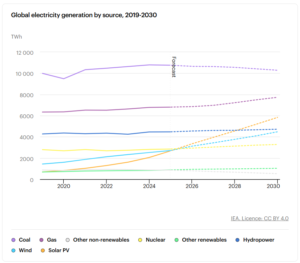
The agency also expects solar PV generation to increase by more than 600 TWh per year on average through 2030. Solar is expected to overtake wind and nuclear in electricity generation by 2026 and hydropower by 2029, as seen below.
This growth creates a large market for solar equipment. It also makes manufacturing capacity more important as governments try to reduce supply-chain risks.
China Still Dominates Solar Manufacturing
Building a large U.S. solar factory would also help Tesla address one of the industry’s biggest challenges: China’s dominance of the supply chain.
China remains the world’s leading producer of solar manufacturing equipment and components. In April, China produced more than 80% of global solar panel components. Tesla’s own supply strategy shows how difficult it can be to reduce that dependence.
Reuters reported in March that Tesla was in talks with Chinese companies over about $2.9 billion in solar manufacturing equipment for its U.S. expansion. The equipment could support the company’s push toward its 100-GW manufacturing goal.
That creates an interesting contrast. Tesla wants to build more solar products in America. Yet, some of the equipment needed to build those products may still come from China.
Project Crystal Sun could eventually reduce that dependence if Tesla develops a fully domestic supply chain around the plant.
Tesla’s Energy Business Is Becoming a Bigger Growth Engine
The solar factory would also support a business that is becoming a larger part of Tesla’s financial results. The company’s energy generation and storage revenue reached $12.77 billion in 2025, up 27% from 2024. The increase was mainly driven by higher Megapack and Powerwall deployments.
Energy storage has continued to grow in 2026. Tesla deployed 13.5 GWh of energy storage products in the second quarter of 2026. That brought the company’s total storage deployments for the first half of the year to at least 22.3 GWh, based on its reported Q1 and Q2 figures.
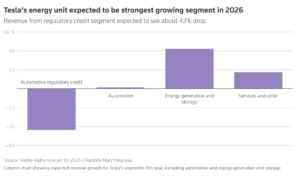
For comparison, Tesla deployed 46.7 GWh of energy storage products during all of 2025.
Solar and batteries are closely linked in Tesla’s energy strategy. Solar generation produces electricity, while battery systems such as Megapack can store that electricity for later use.
That combination could become more valuable as electricity demand rises and grids add more variable renewable power.
A Bigger Solar Footprint Brings a Bigger Climate Test
The project also fits Tesla’s wider environmental mission. The EV giant’s latest Impact Report says its customers avoided 37 million metric tons of CO2e emissions in 2025 through the use of its products. The company says its mission is to build an energy system powered by solar energy and supported by batteries and electric vehicles.
Tesla has also linked its energy products to broader grid needs.
In its 2025 financial materials, the company said Megapack can help increase the use of existing generation and transmission capacity. Tesla also said that pairing Megapack with solar PV can make it cost-competitive with traditional fossil-fuel generation assets and allow faster deployment.
These efforts support Tesla’s broader emissions reduction goals. But the new factory itself would also create environmental impacts from construction, energy use, and manufacturing. That distinction matters. A solar factory can support clean energy deployment while still having its own industrial emissions and resource needs.
Project Crystal Sun Could Redefine Tesla Energy
Project Crystal Sun marks a major potential expansion of Tesla’s clean energy business. The company already has a growing battery operation, and its energy generation and storage revenue have increased.
If Tesla builds Project Crystal Sun as proposed, it could move beyond selling solar and batteries and become a major U.S. solar manufacturer.
For now, however, the $10.1 billion figure remains a proposed investment, not a completed project. The next steps will be Tesla’s final site decision, approval of the Texas incentives, and the start of construction.
If those steps happen, Project Crystal Sun could become one of the clearest signs yet that Tesla’s future energy business is moving from a supporting operation toward a much larger part of the company’s strategy.