


Battery storage is becoming one of the most important technologies supporting the clean energy transition. As more wind and solar power come online, large-scale batteries help keep electricity flowing even when the sun is not shining or the wind is not blowing.
According to the press release, Danish renewable energy company Ørsted has taken another step in that direction by bringing its Old 300 battery energy storage system (BESS) into commercial operation in Needville, Texas.
The new 250-megawatt (MW) / 500-megawatt-hour (MWh) facility strengthens the reliability of the Texas power grid while expanding Ørsted’s growing U.S. renewable energy portfolio.
The project also highlights the increasing role of Tesla’s Megapack battery systems, which are becoming a preferred storage solution for utility-scale renewable energy projects.
Ørsted Adds Large Battery Project in Texas
Old 300 Storage is located alongside the company’s 430 MW Old 300 Solar project in Fort Bend County, Texas. Although the battery system is co-located with the solar farm, it operates independently and stores electricity when supply exceeds demand. It can then send power back to the grid during periods of high electricity use.
This flexibility helps improve grid stability and reduces pressure during periods of extreme demand.
Old 300 Solar: Powering Communities
Old 300 Solar has supplied electricity to nearly 80,000 homes and businesses since it began operating in 2024. At the time, it ranked among the largest solar projects commissioned in the United States.
Together, the solar and battery projects are expected to generate around $110 million in local property tax revenue over their lifetime. Those funds will support schools, emergency services, roads, and other community infrastructure in Fort Bend County.
The project also expands Ørsted’s U.S. onshore renewable energy business, which now includes more than 6 gigawatts (GW) of operating wind, solar, and battery storage projects across eight states.
Tesla Megapacks Power the Storage System
Ørsted selected Tesla’s Megapack battery technology for the project. The Megapacks were manufactured at Tesla’s Megafactory in Lathrop, California, the largest battery storage manufacturing facility in the United States.
Designed specifically for utility-scale applications, Megapacks allow renewable electricity generated during periods of high production to be stored and released when demand increases. This helps utilities reduce dependence on fossil fuel power plants while improving grid reliability.
Tesla’s energy storage business has become one of the company’s fastest-growing divisions.
During its latest quarter, Tesla deployed a record 13.5 gigawatt-hours (GWh) of battery storage systems, driven largely by strong demand for Megapacks. The rapid growth reflects rising global investment in battery storage as utilities look for reliable ways to integrate renewable energy into electricity grids.
Safety Remains a Priority
Ørsted also worked closely with Tesla and the Needville Fire Department before the project entered service.
The companies provided local emergency responders with training on battery technology, fire response procedures, and operational safety protocols. As battery storage expands across the country, collaboration with first responders is becoming an increasingly important part of project development.
These preparations aim to ensure safe operations throughout the facility’s lifetime while giving local emergency personnel the knowledge needed to respond effectively if required.
Why Battery Storage Matters in Texas
Texas has become the largest battery storage market in North America because of the unique design of its electricity market.
As per sources, unlike many U.S. regions, the Texas grid, managed by the Electric Reliability Council of Texas (ERCOT), operates as an energy-only market. Power producers earn revenue mainly by selling electricity into wholesale markets instead of receiving separate payments simply for keeping generation capacity available.
As a result, electricity prices can change rapidly. Prices rise sharply when electricity becomes scarce and fall just as quickly when supply exceeds demand. During periods of abundant wind or solar generation, wholesale prices can even become negative.
Battery storage systems thrive under these market conditions. They charge when electricity prices are low and discharge stored energy when prices increase, helping stabilize the grid while creating new revenue opportunities for operators.
Recent years have also shown how valuable battery storage can be during periods of high electricity demand. Batteries help reduce the need for energy conservation alerts by supplying additional power during peak hours.
Texas Battery Capacity Continues to Surge
Battery deployment across Texas has accelerated at an extraordinary pace.
According to Modo Energy’s ERCOT’s latest Annual Buildout Report, approximately 6 GW of new battery capacity entered commercial operation during 2025, making it the largest year for battery installations in the state’s history.
- The additions increased Texas’ operational battery fleet to approximately 13.9 GW of power capacity and 22.9 GWh of energy storage entering 2026—almost double the previous year’s total.
Industry analysts expect this rapid growth to continue. The report projects that Texas could have between 40 GW and 55 GW of operational battery storage by 2029, depending on future project completion rates.
Unlike many other electricity markets, this expansion is being driven largely by market economics rather than government incentives or long-term capacity payments. The volatility of the ERCOT market continues to make battery storage an attractive investment.
Ørsted Continues to Grow Its Global Renewable Portfolio
Beyond Texas, Ørsted continues to expand its renewable energy business worldwide.
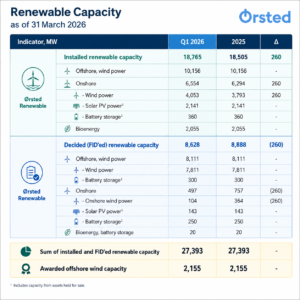
- According to the company’s Q1 2026 financial report, its installed renewable energy capacity reached 18.8 GW as of March 31, 2026, up from 18.5 GW at the end of 2025.
The increase came primarily from an additional 260 MW of onshore wind capacity. Meanwhile, offshore wind, solar, battery storage, and bioenergy capacity remained largely unchanged during the quarter.
The company generated 11.3 terawatt-hours (TWh) of electricity during the first quarter, with 98% coming from renewable energy sources.
Offshore wind generation increased 27% year over year to 6.9 TWh, supported by stronger wind conditions and higher production from the Borkum Riffgrund 3 and Greater Changhua 4 offshore wind farms.
Battery Storage: A Core Part of the Energy Transition
The launch of Old 300 Storage reflects a broader shift in renewable energy development. Solar and wind projects are increasingly being paired with large battery systems that can store clean electricity and deliver it when demand is highest.
As electricity consumption rises because of data centers, artificial intelligence, electrification, and population growth, reliable battery storage is becoming essential for modern power systems.
For Ørsted, the Texas project strengthens its position as one of America’s largest renewable power producers. For Tesla, it showcases the growing demand for utility-scale battery technology. And for Texas, it represents another milestone in building a cleaner, more flexible, and more reliable electricity grid.