

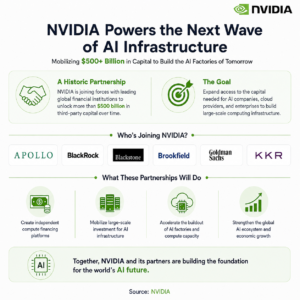
NVIDIA (NASDAQ: NVDA) is bringing some of the world’s largest financial institutions into the artificial intelligence infrastructure boom as it seeks to mobilize more than $500 billion in third-party capital over time.
The chipmaker has signed memorandums of understanding with Apollo, BlackRock, Blackstone, Brookfield, Goldman Sachs and KKR to establish independent compute financing platforms.
The goal is simple: give AI companies, cloud providers and enterprises better access to the capital needed to build large-scale computing infrastructure.
The timing is important. AI demand continues to grow rapidly, but the next phase of the boom will require much more than advanced chips. Companies also need data centers, electricity, cooling systems, networking equipment, and financing.
NVIDIA now wants to help bring those pieces together.
NVIDIA Wants to Turn Compute Into Infrastructure
NVIDIA has become one of the biggest beneficiaries of the AI boom by supplying the GPUs that power many of the world’s AI data centers. Now, however, the company is moving beyond selling chips.
NVIDIA describes large-scale AI data centers as “AI factories.” These facilities use electricity, computing power, and data to produce AI services and intelligence. And this makes AI compute look increasingly like an infrastructure asset.
This is important because infrastructure investors already understand how to finance long-lived assets that generate cash flows over time.
Under the proposed financing model, the six financial institutions will independently evaluate individual projects. Their assessments will include customer demand, expected utilization, cash flow, and the residual value of computing equipment.
As a result, NVIDIA is not promising to finance every AI project. Instead, it is helping create financing platforms that could allow qualified customers to raise capital at scale.
What Does the $500 Billion Figure Mean?
The more than $500 billion figure represents aggregate third-party capital that the platforms are designed to mobilize over time.
It is not NVIDIA revenue. It is also not a single $500 billion fund or a commitment to one customer.
The financial institutions will make independent investment decisions based on the economics of each project. NVIDIA will provide the technology platform and broader AI ecosystem, while the financial institutions bring long-term capital and infrastructure-financing expertise.
This structure could address a growing problem in the AI market.
Many AI companies, enterprises, and AI cloud providers have strong demand for computing capacity but may not have enough capital to build the infrastructure themselves.
Financing could allow these companies to secure computing capacity without taking on the full upfront cost of building and owning the infrastructure.
Why NVIDIA Could Support Some Projects
The GPU giant said it may provide residual-value support of up to 25% for certain opportunities. However, this support would be assessed individually and would be limited to residual value. It would not replace independent underwriting by the financial institutions.
NVIDIA believes its computing infrastructure has characteristics that can make it attractive to investors. Its GPUs are widely used across the AI industry and can serve different models and workloads. They can also potentially be redeployed between customers and operators.
Meanwhile, NVIDIA’s CUDA software ecosystem supports a large global base of developers and customers. Together, these factors could help computing equipment retain value even as newer generations of GPUs reach the market.
That is particularly important for investors financing assets in a sector where technology changes quickly.
NVIDIA’s Revenue Shows the Scale of AI Demand
NVIDIA’s financial results demonstrate why investors are paying close attention to AI infrastructure.
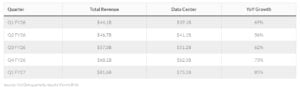
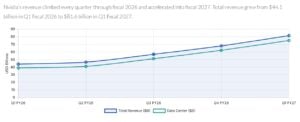
The company reported $81.6 billion in revenue for fiscal Q1 2027, an 85% increase from a year earlier. Data center revenue reached $75.2 billion, making up the vast majority of quarterly sales.
- For full fiscal 2026, NVIDIA generated $215.9 billion in revenue. Data center revenue reached $193.7 billion, accounting for roughly 90% of the company’s total revenue.
The shift shows how quickly AI has transformed NVIDIA’s business.
The company is also moving through another major technology cycle. Its Blackwell platform has become a major source of revenue, while the next-generation Rubin platform is expected to enter production in the second half of 2026.
However, rapid innovation also creates a challenge for infrastructure investors.
Projects financed today must generate enough value to justify their cost even as newer and potentially more powerful computing systems enter the market.
A New Financing Model for AI Factories
NVIDIA’s initiative could ultimately have implications far beyond the chip industry.
Major infrastructure buildouts have historically depended on outside capital. Electricity networks, telecommunications systems, transportation infrastructure and data centers all required significant investment before they could generate returns.
NVIDIA sees AI factories entering a similar phase.
The economic cycle is relatively straightforward. More computing capacity can support better AI models and services. Better AI can increase usage. Higher usage can generate more revenue. That revenue can then support additional investment in computing capacity.
However, the model depends on real demand and strong project economics.
But AI Is Creating a New Electricity Demand Surge
The financing push also comes as AI reshapes global electricity demand.
AI data centers require huge amounts of electricity to operate and cool increasingly powerful computing systems.
The International Energy Agency expects global data center electricity consumption to more than double by 2030. It projects demand will reach about 945 terawatt-hours (TWh), compared with roughly 415 TWh in 2024.
This would bring data centers close to 3% of global electricity consumption by the end of the decade.
Accelerated servers, primarily used for AI workloads, are expected to drive much of this growth. The IEA expects electricity consumption from these systems to increase by around 30% annually through 2030.
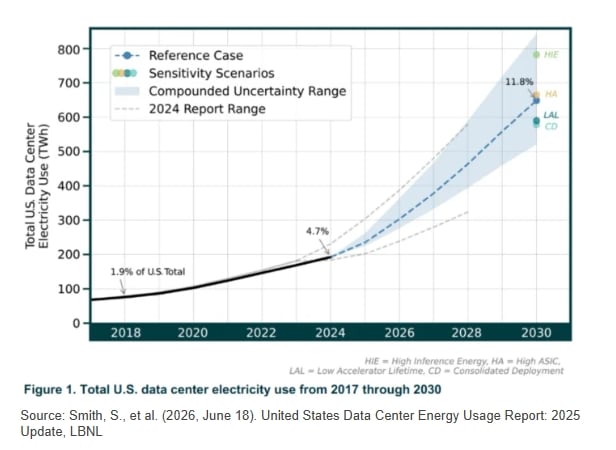
The United States faces an especially significant increase. Data centers could account for almost half of the growth in U.S. electricity demand through 2030.
Therefore, the AI infrastructure story is increasingly becoming an energy story as well.
Building more GPUs will not solve the problem if data centers cannot secure enough electricity or connect to the grid.
NVDA Stock Gains: Can AI Infrastructure Deliver the Returns?
NVIDIA’s partnerships with major financial institutions could help turn AI compute into a new investable infrastructure asset. By improving access to capital, the initiative may allow more companies to expand their AI capacity without funding the entire buildout themselves.
For NVIDIA, that could support long-term demand for its GPUs. However, investors still need to weigh risks such as high valuations, changing AI spending, export restrictions and limited power capacity.
NVDA stock closed at $225.30 on August 13, up 0.54%. The share price reflects strong investor confidence in NVIDIA’s role in the AI boom. Yet, the bigger question is whether growing AI infrastructure spending will generate enough revenue to justify the capital being deployed.

If demand and utilization remain strong, NVIDIA’s financing strategy could accelerate the next phase of the AI buildout. Conversely, weaker demand or lower returns could increase risks for investors. For now, NVIDIA is betting that compute will become a core infrastructure asset of the AI era