

The U.S. electric vehicle (EV) market is going through a reality check.
New EV sales plunged 46.9% year over year in August 2026, according to Cox Automotive, even as the market showed some month-to-month improvement. Yet the latest outlook from the U.S. Energy Information Administration (EIA) paints a very different picture for the years ahead.
Under scenarios that include the EPA’s latest vehicle emissions standards, EIA projects battery-electric vehicles could reach about 53% of annual U.S. light-duty vehicle sales by 2032.
So, what is happening?
The answer is a market caught between a short-term slowdown and a potentially much bigger long-term transition.
EV Sales Are Down, But August Brought a Small Rebound
The latest numbers show just how sharply the U.S. EV market has changed.
Cox Automotive estimates that Americans bought 78,895 new EVs in August 2026. That was 2.5% higher than July, but still 46.9% below August 2025, when buyers were rushing to take advantage of the federal $7,500 EV tax credit before it expired. EVs represented 5.7% of total new-vehicle sales in August.

The second quarter tells a similar story.
U.S. EV sales reached 247,226 units in Q2 2026, according to Cox, up 14.7% from Q1 but down 20.5% from Q2 2025. The decline was smaller than the 27.3% year-over-year drop recorded in Q1, suggesting the market was beginning to stabilize after the post-incentive correction.
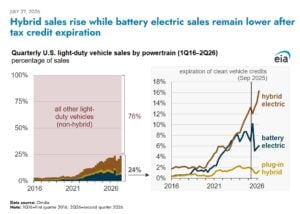
- EIA’s own analysis shows battery-electric vehicles represented about 6% of new U.S. light-duty vehicle sales in Q2 2026, down from 7% a year earlier.
Interestingly, the broader electrification market is doing better than the pure EV numbers suggest.
Hybrids accounted for a record 16% of new light-duty sales in Q2 2026, while battery-electric and plug-in hybrid vehicles added another share. Combined, hybrids, EVs and plug-in hybrids represented 24% of new light-duty vehicle sales.
Tesla Still Leads, But Toyota Is Making Noise
Tesla remains the heavyweight in the U.S. EV market.
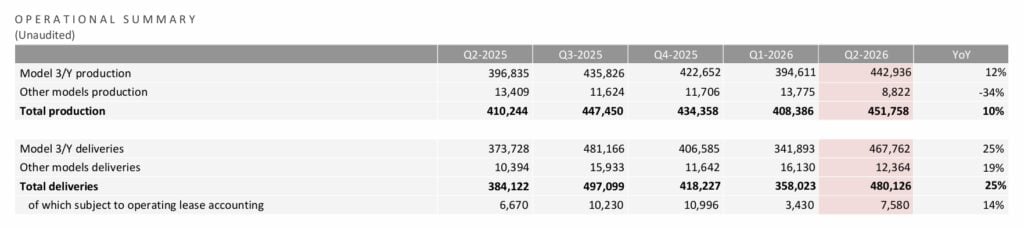
- In August, Tesla (TSLA Stock) sold an estimated 40,816 EVs, giving it 51.7% of the U.S. EV market. But its sales declined 3.8% from July, while several competitors gained ground.
Toyota was the standout.
The Japanese automaker sold 4,964 EVs in August, up 34.9% from July. Its updated bZ electric SUV was a major contributor. Chevrolet, Cadillac and Kia also posted month-to-month gains of 30.3%, 13.1% and 12%, respectively.
Toyota’s progress is particularly notable because it started from a much smaller EV base. Through the first eight months of 2026, Toyota had sold more than 22,500 bZ electric SUVs, compared with just 15,609 bZ4X units during all of 2025.
Meanwhile, Ford’s Mustang Mach-E sold 15,484 units through August, down 55% from the same period last year.
The competitive picture is therefore changing, even with Tesla still controlling more than half of the market.
EIA Sees a Much Bigger EV Market Ahead
This is where the latest EIA outlook gets interesting.
The Annual Energy Outlook 2026 does not present one fixed forecast. Instead, EIA models several possible futures based on technology costs, markets, and policy assumptions.
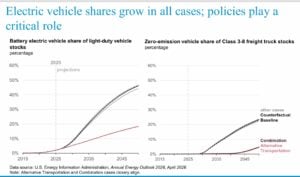
- In cases where the EPA’s Model Year 2027–2032 tailpipe emissions standards are incorporated, EIA projects electric vehicles could reach about 53% of U.S. light-duty vehicle sales by 2032.
But getting from more than half of annual sales to more than half of vehicles on the road takes much longer.
EIA estimates that EVs could represent roughly 40%–46% of the U.S. light-duty vehicle fleet by 2050 in cases that include those standards.
Without the standards, the outcome is dramatically different. EVs would reach only about 20% of annual light-duty vehicle sales by 2050, while their share of vehicles on the road would be around 18%.
There is a simple reason for the difference.
Cars stay on the road for a long time. EIA estimates new vehicles remain in use for an average of 18–28 years, depending on the vehicle type and how it is used.
That means even if EVs dominate new-car sales, gasoline vehicles will remain a major part of America’s fleet for decades.
The Carbon Story Is Bigger Than EV Sales
The EV transition also matters because transportation remains one of America’s largest sources of energy-related carbon emissions.
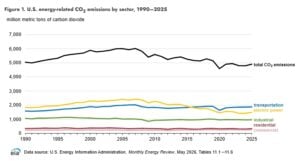
- EIA’s latest emissions data show that the U.S. transportation sector produced about 1.87 billion metric tons of CO₂ in 2025. Transportation emissions were essentially flat, as lower gasoline-related emissions offset higher emissions from diesel and other fuels.
EVs are already beginning to affect the energy system.
- EIA estimates U.S. light-duty EVs consumed about 11.2 million megawatt-hours of electricity in the first five months of 2026, including 9.3 million MWh from battery-electric vehicles and 1.9 million MWh from plug-in hybrids.
The longer-term impact could be much larger.
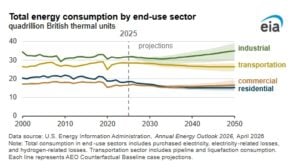
EIA projects transportation energy use will fall from about 27 quadrillion British thermal units in 2025 to between 21 and 25 quads by 2050, even as Americans drive more. In scenarios incorporating the EPA standards, transportation energy consumption falls by 13%–25%.
That is an important climate-market story.
EVs don’t eliminate transportation emissions by themselves. Their climate benefit depends partly on the electricity used to charge them. But replacing gasoline-powered vehicles with increasingly efficient electric vehicles can reduce direct tailpipe emissions while shifting energy demand from petroleum toward electricity.
The EV Market Is Slowing. The Transition Isn’t Over
The U.S. EV market in 2026 looks very different from the boom years.
Sales are down sharply from last year’s incentive-driven highs. Tesla remains dominant, while Toyota, Chevrolet, Hyundai, Cadillac and other automakers are fighting for more market share. Hybrids are also capturing consumers who want better fuel economy without going fully electric.
But EIA’s 2050 outlook shows why today’s sales slump may not tell the whole story.
The bigger investment question is no longer simply how many EVs Americans buy this year.
It is how quickly electric vehicles, batteries, charging infrastructure and cleaner electricity can replace petroleum across the transportation system.
If EIA’s higher-adoption scenarios play out, 53% of new U.S. light-duty vehicles could be electric by 2032, while as much as 46% of the entire light-duty fleet could be electric by 2050.
For the EV and clean-energy industries, the road may be bumpier than expected. But the destination could still look dramatically different from today’s gasoline-heavy transportation system.