

NVIDIA has entered a strategic partnership with IREN Limited worth up to $2.1 billion, deepening its push into the fast-growing artificial intelligence (AI) infrastructure market.
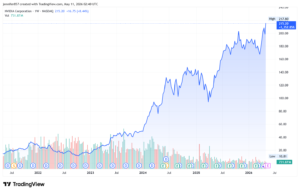
The deal gives NVIDIA the option to purchase up to 30 million IREN shares over five years at $70 per share. Investors reacted positively to the announcement, sending IREN shares up more than 20%. The same goes for NVIDIA’s stock, which almost hit its highest record price on April 27 at $216.61.
The partnership centers on building large-scale AI infrastructure powered by high-performance GPUs and backed by massive electricity capacity. It also reflects a larger trend reshaping global energy markets: AI is driving an unprecedented surge in electricity demand from data centers.
Jensen Huang, founder and CEO of NVIDIA, remarked:
“Deploying these systems [AI factories] at scale requires deep integration across the full stack — compute, networking, software, power and operations. IREN brings the scale and infrastructure expertise to help accelerate the buildout of next-generation AI infrastructure globally. Together, we are building for the age of AI.”
NVIDIA Expands Beyond Chips Into AI Infrastructure
NVIDIA has become the dominant supplier of AI chips used in generative AI systems, cloud computing, and advanced data centers. The company’s GPUs power many of the world’s largest AI platforms, including models developed by OpenAI, Microsoft, Meta, and Google.
But NVIDIA is moving beyond just selling hardware. It’s now placing itself deeper in the AI infrastructure ecosystem. The company has pursued several similar infrastructure partnerships as AI power demand accelerates globally.
The tech giant strengthened its ties with CoreWeave by investing in 5 GW of AI “factory” capacity by 2030. It also teamed up with Oracle and the U.S. Department of Energy to create one of America’s largest AI supercomputers, using 100,000 NVIDIA Blackwell GPUs.
NVIDIA has also partnered with AI firms like Nscale, Microsoft, and OpenAI. They focus on large data center projects in the U.K., Europe, and North America. These deals show a bigger plan to secure long-term computing and power resources. AI workloads are growing fast around the world.
The partnership with IREN aims to deploy NVIDIA’s DSX AI factory setup in IREN’s global data center network. This network has the potential for up to 5 gigawatts (GW) of infrastructure capacity.
A key part of the project will take place at IREN’s Sweetwater campus in Texas. This 2 GW site is set to be one of the biggest AI-focused data center hubs in the U.S.
AI’s Electricity Demand Is Rising at an Extraordinary Pace
The deal comes as AI systems rapidly increase global electricity consumption. According to the International Energy Agency (IEA), global data centers consumed about 415 terawatt-hours (TWh) of electricity in 2024. That is roughly equal to the annual electricity demand of countries such as Japan.
The IEA expects global data center electricity use to more than double by 2030, reaching around 945 TWh. AI workloads are becoming a major driver of this growth. The agency estimates electricity demand from AI-focused servers could rise by about 30% annually through the end of the decade.
Research from Lawrence Berkeley National Laboratory shows that U.S. data center electricity demand might grow. It could increase from 176 TWh in 2023 to 580 TWh by 2028 in high-growth scenarios.
Generative AI systems consume significantly more electricity than traditional internet services. Analysts say one AI-generated query uses about 10 times more electricity than a typical web search. This is due to the high computing power needed for large language models.
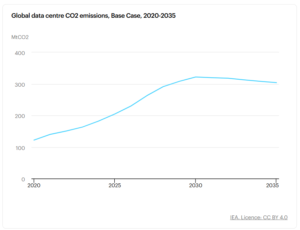
CO₂ emissions from electricity used by data centers are expected to peak at around 320 million tonnes (Mt CO₂) by 2030, per the IEA Report. Emissions are then projected to decline slightly to about 300 Mt CO₂ by 2035.
Despite fast growth in AI and digital demand, data centers are still expected to remain a small part of the global energy system. Their electricity use is projected to rise from around 1% of global demand today to about 3% by 2030. Even at that level, they would account for less than 1% of total global CO₂ emissions.
Power Capacity Is Becoming the New Competitive Advantage
As AI infrastructure expands, access to reliable electricity is becoming one of the sector’s most important strategic assets. IREN’s value largely comes from its access to large amounts of grid-connected power in regions with abundant renewable energy resources. The company operates across North America, Europe, and the Asia-Pacific.
Originally a bitcoin mining company, IREN has quickly moved to AI cloud infrastructure. This shift responds to the growing demand for high-performance computing.
The company has signed a $9.7 billion deal with Microsoft. This deal is for multi-year GPU cloud services that use NVIDIA GB300 systems. The agreement requires a 20% prepayment. It could bring in about $1.94 billion in annual revenue when fully operational.
IREN has also expanded into Europe through the acquisition of Spain-based data center developer Nostrum Group. The deal added about 490 megawatts (MW) of secured grid-connected power capacity and increased IREN’s total power portfolio to roughly 5 GW.
Industry analysts increasingly view power access as a major competitive moat in AI infrastructure. Building advanced AI data centers now relies on more than just chip availability. It also requires securing electricity, cooling systems, land, and transmission capacity.
AI and Clean Energy Are Becoming Closely Linked
The rapid expansion of AI infrastructure is also reshaping clean energy markets. Large technology companies are signing long-term power agreements for renewable electricity to support growing AI operations and meet climate goals.
Companies including Microsoft, Google, Amazon, and Meta are investing heavily in solar, wind, battery storage, and nuclear energy projects.
BloombergNEF reports that global investment in the energy transition topped $2 trillion in 2024. This surge was fueled by rising electricity demand from AI and electrification trends.
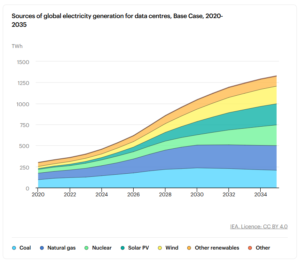
Data centers are now big buyers of renewable electricity as operators feel pressure to cut emissions and ensure stable energy supplies. Renewables supply around 27% of the electricity for data centers globally, as the IEA reports. Wind and solar are set to meet almost half of the future demand growth by 2030.
IREN’s infrastructure strategy focuses heavily on renewable-rich regions with lower power costs and cleaner electricity grids. This positioning could grow more valuable as governments tighten emissions reporting and sustainability rules for digital infrastructure.
NVIDIA has also increased its focus on energy efficiency. Its latest AI systems aim to deliver higher computing performance while lowering energy use per workload. The company claims its Blackwell platform cuts electricity use more than older AI systems.
Trillions in AI Infrastructure Spending Are Coming
The NVIDIA-IREN partnership is part of a much broader wave of AI infrastructure investment. Major technology companies are expected to spend hundreds of billions of dollars this decade on AI-related infrastructure, including:
- advanced semiconductors,
- hyperscale data centers,
- transmission infrastructure,
- cooling systems,
- battery storage, and
- renewable power generation.
According to Goldman Sachs, global power demand from data centers could increase by as much as 165% by 2030 due to AI growth.
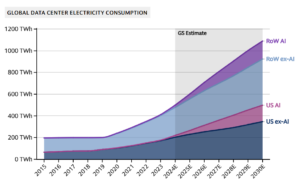
McKinsey estimates that global demand for AI-ready data center capacity could require more than $6 trillion in infrastructure investment worldwide by 2030. This surge is creating opportunities for companies with access to electricity, land, and digital infrastructure assets.
The New Converging Supercycle
NVIDIA’s potential $2.1 billion investment in IREN highlights how AI growth is transforming both the technology and energy sectors.
As AI systems become more powerful, the industry’s biggest challenge may no longer be chips alone. Reliable electricity supply is quickly emerging as one of the most critical factors in scaling AI infrastructure globally.
The partnership also shows how clean energy, data centers, and AI infrastructure are becoming increasingly interconnected. Companies that can combine computing power with scalable, lower-carbon electricity may be best positioned to benefit from the next phase of the AI economy.